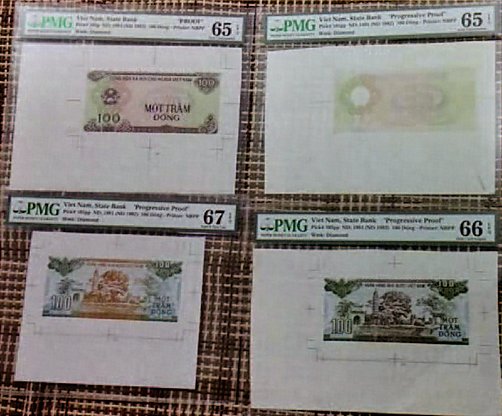
More on collecting graded banknotes
Quang Duy, Vietnam Numismatics #4 (07-2018), p.21-22
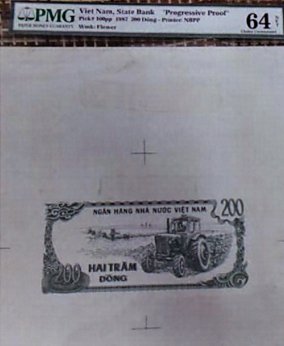
In the previous article, we learned about the grading levels of a banknote and the value of graded banknotes. In this article, we as collectors will explore and clarify three issues:
First, how do collectors around the world collect graded banknotes?
Second, how should graded banknotes be collected?
Third, who collects graded banknotes?
1. In some countries with a long history of banknote collecting and a large number of collectors, such as the United States, banknotes are graded to ensure transparency in transactions. Their market is so highly professionalized that specialized catalogues exist for every series and type, explicitly listing prices according to a note's precise condition grade. Consequently, buyers and sellers conduct transactions based on these catalogs. In this way, grading banknotes helps prevent sellers from misrepresenting the condition of the banknotes. In fact, at major auctions, most of the banknotes offered for auction have already been professionally graded.
As for Southeast Asia, represented by Hong Kong and Singapore, collectors only collect graded banknotes with the highest grades possible. For example, with Singapore's famous "Orchid" series, notes graded 67 (Super Gem Unc) garner little interest, as serious collectors aim exclusively for 69 or 70. They believe they should collect banknotes of the highest and hardest-to-find grades as a statement of prestige within the collecting community. Indeed, Pop One notes (the highest grade in the grading system) are always sold for 8–15 times the price of lower-graded notes.
In Vietnam, where graded banknote collecting is still in its early stages compared with other countries, we can easily misunderstand the value of common graded banknotes. It is easy to buy banknotes at prices far higher than their actual value.
2. To collect graded currency, first we must collect a complete set of Vietnamese banknotes from the French colonial era to the Socialist Republic of Vietnam, or the set we have chosen to collect. When embarking on this pursuit, collectors must define their target condition tier, VF, XF, AU, or UNC. For an objective guide on evaluating banknote condition grades, readers are invited to consult our previous article, "Notes on collecting graded banknotes", featured in the previous issue.
David Hall, a grading expert at the renowned grading company PCGS, stated: "If you collect a Buffalo set (Buffalo nickels issued from 1913 to 1938) in XF condition, you only need to spend $500 to complete it, while an UNC set will cost you $9,000 to complete. Because every collector's budget is different, the very first rule of collecting is to set your own clear limits".
3. Those who collect graded banknotes are collectors who have already completed their collections of Vietnamese banknotes from different periods. The important point here is that we already have the "necessary" condition. That is the passion that keeps our collecting fire burning. We should collect in our own way, because collecting is a lifelong pursuit; we cannot rush it. With a solid foundation, we can move on to the "sufficient" condition: selecting the finest beautiful notes from our collection to have them graded. Then, whatever grade we receive, we will always be happy and relaxed. That is the true benefit of collecting banknotes.
However, if we try to take a shortcut and collect graded banknotes before completing our basic collection, we can easily make the wrong decisions. Due to a lack of experience and information, we may easily buy high-grade banknotes that are not rare, yet priced far higher than their actual value.
Therefore, be a traditional banknote collector and first discover all the beauty and details of Vietnamese banknotes before choosing to collect graded banknotes.