Notes on collecting graded banknotes
Quang Duy, Vietnam Numismatics #3 (04-2018), p.22-23
Over the past two years, collectors have been buzzing about collecting graded banknotes. This practice may seem foreign to local collectors, who have long focused on simply acquiring beautiful notes for their collections based on standard catalogues. Any missing note had to be found at all costs to fill the empty spaces in the collection. As collections expanded and neared completion, collectors eventually turned their attention toward upgrading to higher-quality notes. Since there are many different ideas of what beauty is, the fairest method is to grade the banknotes.
In fact, this trend began in the United States in the late 1980s, when American companies invented a new way to extract money from collectors by subdividing the quality of collectibles into grades, first with coins and then with banknotes. It spread throughout the world and has continued to the present day. To better understand this practice, we will discuss the grading of banknotes.
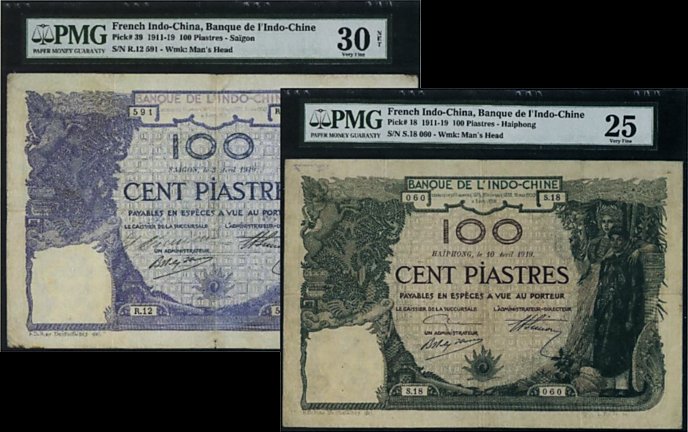
Graded banknotes are typically divided into multiple grades, as follows:[1]
Grades 65 and above: GEM UNC (Gem Uncirculated). The banknote is bright and pristine, free of folds or physical handling marks like staples or ink smudges. It has never entered circulation, the corners remain sharp and perfectly square.
Grades 60 to 64: These are UNC (Uncirculated). In grade 64, the banknote has been handled multiple times, but has not entered circulation. It may exhibit minor foxing, slightly blunted corners, and minor signs of handling. These banknotes may be marked as NET (the defect and its cause are noted on the back). In grade 63, banknote is in nearly the same condition as in grade 64, but it may have heavier staining or a light dent in the decorative design area, but not in the main image area. A banknote is graded 62 when it is in similar condition to a grade 64 note but has a bent corner not affecting the design. Grades 60-61 are similar to grade 63 but with an additional corner bend.
EPQ (Exceptional Paper Quality): A designation indicating that the banknote has superior original paper quality. For instance, of two notes graded 64, one with minor staining would be ineligible for the EPQ status. Many collectors prefer a grade 64 EPQ over a grade 65 not evaluated as EPQ.
Grade 58: Choice About Unc (Almost Uncirculated). The banknote has a single light fold reaching into the design.
Grades 50 to 55: AU (About Uncirculated). A bright note with a single light center fold earns grade 55; adding a corner flick drops it to grade 53. Grade 50 note typically shows two light vertical folds but has not been folded into quarters. NET banknotes, already explained above, will not be discussed further here.
Grades 40 to 45: EF or XF (Extremely Fine) - showing signs of circulation. Notes with three vertical folds typically fall into this range, provided there are no horizontal creases.
Grades 20 to 35: At this level, the banknote is VF (Very Fine) - having seen considerable circulation. Banknotes in this range are typically folded in thirds with a horizontal crease; they are assigned scores between 30 and 35 based on the severity of handling marks on their surfaces.
In addition, there are even lower grades such as 15, 12, 10, 8, and 4. Lower-grade notes are sought after only when they are very rare.
The above is a method for evaluating the quality of a banknote as a starting point for collecting. Of course, this is only a standard framework for the grading scale. Readers can use it as a reference to develop their own experience.
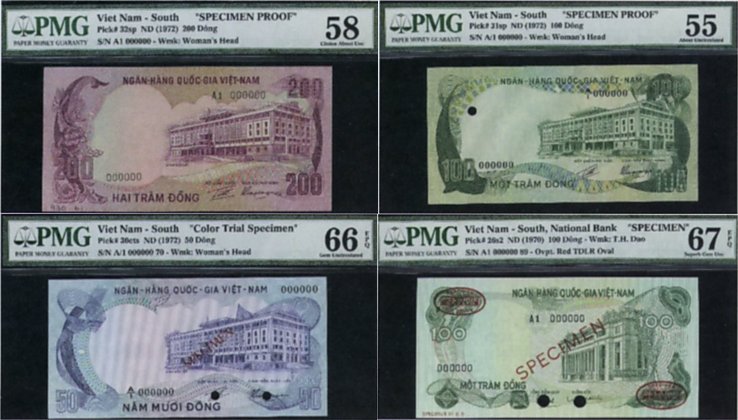
Currently, there are many grading companies in the world; however, the most reputable are still PMG and PCGS Currency, both founded in 2005. PMG is a subsidiary of NGC, which specializes in coin grading, while PCGS Currency is the paper money division of PCGS, specializing in grading U.S. coins. In Vietnam, PMG is often preferred for its attractive packaging, professional approach, and stronger aesthetic appeal compared to PCGS Currency. However, this does not mean PCGS Currency is undervalued. In fact, many collectors in the United States prefer PCGS due to the company’s long history and established reputation.
The value of graded banknotes:
International auctions have yielded extraordinary results that have repeatedly astonished numismatists both locally and globally. Roughly nine months ago, two banknotes appeared on the market, including a "Trần Hưng Đạo" 500 Đồng note of the Republic of Vietnam, graded 67 EPQ. This note was sold at auction for $350. At the same time, a "Three Ladies of Vietnam" 100 Piastres Indochina note graded 65 EPQ was no less impressive. It sold for about $1,400. This was a major shock for the Vietnamese numismatic community. Collectors in Vietnam began asking themselves how much Vietnamese banknotes in UNC condition could actually be worth. Subsequent auction cycles followed like consecutive waves, creating a trend of collecting graded banknotes not only in Vietnam but also in many other countries around the world. In fact, according to the author’s observations, the number of Vietnamese banknotes being graded and recorded in PMG’s database has continued to increase, with some types appearing in quantities twice as high as last year. This is an encouraging sign, showing that Vietnamese banknotes are on track to achieve equal status alongside established international currency fields.
However, many collectors still do not fully understand the nature of banknote grading. Collecting graded notes is like a beauty contest: one should focus on top-population notes within a specific issue. For lower grades, slabbing in a plastic holder serves merely as a form of protection - nothing more, nothing less. This view is contrary to domestic traditions, where collectors tend to acquire available notes first and then incrementally upgrade them later. Yet, when collecting graded banknotes, targeting elite grades from the beginning yields long-term advantages, given that obtaining a high-grade example in by no means easy.
Are graded banknotes the future, and are they a sound investment? How are graded banknotes collected internationally? All of this will be covered in the next issue: "Graded Banknotes - Future or Fad?"
[1] art-hanoi.com: For more precise definitions, see https://www.pmgnotes.com/paper-money-grading/grading-scale