Minh Mạng Thông Bảo coins
明命通寶
Mai Ngọc Phát, Bùi Tiến Đạt, Vietnam Numismatics #3 (04-2018), p.36-42
1. Historical overview
1.1. Life and reign
King Minh Mạng (or Minh Mệnh) was the fourth son of King Gia Long and Empress Thuận Thiên (Trần Thị Đang). His personal name was Nguyễn Phúc Đảm (or Đởm), and he was also known as Nguyễn Phúc Kiểu. He was born on the 23rd day of the fourth lunar month of the Year of Tân Hợi [辛亥] (corresponding to 25 May 1791 in the Gregorian calendar) in Tân Lộc village near Gia Định (present-day Saigon). King Gia Long's eldest son, Crown Prince Nguyễn Phúc Cảnh, died young in 1801. Because Crown Prince Cảnh and his children had been strongly influenced by Catholicism from France, after his death King Gia Long did not choose his eldest grandson (the son of Crown Prince Cảnh) as heir to the throne, fearing French influence at court, but instead appointed Nguyễn Phúc Đảm as Crown Prince. Prince Đảm was strongly opposed to Catholicism and held unfavorable views toward the French, a viewpoint he shared with King Gia Long. This appointment met with strong opposition from many high-ranking court officials at the time, especially Lê Văn Duyệt. In 1816, Prince Nguyễn Phúc Đảm was formally appointed Crown Prince. The Nguyễn Dynasty National History Office wrote: "In the 15th year of Gia Long (1816), in the summer, on the Kỷ Mùi [己未] day of the sixth month, he was formally invested as Crown Prince at Thanh Hòa Palace".[1] he began studying matters of state governance and the administration of the country in preparation for his future reign.
In the 12th month of the Year of Kỷ Mão [己卯] (early 1820), King Gia Long passed away. In the first month of the Year of Canh Thìn [庚辰] (1820), Crown Prince Nguyễn Phúc Đảm ascended the throne and adopted the reign title Minh Mạng [明命]. In 1839, he changed the country name to Đại Nam [大南], which remained in use until the end of the Nguyễn Dynasty in 1945. The Nguyễn Dynasty National History Office recorded: "Canh Thìn [庚辰], the first year of Minh Mạng (1820), (the 25th year of Qing Emperor Jiaqing), in the spring, on the Mậu Ngọ [戊午] day, the first day of the first month, the Crown Prince ascended the imperial throne at Thái Hòa Palace, proclaimed the reign title, granted a general amnesty, and issued an imperial edict to officials and people throughout the realm".[2] At that time, he was already 30 years old and had a profound understanding of court affairs. Many times after court audiences, he remained with several high-ranking officials to discuss state affairs, inquire about historical events, or ask about notable figures and the customs of other countries.
King Minh Mạng was regarded as an intelligent and knowledgeable ruler who valued learning, talent, and virtue. Throughout his 20 years of reign and governing the country, he carried out many reforms of the state administrative system at all levels and introduced well-structured economic policies that later generations continued to use as models, including the establishment of the National History Office... However, this period was also marked by many resistance movements by peasants and other social groups, notably the uprisings of Phan Bá Vành in Nam Định, Lê Duy Lương in Ninh Bình, Nông Văn Vân in Tuyên Quang in the North, and Lê Văn Khôi in the South.
King Minh Mạng died on the 28th day of the twelfth lunar month of the Year of Canh Tý [庚子], corresponding to 20 January 1841, at Quang Minh Palace. He died at the age of 50 after reigning for 21 years, and was given the temple name Thánh Tổ [聖祖]. The Nguyễn Dynasty National History Office recorded: "That day, at the Hour of Hợi [亥], the emperor passed away at Quang Minh Palace, aged 50. He had 142 children (78 sons and 64 daughters)".[3] He was buried at Hiếu Lăng.
1.2. Monetary policies under the reign of King Minh Mạng
During over 20 years as the ruler of the country, King Minh Mạng introduced many monetary and economic policies. The official chronicles of the Nguyễn Dynasty record numerous decrees concerning the suspension or prohibition of the circulation of "rebel currency" during the Minh Mạng era:
- "In the Year of Nhâm Ngọ [壬午], the 3rd year of Minh Mạng (1822), in the second month, the prohibition on the circulation of rebel currency (of the Tây Sơn Dynasty) was suspended. During the reign of Gia Long, an edict had temporarily allowed the circulation of that currency for five years, from Đinh Sửu [丁丑] (1817) to Tân Tỵ [辛巳] (1821). From Nhâm Ngọ [壬午] (1822) onward, it was completely prohibited. At this time, the Ministry of Revenue submitted another report. The Emperor proclaimed: When the State issues an order, it must be obeyed. Now that the deadline has passed, all remaining rebel coins in the hands of the people have become useless. Considering that the common people did not have much money, if it suddenly could not be spent, their daily expenses would certainly be affected. Therefore, we grant a one-year extension; all rebel coins may be used to pay taxes. Those who wish to exchange them for official currency may do so (at the rate of two rebel coins for one new copper coin); this arrangement will end in the following year. All buying, selling, and exchanges among the people and in the markets shall cease according to the established deadline".[4]
- "In the sixth month, the private transportation of rebel coins was prohibited. The King saw that the use of rebel currency had already been prohibited from Quảng Trị southward, yet many merchants still privately exchanged it for profit. Wishing to enforce the prohibition more strictly, he decreed that all official and private boats traveling from the Capital to Quảng Nam and as far as Gia Định were not allowed to carry rebel coins. Violators would be punished according to the law, and the currency would be confiscated into the state treasury. Only those transported to Thanh, Nghệ, and further north were exempt from this prohibition".[5] And the complete prohibition on the circulation of Tây Sơn currency was finally established in 1839: "In the fifth month, the prohibition against the people using the four types of Tây Sơn rebel coins (Thái Đức [泰德], Quang Trung [光中], Cảnh Thịnh [景盛], and Bảo Hưng [保興]) was reaffirmed. The King instructed the Ministry of Revenue: Coins with reign titles are for respect and distinction, and are tied to the imperial reigns; how could they be allowed to be mixed together? In the past, when the Tây Sơn usurped the throne, they issued four types of coins bearing reign titles, which were widely used by the people in circulation. Although it has been prohibited many times, nearly twenty years have passed, and it is still heard that some of these coins remain in circulation in small amounts, still being privately bought and sold among the people. Just recently, when the holdings of the Thanh Ba treasury were submitted, it was found that some coins bore rebel reign titles; therefore, coins in other provinces may also not be entirely free of them. Therefore, provincial officials are ordered to notify all people in their jurisdictions that any household possessing rebel coins must destroy them within this year; or, if they wish to surrender them to the authorities, they shall be compensated according to the previous decree (2 rebel copper coins for 1 official coin, or 3 rebel zinc coins for 1 official coin). No inquiry shall be made into past offenses. If, after the deadline, anyone is found secretly keeping and using them, they shall be punished for the offense of violating the decree. If any rebel coins are found mixed among the coins in provincial treasuries, the authorities shall report them and request permission to destroy them; they shall not be kept mixed with other coins".[6]
Besides prohibiting the Tây Sơn coins mentioned above, during the reign of Minh Mạng the minting of silver coins in the southern provinces bearing chicken motifs resembling earlier Champa coinage was also strictly prohibited: "In the third month of the Kỷ Hợi [己亥] year, the 20th year of Minh Mạng (1839), the minting of silver coins with the images of a chicken and a lotus by Trấn Tây was prohibited. In the past, following barbarian customs, silver and copper were melted together to mint tiny silver coins stamped with chicken and lotus designs, known as chicken silver and lotus silver, which were very crude and rustic in appearance. The King instructed the Ministry of Revenue, saying: This region has long been included in the court's administrative registers; the people's customs in food, clothing, and daily utensils have almost become those of the Kinh people. Now that troops are stationed there and merchants are increasingly gathering, zinc cash coins have already been issued for use in exchange and trade among them. Why still follow obsolete customs and continue to produce such silver coins? Let the military commanders and counselors clearly inform the local chiefs and indigenous people that those who previously had such coins may temporarily continue using them, but from now on they are permanently forbidden to mint them again; anyone who violates the order shall be punished".[7] (Figure 1)
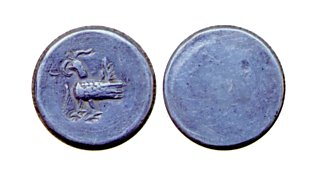
At this stage, apart from the officially minted coins issued by the court, the monetary circulation policy also permitted the circulation of ancient coins from previous dynasties that had long been recognized by the Nguyễn court in Vietnamese history. The Minh Mạng reign records state: "In the 20th year of Minh Mạng, the King instructed the Ministry of Public Works as follows: Since ancient times, successive dynasties have minted a great variety of coins. The coins officially minted by the four preceding dynasties were issued for circulation both within and outside the country, but ancient coins were also permitted to circulate. Only the four types of Tây Sơn rebel coins (Thái Đức [泰德], Quang Trung [光中], Cảnh Thịnh [景盛], and Bảo Hưng [保興]) should not be mixed with official coinage and were therefore prohibited from circulation. Recently, it has been reported that people have been buying and selling coins of earlier reign titles. If all such coins were uniformly selected and eliminated from circulation, it would be impossible to distinguish which are rebel coins and which are legitimate coins, and how could money and goods continue to circulate?"[8]
Besides the common copper and zinc coins as under King Gia Long, large coins with auspicious inscriptions began to be minted for rewards and circulation: "Canh Dần [庚寅], the 11th year of Minh Mạng (1830), fifth month, 10,000 large copper coins with the inscription Minh Mạng Thông Bảo [明命通寶] were minted. The Ministry of Revenue and the Imperial Guards were ordered to jointly supervise the work at the Imperial Mint, in accordance with the prescribed inscriptions and specifications, to mint 20 types with eight-character inscriptions and 10 types with four-character inscriptions"[9], as well as various gold and silver issues such as Phi Long (Flying Dragon) and Long Văn (Dragon and Clouds), including gold and silver ingots of different types, and to standardize the minting procedures for these monetary objects: "Nhâm Thìn [壬辰], the 13th year of Minh Mạng (1832), sixth month, minting of gold and silver coins Phi Long during the Minh Mạng reign"[10] or as in the passage on gold ingots: "Quý Tỵ [癸巳], the 14th year of Minh Mạng (1833), third month, ordered the casting of 100 gold ingots, each weighing 100 taels, named Việt Nam Nguyên Bảo [越南元寶]".[11]
2. Artifacts and discussion
King Minh Mạng reigned for a long period of independence and autonomy, during which the country developed both territorially and economically. The issuance of a wide diversity of coins in various materials bearing the inscription Minh Mạng Thông Bảo [明命通寶] clearly reflects the stability of the economy during this period.
2.1. Official dynastic coinage
2.1.1. Copper coins
2.1.1.1. Small 6-phân coins
The chronicles record: "Canh Thìn [庚辰], the 1st year of Minh Mạng (1820), second month, the minting of six-phân Minh Mạng Thông Bảo copper and zinc coins began. Coin patterns were sent to the Bảo Tuyền Bureau in the Northern Citadel for minting according to the exact specifications. The standard for minting costs was established: for every 100 cân of copper-zinc alloy, consisting of 49 cân of red copper, 45 cân of zinc, and 6 cân of lead, 37 quan and 8 tiền of copper cash were cast, with an allocated minting cost of 5 quan, 5 tiền, 33 đồng, 6 phân, and 2 ly. For every 100 cân of zinc, 41 quan of zinc cash were cast, with an allocated minting cost of 3 quan, 4 tiền, 21 đồng, 6 phân, and 5 ly".[12] Thus, we can see that the small six-phân coins bearing the Minh Mạng Thông Bảo inscription began to be minted only a few months after Minh Mạng ascended the throne, including both copper-zinc alloy coins and zinc coins. However, the six-phân coins of the Minh Mạng period clearly exist in two distinct varieties, differing in both casting molds and calligraphy, yet the official chronicles do not clearly record how these two types were minted:
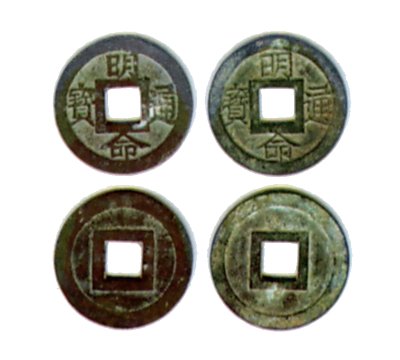
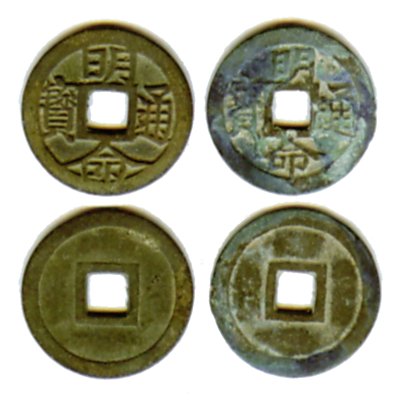
- The first type has a square-headed Thông [通] character, with calligraphy completely identical to that of Gia Long Thông Bảo [嘉隆通寶] coins from the period beginning in 1814. Diameter: 22.5-23 mm. Thin calligraphic strokes, with a thick and well-made raised rim on both obverse and reverse, and a square central hole measuring 6×6 mm. This may have been the earliest minting series of Minh Mạng coins; this type is relatively scarce compared to the other variety. (Figure 2)
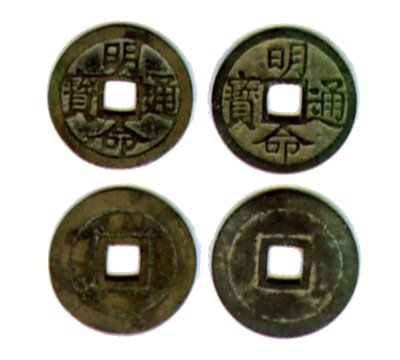
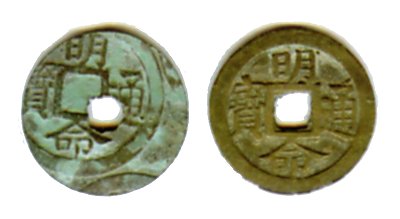
- The second type has a triangular-headed Thông [通] character, with a diameter of 22.5-23.5 mm; this represents the typical calligraphic style compared to later large-sized Minh Mạng coins. This type is found more frequently than the square-headed variety (Figure 3), indicating that it was minted in large quantities and served as the principal circulating type of Minh Mạng six-phân coinage.
This six-phân coin series was minted for six years, after which its production was discontinued. The principal Minh Mạng coin series minted thereafter were those of nine phân and above. The chronicles recorded: "In the 6th year of Minh Mạng (1825), the state had already minted nine-phân copper coins. Some officials stated that copper was expensive at the time, and the coins being cast were heavy, so the state gained no benefit from them. The King instructed: The state has its own principles for directing and administering the finances of the realm. Why is there any need to weigh, compare, and calculate in detail what is gained or lost, what is in excess or lacking? At present, the treasuries are fully stocked with money and commodities, and the levels of income and expenditure are regular and stable. Moreover, money is a source of enduring benefit for generations to come and can never be exhausted. If coins are minted of a thin and fragile quality, they will gradually wear away over time. Therefore, when the nine-phân coin is compared with the coinage of earlier dynasties, its weight is found to be appropriate. It should therefore continue to be minted in its present form so that it may remain durable and long-lasting, and the six-phân coin shall be abolished".[13]
2.1.1.1. Large copper oins 9-phân to 1-đồng cân
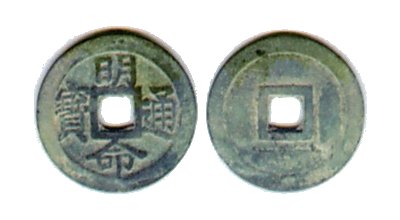
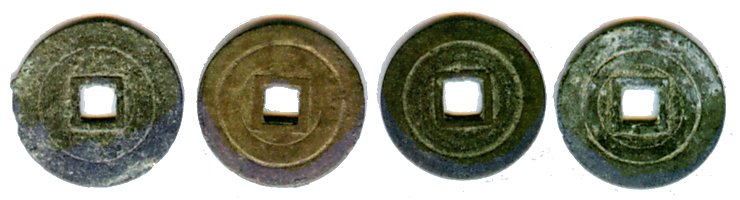
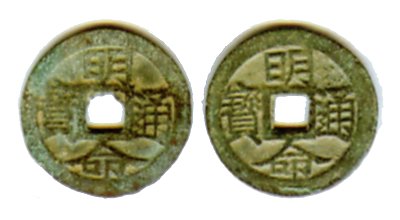
- Large coins weighing from 9.1 phân to 9.9 phân. The Dai Nam Thực Lục records: "In the 4th month of the Nhâm Ngọ year, the 3rd year of Minh Mạng (1822), the minting of large copper coins was initiated, ranging from 1 đồng cân and below to 9 phân 1 ly and above. The standard composition for a copper-zinc-tin alloy was established (for casting large copper coins, per 100 cân there were 52 cân 4 lạng of red copper, 47 cân 8 lạng of zinc, and 4 lạng of tin. To mint 6-phân copper coinS, for every 100 cân of metal, 52 cân of rebel copper coins, 27 cân of red copper, 20 cân and 14 lạng of zinc, and 2 lạng of tin)"[14] (Figure 4), the diameter of this variety ranges from 24.2 to 25.5 mm, with the weight with weights ranging from 3.4 to 3.7 grams.[15] The coins are well struck. The calligraphy follows the regular script style, with broad and strong strokes. The character Thông [通] appears only in the triangular-headed form, and the "walk" radical [辶] has a single dot. The reverse side of this coin type varies considerably (some common types are shown in Figure 5).
- Large copper coins (over 9 phân 9 ly). This type began to be cast in the 8th year of Minh Mạng (1827). The Records state: "In the fifth month of the Đinh Hợi [丁亥], the 8th year of Minh Mạng (1827), the casting of large Minh Mạng Thông Bảo coins began. The Emperor told the Ministry of Revenue: Money in circulation is meant to provide benefits for countless generations to come. Until now, the coins that have been cast have all weighed less than one đồng cân; over time they are easily damaged, and I fear they will not last long. Therefore, We command the Treasury Workshop to cast trial coins, each weighing one đồng cân as the standard, and to send the samples to the Bảo Tuyền office in the Northern Citadel for casting; the production of 9-phân coins shall cease. (The production method, including large and small labor tasks, the number of workers, and the cost, all followed the regulations for minting 9-phân copper coins, though the material waste deduction was reduced. For every 100 cân of brass, Qing Dynasty copper coins allow a wastage deduction of 14 cân, scrap copper vessels allow 15 cân, and rebel copper coins allow 16 cân)".[16] The diameter of these coins is all over 25.5-25.7 mm; in particular, some coins reach 26 mm or more (figures 6, 7, 8). This was the main coin series of the Minh Mạng era, demonstrating a high level of economic stability. The calligraphy on the coins varies considerably: the character Thông [通] has a triangular head; the "walk" radical [辶] appears in both single-stroke and double-stroke forms; the calligraphy of the character Mạng [命] also shows multiple stylistic variations. Defective or miscast coins with deformed shapes were quite rare during the Minh Mạng reign, due to the strict regulatory control of the mints.
2.1.2. Zinc coins
In addition to the copper coins listed above, King Minh Mạng also produced zinc coins cast in much greater quantities than the copper coins and on many occasions. The chronicles state: "In the eighth month of the Đinh Hợi [丁亥] year, the 8th year of Minh Mạng (1827), the regulations for casting zinc coins were revised"[17] and "In the ninth month of the Quý Tỵ [癸巳] year, the 14th year of Minh Mạng (1833), the Treasury Workshop was ordered to cast 10,000 strings of Minh Mạng Thông Bảo coins in zinc on a trial basis."[18] Under the regulations, each zinc coin weighed 6 phân, and this became the principal circulating currency during this period. Due to the large-scale casting of zinc coins, production costs were reduced, labor requirements were minimal, and profits increased, which encouraged the production of counterfeit coins. Compared with official coins cast by the state, counterfeit coins were smaller and thinner, so the profit was even higher. Therefore, the problem of counterfeit zinc coins was most severe during the Minh Mạng era. Accordingly, King Minh Mạng issued many decrees prohibiting the minting of counterfeit coins in order to maintain the stability of zinc coin prices, thereby keeping the country’s monetary system stable. A typical example of these prohibitions was recorded by the National History Office: "In the third month of the Tân Mão [辛卯] year, the 12th year of Minh Mạng (1831), another decree concerning the illicit casting of coins was issued. The King instructed the Ministry of Revenue: From the autumn of last year until now, most localities have enjoyed good harvests. Although some places had slightly poorer yields, this amounted to no more than one or two parts in a hundred thousand. Yet, places like Thừa Thiên and the Gia Định had excellent crops rather than failures...? In short, it is simply because the evil of illicit coin casting has not yet been completely eradicated that money is abundant while goods remain expensive. Moreover, these counterfeit coins are deliberately made lightweight and thin, fracturing easily, causing merchants to regard them unfavorably. If any locality fails to investigate and detect these operations, allowing officials from a different district to uncover them, or relying on citizens to lodge complaints before an arrest is made, then the local officials shall be charged with neglect of official duties, and the provincial governor shall likewise face disciplinary action."[19]
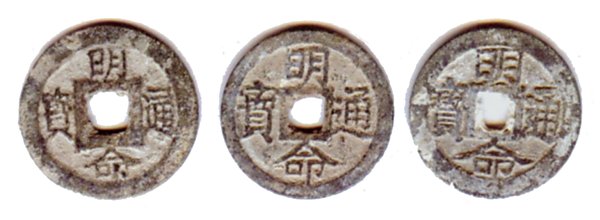
Zinc coins of King Minh Mang's reign were produced in volumes far exceeding copper coins, but due to their low face value, they were not highly valued by the public; furthermore, since they were made of base zinc, they were highly susceptible to corrosion and deformation, meaning that few survive today compared to copper coins of the same era. The calligraphy on the zinc coins was as diverse as that on the copper coins. The character Thông [通] appeared in both square-headed and triangular-headed forms; the "walk" radical [辶] occurred in both one-stroke and two-stroke forms; and the character Bảo [寶] appeared in two varieties: Nhĩ Bảo [耳寶] and Phẫu Bảo [缶寶] (Figure 9). Additionally, during the course of field collecting, certain varieties of Minh Mang Thong Bao cast in pure lead have been discovered, yet they perfectly match the official molds used for dynastic coins.
2.2. Privately cast coins
Counterfeit or privately cast coins bearing the inscription Minh Mạng Thông Bảo are perhaps among the more interesting subjects and have attracted the attention of many collectors and researchers. Even during his own reign, it was precisely because of the problem of illicit coin casting in the North that the King ordered the mint at the Northern Citadel to be closed for a long period: "In the seventh month of the Quý Tỵ [癸巳] year, the 14th year of Minh Mạng (1833), the mint in Hanoi was reopened. The King instructed the Imperial Cabinet: The casting of coinage according to established regulations is intended to facilitate the circulation of wealth and benefit the daily commerce of the people. Recently, because many individuals among the populace engaged in illicit counterfeiting, We suspended the operations. Now the northern region has suddenly suffered flooding. Relief must be provided urgently, and after the actual extent of the disaster has been determined, taxes must be remitted or refunded, grain distributed, or loans of grain provided to help the people through their hardship. As a result, the funds available for expenditure will certainly not be as abundant as before. Therefore, We issue an imperial directive to Governor Đoàn Văn Trường to consult with the offices of Finance and Justice to arrange the immediate re-opening of the casting furnaces at the former Bảo Tuyển office. As soon as their joint administrative protocol is finalized, let them petition the throne for approval"[20], or repeatedly issued bans against coin counterfeiting, as we mentioned above, and this coin type was also illicitly cast during the reign of Tự Đức, as we discussed in the article Gia Long Thông Bảo Coins in Vietnam Numismatics magazine #2. Within the scope of this article, we only briefly list some typical varieties in this coin series. If we have the opportunity to write a specialized study, we will discuss them in greater detail. Readers may also refer to a fairly in-depth article on this subject by Craig Greenbaum, an American collector and researcher of ancient Vietnamese coins.[21]
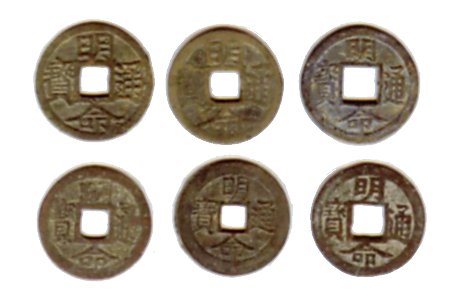
- Copper coins with a diameter of 22-23 mm: This coin type was likely cast on many occasions and is extremely diverse in calligraphy and mold variations. In general, these coins are very thin compared with official imperial coins. However, some specimens are quite thick and of a quality nearly comparable to official coins of the same type (Figure 10).
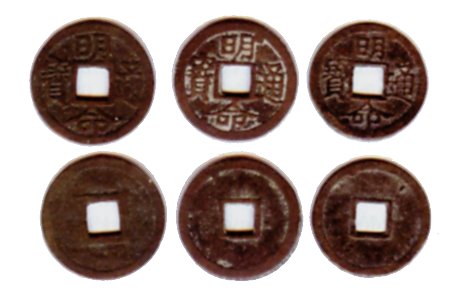
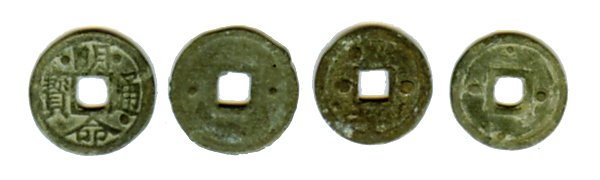
- Coins cast by Chinese merchants and smuggled into Vietnam: In addition to privately cast coins produced domestically for various purposes, in the later years of Minh Mạng's reign, and especially during the reign of Tự Đức, Chinese merchants brought into circulation small, thin Minh Mạng Thông Bảo and Tự Đức Thông Bảo [嗣德通寶] coins with diameters of 19-21 mm. These coins were exceptionally thin, with many specimens weighing less than 1 gram and able to float on water, and they exist in a great variety of types (Figure 11). Many examples were cast with characters on both sides; some have the characters on both sides in the same orientation, while others have them in opposite orientations (Figure 12). Some also have dots on both the obverse and reverse (Figure 13).
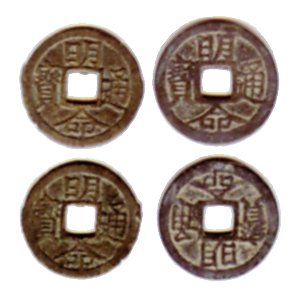
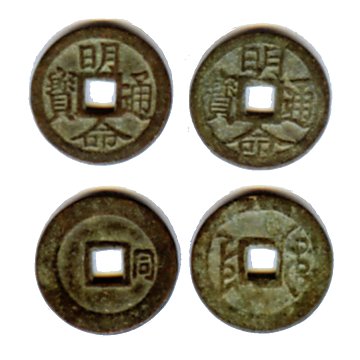
- Copper coins with a diameter of 25.5 mm: In addition to the small, thin coins, collectors have also found Minh Mạng Thông Bảo coins with a larger diameter of about 25.5 mm, well cast and thick, made of red copper. The reverse of the coins bears either the character Đồng [同] or Manchu-style inscriptions such as Bảo Tuyền and Bảo Vân. These are very rare specimens within this coin series (Figure 14).
3. Conclusion
Within the scope of this article, we only provide a general overview of official dynastic coinage and privately cast coins bearing the inscription Minh Mạng Thông Bảo [明命通寶]. This is one of the most diverse coin series in the numismatic history of Vietnam. The official copper coins can generally be divided into three clear types that were cast across multiple successive minting periods. Zinc coins were issued only in the 6-phân” series, with a highly rich variety of calligraphy styles. The private and unofficial issues bearing the same title comprise an incredibly diverse field of study that requires substantial further research and cataloging to fully clarify. In addition to the copper and zinc coin series mentioned above, during the reign of Minh Mạng, silver and gold ingots, silver and gold coins, and large presentation coins with auspicious inscriptions were also minted. However, we are unable to discuss them within the scope of this study. It is our hope that specialized numismatic scholars will conduct deeper research to address these unresolved questions; alternatively, given the opportunity in future papers, we intend to follow up and explore these specialized topics further. Driven by the desire to see a greater body of advanced research that systematically clarifies both official and unofficial series from the Minh Mạng era, we warmly welcome feedback and insights from collectors and researchers. This collaborative effort will help bring undocumented specimens to light and improve the accuracy of our understanding of Minh Mạng Thông Bảo coinage.
Resources:
1. Dr. R. Allan Barker (2004). The Historical Cash Coins of Vietnam. Singapore.
2. National Museum of Vietnamese History (2005). Tiền kim loại Việt Nam (Coins of Vietnam). Hanoi.
3. Anonymous. (1943). 東洋古銭図録 - 安南銭之部 (Catalog of Ancient Oriental Coins: Annam Section). Japan.
4. Ding Fubao [丁福保], and Ma Dingxiang [馬定祥] (1992). 歷代古錢圖譜 (Illustrated Catalog of Ancient Coins through the Ages). Shanghai Classic Publishing House, Shanghai.
5. Đỗ Văn Ninh (1992). Tiền cổ Việt Nam (Ancient Coins of Vietnam). NXB Khoa học Xã hội, Hanoi.
6. Hội đồng trị sự Nguyễn Phúc tộc (1995). Nguyễn Phúc tộc thế phả (Genealogy of the Nguyen Phuc Clan). NXB Thuận Hóa, Huế.
7. Nguyễn Anh Huy (2010). Lịch sử Tiền tệ Việt Nam - sơ truy và lược khảo (History of Vietnamese Currency: Preliminary Research). NXB Văn hóa Sài Gòn, TP. HCM.
8. Nguyen Dynasty Cabinet, (1993). Khâm định Đại Nam hội điển sự lệ (Imperially Commissioned Administrative Statutes of Đại Nam). NXB Thuận Hóa, Huế.
9. Tominaga Masayoshi [富永正三] (1994). 穴銭入門 - 手類銭稿 (Introduction to Cash Coins: A Study of Coin Types). Japan.
10. Nguyễn Dynasty National History Bureau (1821-1945). Đại Nam thực lục (Veritable Records of Đại Nam). Translated from Hán-Nôm by Nguyễn Ngọc Tĩnh, 2004. NXB Giáo dục, Đà Nẵng.
11. Nguyễn Dynasty National History Bureau (1821-1945). Minh Mạng chính yếu (Essentials of Minh Mạng's Reign). Translated from Hán-Nôm, 1994. NXB Thuận Hóa, Huế.
12. Lục Đức Thuận and Võ Quốc Kỳ (2009). Tiền cổ Việt Nam. Nxb Giáo Dục, Đà Nẵng.
13. Quỳnh Cư and Đỗ Đức Hùng (2003). Các triều đại Việt Nam. Nxb Thanh niên, Hanoi.
14 Various Authors (2017). Vietnam Numismatics, Issue No. 1. Internal Publication, Hanoi.
[1] Quốc sử quán triều Nguyễn, 1821-1945. Đại Nam thực lục. 2004. Nxb Giáo Dục, Đà Nẵng. vol. 2, p. 30.
[2] Quốc sử quán triều Nguyễn, 1821-1945. Đại Nam thực lục. 2004. Nxb Giáo Dục, Đà Nẵng. vol. 2, p. 31.
[3] Quốc sử quán triều Nguyễn, 1821-1945. Đại Nam thực lục. 2004. Nxb Giáo Dục, Đà Nẵng. vol. 5, p. 889.
[4] Quốc sử quán triều Nguyễn, 1821-1945. Đại Nam thực lục. 2004. Nxb Giáo Dục, Đà Nẵng. vol. 2, p. 190.
[5] Quốc sử quán triều Nguyễn, 1821-1945. Đại Nam thực lục. 2004. Nxb Giáo Dục, Đà Nẵng. vol. 2, p. 225.
[6] Quốc sử quán triều Nguyễn, 1821-1945. Đại Nam thực lục. 2004. Nxb Giáo Dục, Đà Nẵng. vol. 5, p. 510.
[7] Quốc sử quán triều Nguyễn, 1821-1945. Đại Nam thực lục. 2004. Nxb Giáo Dục, Đà Nẵng. vol. 5, pp. 472-473.
[8] Quốc sử quán triều Nguyễn, 1821-1945. Minh Mạng chính yếu. 1994. Nxb Thuận Hóa. vol. 3, p. 471.
[9] Quốc sử quán triều Nguyễn, 1821-1945. Đại Nam thực lục. 2004. Nxb Giáo Dục, Đà Nẵng. vol. 3, pp. 69-71.
[10] Quốc sử quán triều Nguyễn, 1821-1945. Đại Nam thực lục. 2004. Nxb Giáo Dục, Đà Nẵng. vol. 3, pp. 69-71.
[11] Quốc sử quán triều Nguyễn, 1821-1945. Đại Nam thực lục. 2004. Nxb Giáo Dục, Đà Nẵng. vol. 3, p. 524.
[12] Quốc sử quán triều Nguyễn, 1821-1945. Đại Nam thực lục. 2004. Nxb Giáo Dục, Đà Nẵng. vol. 2, p. 48.
[13] Quốc sử quán triều Nguyễn, 1821-1945. Minh Mạng chính yếu. 1994. Nxb Thuận Hóa. vol. 3, pp. 425-426.
[14] Quốc sử quán triều Nguyễn, 1821-1945. Đại Nam thực lục. 2004. Nxb Giáo Dục, Đà Nẵng. vol. 2, p. 206.
[15] Tiền cổ Việt Nam. 2009. Nxb Giáo Dục. p. 85.
[16] Quốc sử quán triều Nguyễn, 1821-1945. Đại Nam thực lục. 2004. Nxb Giáo Dục, Đà Nẵng. vol. 2, p. 618.
[17] Quốc sử quán triều Nguyễn, 1821-1945. Đại Nam thực lục. 2004. Nxb Giáo Dục, Đà Nẵng. vol. 2, p. 663.
[18] Quốc sử quán triều Nguyễn, 1821-1945. Đại Nam thực lục. 2004. Nxb Giáo Dục, Đà Nẵng. vol. 3, p. 774.
[19] Quốc sử quán triều Nguyễn, 1821-1945. Đại Nam thực lục. 2004. Nxb Giáo Dục, Đà Nẵng. vol. 3, pp. 149-150.
[20] Quốc sử quán triều Nguyễn, 1821-1945. Đại Nam thực lục. 2004. Nxb Giáo Dục, Đà Nẵng. vol. 3, p. 665.
[21] Readers can access and download this study at https://app.box.com/s/ivlv8hni3d