Gia Long Thông Bảo coins
嘉隆通寶
Mai Ngọc Phát, Bùi Tiến Đạt, Vietnam Numismatics #2 (01-2018), p.23-31
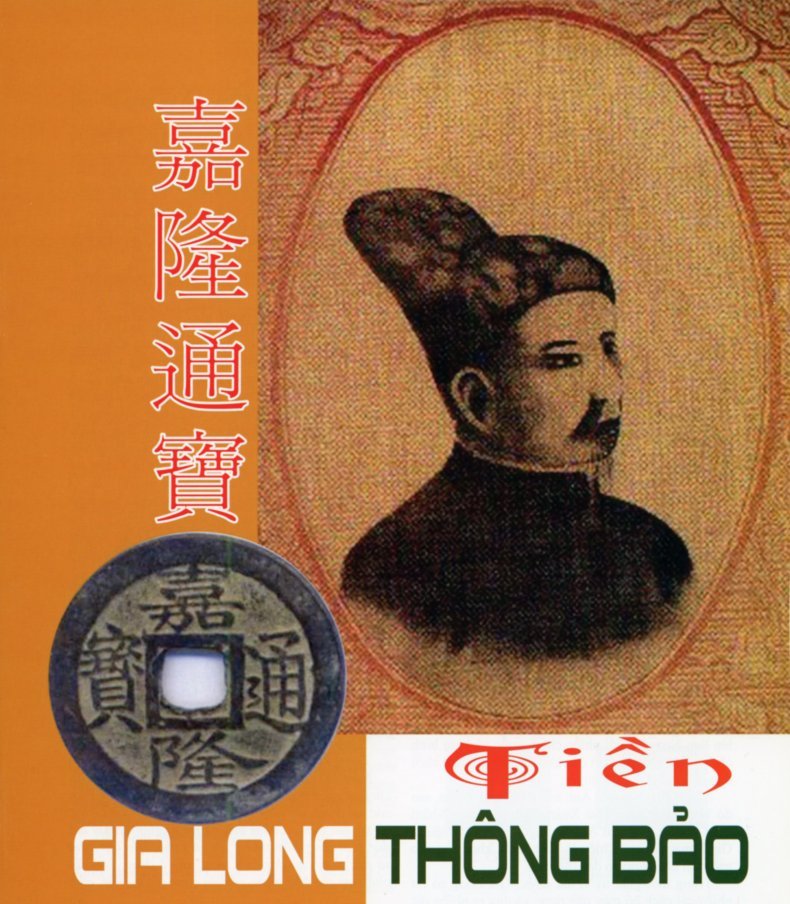
According to the official royal chronicle of Đại Nam (Đại Nam Thực Lục), in the year Quý Hợi [癸亥], the 2nd year of the reign of Gia Long (1803) ... in the 6th month ... the casting of Gia Long Thông Bảo [嘉隆通寶] coins began. Commander Cáp Văn Cẩn was appointed to oversee the work. After casting, 1,000 coins were sent to the Northern Citadel (Bắc Thành) to be copied as a standard pattern. (Sample coins: each coin had a diameter of 5 phân 5 ly, and each string of coins weighed 2 cân 4 lạng).
1. Introduction
Currently, there are many studies on Vietnamese ancient coins, and it remains a field with many conflicting opinions among researchers and collectors. Perhaps these issues all stem from the fact that there are very few contemporary official sources, and later sources that mention monetary matters during the monarchy period do so only in a general and unclear way. Therefore, besides relying on official historical sources, examining the coins themselves - their physical samples, the regions where they were found, and their materials - is also an important basis for studying and understanding Vietnamese ancient coins. Based on this perspective, we would like to present a type of ancient coin from the official coinage of the Vietnamese monarchy under the Nguyễn dynasty: the Gia Long Thông Bảo [嘉隆通寶]. We sincerely thank Dr. Nguyễn Anh Huy, who provided us with several valuable official historical sources for this article.
2. Historical overview
2.1. Life and reign
King Gia Long's real name was Nguyễn Ánh (also Nguyễn Phúc Ánh). He was born on the 15th day of the first lunar month in the year Nhâm Ngọ [壬午] (February 8, 1762), and was the third son of Prince Nguyễn Phúc Luân and Lady Nguyễn Thị Hoàng. During the period when the Nguyễn lords' domain in Đàng Trong was in decline, the Tây Sơn rebellion broke out in 1773. Taking advantage of this moment, the Trịnh lord sent troops to attack Phú Xuân. Phú Xuân fell, and the Nguyễn lords had to flee to Gia Định.
In 1777, Nguyễn Huệ led troops to capture Gia Định, forcing the Nguyễn Lord and his clan to flee to Định Tường and Cần Thơ. However, Nguyễn Phúc Thuần and several of his generals were captured there and later executed in Gia Định. In 1778, Nguyễn Ánh was proclaimed Grand Marshal and Regent, and raised troops to reclaim Gia Định, marking the beginning of a 24-year period of building the Nguyễn dynasty.
In 1801, Nguyễn Ánh advanced to attack Quy Nhơn, and then pacified Phú Xuân. In the 5th month of the year Nhâm Tuất [壬戌] (1802), Nguyễn Ánh ascended the throne, adopted the reign title Gia Long, and established the country name Việt Nam, marking the beginning of the Nguyễn dynasty, which lasted 144 years.
During his reign, Gia Long carried out many reforms of the state administration, issued numerous decrees, implemented various tax policies, improved roads, established the National Academy, and set up diplomatic relations with several countries.
King Gia Long died on the 19th day of the 12th lunar month in the year Kỷ Mão [己卯] (February 3, 1820), at the age of 58, and was given the temple name Thế Tổ Cao Hoàng Đế [世祖高皇帝].
2.2. Monetary policies during the reign of Gia Long
Before ascending the throne, Nguyễn Ánh had already issued decrees related to monetary matters, including coin casting: "In the year Kỷ Dậu [己酉], the 10th year (1789) ... in the 11th month ... he prohibited the selective rejection of coins in circulation. Tax officials and merchants were required to accept all coins, even those that were chipped or worn; as long as they could still be strung together, they were to remain in circulation, and anyone who rejected them would be punished".[1]
One year after ascending the throne in 1803, Gia Long began minting coins for circulation. Although earlier records exist: "In the year Bính Thìn [丙辰], 1796, in the 12th lunar month, the Gia Hưng Thông Bảo [嘉興通寶] coins were cast"[2]. However, it was not until 1816 that a formal edict was issued prohibiting circulation and ordering the recall of Tây Sơn coins: "In the 15th year of Gia Long (1816), an edict was issued to destroy Tây Sơn coinage, stipulating that rebel coins from the five-year period between Đinh Sửu [丁丑] (1817) and Tân Tỵ [辛巳] (1821) remained legal tender, while those from Nhâm Ngọ [壬午] (1822) onward were banned. During this transition, neither state treasuries nor private citizens were permitted to discriminate between acceptable coin types under penalty of law"[3].
"In the year Đinh Sửu [丁丑], the 16th year of Gia Long (1817) ... in the 12th month .. an order was issued for localities from Quảng Bình southward to put zinc coins into circulation ..."[4]
In 1803, a mint was opened in Bắc Thành, with Commander Nguyễn Văn An as director and Lê Duy Bạt as deputy ... "Now when coins are cast, the price of copper is high because the people seek profit and buy up all the copper, causing the price to rise. To eliminate this problem, one must address its root. I think that when copper is bought from the people, the price is high, but when copper is collected from officials, the price is low - that is only natural" ... they received money to buy copper, cast it into coins and submit them to the treasury, then received additional payment.[5]
"Canh Ngọ [庚午], 9th year of Gia Long (1810) ... 2nd month ... a currency treasury was established in Thanh Hoa."[6]
In the year 1811, 4th month, at Quảng Đức, the Treasury official Lý Gia Du was made director of the mint in Bắc Thành and was placed in charge of the copper and zinc mines. Gia Du reported: "The Lê dynasty established three mints, ... In this way, people competed with each other to cast coins, and the money became increasingly abundant". The Emperor approved it and ordered the establishment of additional mints, informing the people that anyone who had copper or zinc must submit it to the State; payment would be made according to official prices, and private buying and selling was forbidden.[7] Thus, the mints in Gia Định Citadel and in the provinces may have been established during this period. "In the year Nhâm Thân [壬申] (1812), 1st month, the Emperor personally set regulations forbidding the smuggling and private purchase of copper and zinc".[8]
"In the winter of Nhâm Thân [壬申], 11th year of Gia Long (1812) ... 10th month ... the casting of 1 lạng silver ingots began. Consequently, more silver ingots were ordered to be cast for circulation. ... one side inscribed with four characters Gia Long niên tạo [嘉隆年造], one side with four characters Tỉnh ngân nhất lạng [省銀一兩], one side with three characters Trung bình hiệu [中平號], and one side with six characters Trị tiền nhị quán bát mạch [治錢二貫八目]. Illegal private minting was subject to the same penalties as counterfeiting ... Fixed the price of gold for Bắc Thành. (1 lạng of gold equal to 16 lạng of silver; when people exchanged their gold for state gold, they had to pay an additional fee of 1 string of coins)".[9]
In 1815, 6th month, cast standard silver to facilitate smaller transactions (each ingot weighing 5 đồng cân, both sides with mint marks: one side inscribed Gia Long niên tạo [嘉隆年造], one side inscribed Trung bình ngân phiếu ngũ tiền [中平銀票五錢]; each ingot valued at 4 strings of coins).[10]
In the year Đinh Sửu [丁丑], the 16th year of Gia Long (1817) ... in the 12th month .. an order was issued for localities from Quảng Bình southward to put zinc coins into circulation The edict stated: "Nothing is more important for governing the country than supporting the people, and supporting the people must first make daily transactions convenient". Now, the mint is opened, and there is already enough money. Thus, starting from the 1st month of the coming year, all expenditures shall be paid with this money for circulation among the people. As for old copper coins and rebel coins in the warehouses, they will be sent to the capital with the next shipment."[11]
3. Artifacts and discussion
3.1. Official dynastic coins
"In Nhâm Tuất [壬戌], the 1st year of Gia Long (1802) ... 12th month ... private coin casting was forbidden. The King noted that since the Tây Sơn rebellion, many people had cast coins illegally, and the coins were too thin; he therefore issued a prohibition."[12]
"In Quý Hợi [癸亥], the 2nd year of Gia Long (1803) ... 5th month ... Nguyễn Văn Khiêm of the Bắc Thành Ministry of Revenue came to court ... Văn Khiêm reported that the post-war population faced a currency shortage and requested additional minting to meet state needs; however, as minting was a royal prerogative, master samples were required to prevent abuses."[13]
According to Đại Nam Thực Lục, "In the year Quý Hợi [癸亥], the 2nd year of Gia Long (1803) ... in the 6th month ... the casting of Gia Long Thông Bảo [嘉隆通寶] coins began. Commander Cáp Văn Cẩn was appointed to oversee the work. After casting, 1,000 coins were sent to Bắc Thành to be copied as a standard pattern. (Sample coins: each coin had a diameter of 5 phân 5 ly, and each string of coins weighed 2 cân 4 lạng)". In addition, the Khâm định Đại Nam hội điển sự lệ (Imperially Authorized Compendium of Đại Nam Regulations) further records: "In the 2nd year of Gia Long, a mint was established in Bắc Thành ... Gia Long Thông Bảo coins were cast according to the newly issued model". So what was this coinage like? Thus, based on the above historical records, it appears that the casting of Gia Long Thông Bảo [嘉隆通寶] may have begun in the 1st year of Gia Long (1802), rather than in 1803 as recorded in the chronicles. ??? However, the number of coins cast in the first year was very small, mainly to mark the establishment of a new dynasty, while other coin types continued to circulate for everyday economic transactions. Furthermore, based on physical artifacts and numismatic expertise, we categorize Gia Long Thông Bảo coinage into two primary periods, each distinguished by unique stylistic and technical characteristics:
3.1.1. The 1802-1813 Period
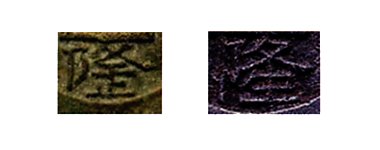
In the first year of his reign, to stabilize the economy and politics, the Tây Sơn mints and coin workers in Huế and the central region were requisitioned to cast coins. Therefore, these coins all bear the style of Tây Sơn coinage. The Gia Long Thông Bảo coins cast in the early stage all show irregular strokes in the character Long [隆] (Figure 1). The character Thông [通] has two types: one with a square top and one with a triangular top; the triangular-top Thông is more common. Although coin models were sent to Bắc Thành for standard casting, the presence of many private mints resulted in variations in size and material at the Bắc Thành mints. In the early stage, Gia Long Thông Bảo coins were cast only in brass.
3.1.1.1. Gia Long Thông Bảo with plain reverse
According to our research, the plain-back coin types from this period include:
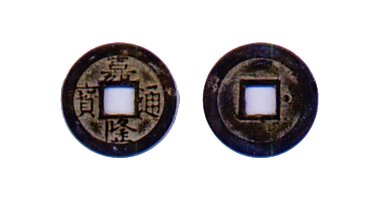
- Coins with a diameter of 19.5-21.5 mm: very rare; brass; clear, well-defined rims; thick flan; the character Thông has a square top; mainly found in the central regions. Therefore, it can be inferred that these coins were cast in the earliest years (1802-1803), mainly at mints in Huế and the central region (Figure 2).
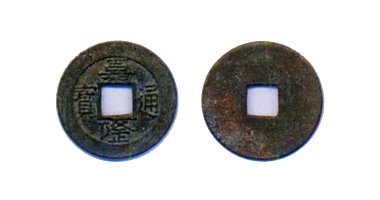
- Coins with a diameter of 23.5-24 mm: uncommon; plain reverse (most coins of this period have a dot to the right of the square hole); the character Thông has a triangular top. Some specimens have a diameter of 25 mm (Figures 3, 4).
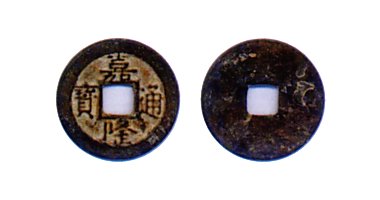
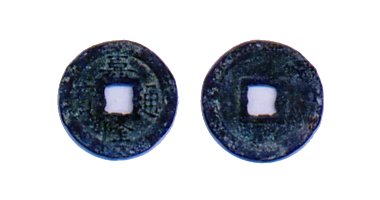
- A double-rim mark appears near the inner border; diameter of 24 mm; the character Thông has a triangular top (Figure 5).
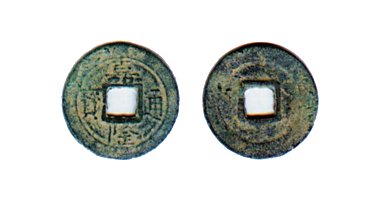
- The reverse rim is thicker than the obverse rim (both square-top and triangular-top Thông); diameter 24 mm (Figure 6).
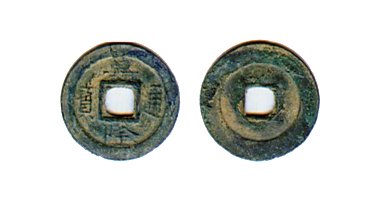
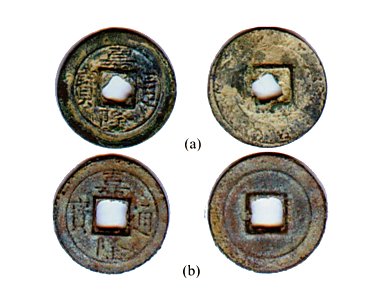
- The obverse rim with a concave profile; diameter 24 mm; the character Thông has a square top (Figure 7a).
- Both obverse and reverse rims are concave; diameter 23 mm; the character Thông has a triangular top; thicker than usual coins (Figure 7b).
3.1.1.2. Gia Long Thông Bảo with reverse marks
This was the main coin type of this period, with a diameter of 23-24 mm and the character Thông having a triangular top. The reverse marks are mainly a plain dot or a dot within a circle to the right of the square hole (Figure 8). The casting of Moon-Star (Nguyệt-Tinh) marks on coins has a long-standing tradition inherited from Chinese coinage. Coins from the Later Lê dynasty and the Tây Sơn era in Vietnam also frequently bore Moon-Star marks; Gia Long Thông Bảo coins likely followed this tradition (Figure 9). After the time of Gia Long, his successors discontinued this practice. Besides the reverse marks mentioned above, some specimens also display other characteristics, such as:
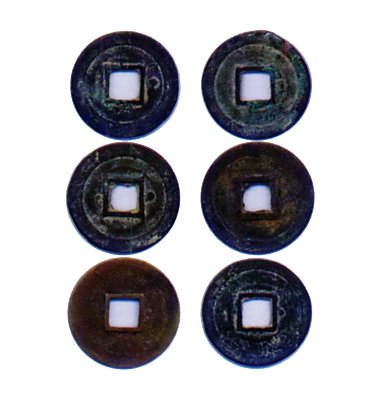
- Obverse rim with a concave profile.
- Reverse rim with a concave profile.
- Both obverse and reverse rims having a concave profile (Figure 10).
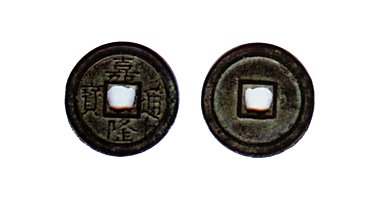
- Reverse with the square hole inscribed within a circle.
- Four crescent shapes surrounding the square hole.
3.1.2. The 1813-1820 Period
3.1.2.1. Gia Long Thông Bảo with reverse characters
- Gia Long Thông Bảo coin with the characters Thất Phân [七分] on the reverse, made of zinc (Figure 11). The Nguyễn dynasty's National History Office records: "Quý Dậu [癸酉], 12th year of Gia Long (1813), spring, 1st month ... Began casting zinc coins weighing 7 phân under the title Gia Long Thông Bảo. In Bắc Thành, two Chinese individuals, Trần Hiển Chu and Chu Vĩnh Cát, requested to purchase zinc to cast coins privately, exchanging 130 strings of zinc for 100 strings of copper coins from the treasury. The city officials reported this matter to the King, and he approved their request. He ordered the establishment of the Bảo Tuyền office at the Tây Long gate outside the city walls. Commander Trương Văn Minh was appointed Director of the Bảo Tuyền office, with Vice-Governor Lê Chất concurrently serving as supervisor. According to the model issued by the Ministry of Revenue for casting (1 string of coins, weighing standard weight of 2 cân 10 lạng, both private individuals and those using state funds brought their materials to the furnaces for casting. Once minted, 125 strings of zinc coins were exchanged for 100 strings of copper coins. Each string had to meet the weight requirements; a deficit of up to 15 coins could be made up with a supplementary payment, but if the deficit exceeded 16 coins, the batch was destroyed. Mixing in lead was punishable. The state cast coins using zinc from Thái Nguyên; for every 100 cân of metal, the loss was 12 cân 8 lạng, yielding 33 quan (string of 600 couns) 3 tiền 20 đồng in coin. Material costs were 6 tiền 13 đồng, and labor costs were 2 quan 7 tiền 41 đồng. On average, for every 100 coins, labor cost amounted to 8 đồng 2 phân 4 ly 5 hốt)".[14] Additionally, the Administrative Statutes of Đại Nam records: "In the 12th year... it was further prescribed that each zinc coin should weigh 7 phân, featuring the four characters Gia Long Thông Bảo on the obverse and the two characters Thất Phân [七分] on the reverse. Each string of coins weighed 2 cân 10 lạng". "In the third month of the year Mau Dan [戊寅], the 17th year of Gia Long (1818) ... 120,000 strings of copper coins were transported from the Capital's treasury to the Bắc Thành, while newly cast zinc coins from Bắc Thành were sent back to the Capital".[15]
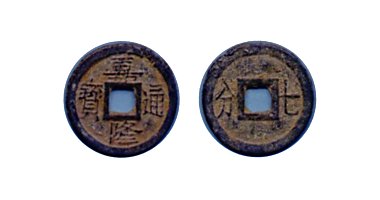
Thus, the casting of these zinc coins with Thất Phân on the reverse was mainly carried out at the Bắc Thành mint, they were minted in large quantities and regularly distributed to other regions. This is a beautifully cast coin type, thick, with standard calligraphy, the diameter is mainly 24mm, made of zinc. However, this "Thất Phân" type also exists in copper, but it is very rare; this copper specimen was likely a pattern coin made by the Ministry of Finance as a standard for casting the zinc coins.
- Gia Long Thông Bảo coins with Lục Phân [六分] on the reverse (Figure 12). The Dai Nam Thuc Luc states: "In the year Giap Tuat [甲戌], the 13th year of Gia Long (1814), copper coins weighing six phân were minted". The reverse of these Gia Long Thông Bảo coin has two characters Lục Phân [六分] written in seal script. The National History Bureau records: "Giap Tuat [甲戌], 13th year of Gia Long (1814) ... 2nd month ... copper 6-phân copper coins under the name Gia Long Thông Bảo were minted". The Bảo Tuyền mint in Bắc Thành followed the coin-casting method of the Qing dynasty. (The alloy consisted of 500 cân of red copper, 415 cân of zinc, 65 cân of lead, 20 cân of tin)".[16]
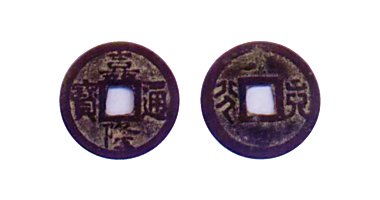
Thus, according to the official history, Lục Phân coins were cast at Bắc Thành. However, this coin type is rarely found in Northern Vietnam but is mainly found in large numbers in Central Vietnam. Therefore, this coin type might have been cast mainly at the Capital mint or transported and used in the Central region. The alloy used was a complex mixture of red copper, zinc, lead, and tin. The calligraphy is beautiful, the Long [隆] character is written in standard style, the Thông [通] character is square-headed, the coin reverse has characters Lục Phân [六分] written in seal script, diameter 22-23 mm. The Long [隆] character written in standard strokes is the main feature to identify Gia Long coins cast from 1813 onward.
3.1.2.2. Gia Long Thông Bảo with plain reverse
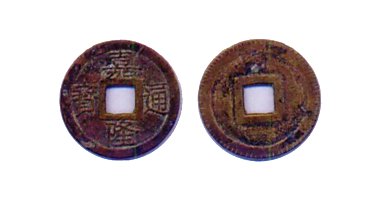
Official history does do not specify the exact period during which this plain-reverse coin was cast. However, according to the National History Office of the Nguyễn dynasty: "Bính Tý [丙子], the 15th year of Gia Long (1816) ... 9th month ... newly minted Gia Long Thông Bảo coins were issued. Orders were given to the provincial administrations from Quảng Bình southward that all salaries and expenses must use these coins. Only for taxes paid by the people, half silver and half cash coins could be used"[17], while also basing on the calligraphy and molds of the Thất Phân and Lục Phân coins above, we can conclude that the plain-reverse coins were minted between 1813 and 1820.
This coin type is found in great numbers in the North and Central regions. In 1998, we came across a very large quantity of Gia Long Thông Bảo coins of the same type at a scrap dealer in Tinh Gia, Thanh Hoa, with no other types of coins mixed in. Soaking them briefly in bleach revealed the red copper material. Coins cast in this period have clear, well-defined rims and holes, fine, delicate characters, and calligraphy similar to the coins with Lục Phân on the reverse. The Long character is written in standard style, the Thong character is square-headed, diameter 22.5-23 mm (Figure 13).
3.1.2.3. Gia Long Thông Bảo characters on both sides
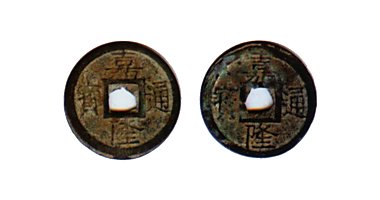
Both sides feature the same inscription as the plain-reverse Gia Long Thông Bảo coins, with standard Long and square-headed Thong characters; diameter 22.5-23 mm. These coins likely resulted from the accidental pairing of two obverse molds, or perhaps a private mint intentionally created them as unique mementos. This variety is rare; it is occasionally found in the northern provinces but is seldom seen in Central Vietnam, suggesting they were primarily produced at the Bắc Thành mints (Figure 14). Due to their rarity, modern forgeries are often sold to collectors. However, one can distinguish them by the material, calligraphy, and especially by examining the coin edges.
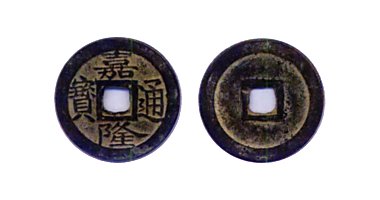
- Besides the main official series mentioned above, there is also a type of Gia Long Thông Bảo coin restruck in 1827, as recorded in Essentials of the Reign of Minh Mạng: "In the 8th year of Minh Mang (1827), the King issued a decree to the Ministry of Finance: The minting of coins is essential for the nation's resources to be abundant for a long time. During the Gia Long era, copper and zinc coins were minted and became commonly used, but large copper coins were not yet discussed. I think of the late Emperor Thế Tổ Cao Hoàng Đế whose divine merit expanded our borders and deserves a good reputation for a thousand years. I now order the minting of 10,000 strings of large copper coins following the Gia Long Thông Bảo style. Of these, 2,000 strings shall be kept in the capital treasury, with the remainder distributed to local provinces for storage."[18]
This type of coin, in material, style, and calligraphy, is essentially identical to the large Minh Mạng Thông Bảo [明命通寶] coins with plain reverse. Usually found with a diameter of 26 mm; however, one specimen with a diameter of 27 mm has been found. This type of coin began to circulate from the 9th month of the 20th year of Minh Mạng, at a rate of 1 large Gia Long coin for 3 zinc coins (Figure 15).
3.2. Privately cast coins
In the process of collecting and studying Gia Long Thông Bảo coins, besides the main official series mentioned above, we also found some specimens that do not belong to the official series. Therefore, we classify them as privately cast coins, circulated as unofficial money during the monarchy. Folk coins are also quite rich in variety, but their quantity is very small compared to official coins, which is understandable. Currently we have cataloged the following specimens:
- Gia Long Thông Bảo, plain reverse: Diameter 23.5-24 mm; style and the character Long similar to early coins; reverse has no rim; made of low-grade copper. We speculate this is a type of money cast illegally by private mints in Bắc Thành while the court was not yet managing strictly. This coin type is found in the North (Figure 16).
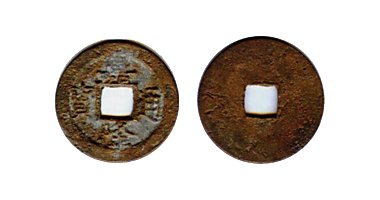
- Gia Long Thông Bảo, writing with wide strokes, made of red copper, clear and standard rims, diameter 23.5 and 24.5mm (Figure 17a,b).
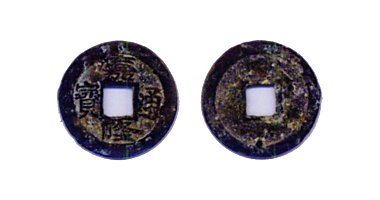
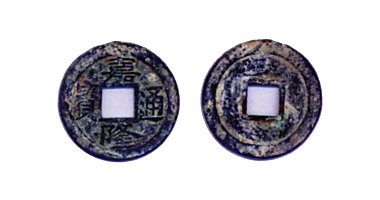
- Gia Long Thông Bảo, made of copper, well-cast, found in a Cảnh Hưng coin hoard, discovered in central Vietnam. Diameter: 22-22.7 mm; coin rim clearly defined; calligraphy of Thông and Bảo similar to the zinc Cảnh Thịnh [景盛通寶] coins. The character Bảo [寶] has the Bối [貝] radical written round shell style, while the square-headed Thong [通] has only a single stroke. The reverse has a clear rim, and a raised dot on the right (star point). These coins were cast at a mint that previously produced Tây Sơn coins; this type is rare (Figure 18a,b).
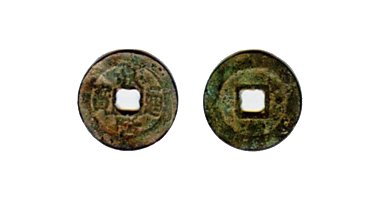
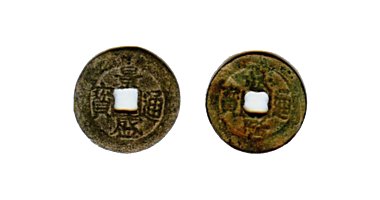
- Gia Long Thông Bảo with Thiệu Trị Thông Bảo [紹治通寶] reverse in the same orientation, cast of brass like the official series; calligraphy is identical to the official dies of both reigns, diameter 22.5 mm (Figure 19).
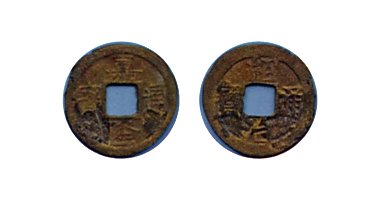
- Coins illegally cast by Chinese merchants during the Tự Đức period, made of impure copper; poor casting quality, hree-legged Bảo [寶] character; diameter 23.5 mm (Figure 20).
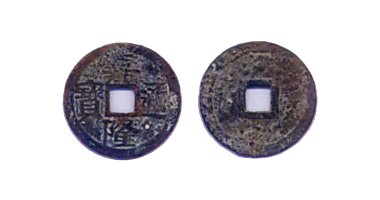
- Privately cast coins in lead (2 specimens) (Figure 21).
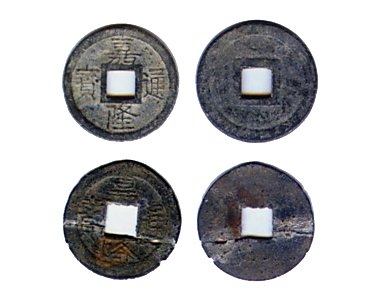
- Coins with two crescent rims on the reverse: besides the types listed above, during our collecting we also found a specimen of Gia Long Thông Bảo with two crescent rims positioned opposite each other above and below the coin hole. These specimens are typically found along the northern border with China and have a diameter of 23 mm (Figure 22).
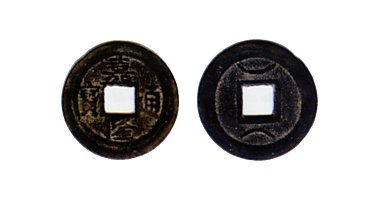
Besides the coin types we mentioned and currently have above, according to some Japanese numismatic reference books, there are also Gia Long Thông Bảo with Nguyễn Phong Thông Bảo [阮風通寶] reverse, Gia Long Thông Bảo with Thái Bình [太平] reverse, and "Gia Long Cự Bảo [嘉隆巨寶]. However, since we have not examined any specimens, we cannot make a judgment on these types.
4. Conclusion
Through our research and collection of Gia Long Thông Bảo [嘉隆通寶] coinage, we can offer several preliminary observations on this series. Gia Long Thông Bảo coins may have been cast from the first year of Gia Long's reign, 1802, rather than 1803 as recorded in the official history. The coins were cast in two stages with two distinct styles, with designs and materials completely different from each other, characterized by the casting molds and the calligraphy of the character Long [隆]. During the 1802-1813 stage, the coins are characterized by the Long character written with non-standard strokes, the coin molds having the appearance of Tây Sơn coins, and the Thong character primarily having a triangular-shaped head. In contrast, the 1813-1819 stage features coins with characteristics of the Thất Phân and Lục Phân dies: Long written in standard form with fine strokes, and Thông with a square initial stroke. Furthermore, based on the geographic distribution of specimens and the official history, Thất Phân coins were mainly cast at the Bắc Thành mint, while Lục Phân coins were mainly cast at mints in Huế and central Vietnam. Besides the official series, many privately cast coins also exist, and the existing specimens are quite diverse. However, many issues remain unclear, such as the appearance of crescent and star marks on Gia Long Thông Bảo coins. The coins with Thái Bình reverse, Nguyễn Phong Thông Bảo reverse, and Gia Long Cự Bảo have not yet been examined; therefore, we tentatively classify them as privately cast coins.
Resources:
1. Dr. R. Allan Barker (2004). The Historical Cash Coins of Vietnam. Singapore.
2. National Museum of Vietnamese History (2005). Tiền kim loại Việt Nam (Coins of Vietnam). Hanoi.
3. Anonymous. (1943). 東洋古銭図録 - 安南銭之部 (Catalog of Ancient Oriental Coins: Annam Section). Japan.
4. Ding Fubao [丁福保], and Ma Dingxiang [馬定祥] (1992). 歷代古錢圖譜 (Illustrated Catalog of Ancient Coins through the Ages). Shanghai Classic Publishing House, Shanghai.
5. Đỗ Văn Ninh (1992). Tiền cổ Việt Nam (Ancient Coins of Vietnam). NXB Khoa học Xã hội, Hanoi.
6. Hội đồng trị sự Nguyễn Phúc tộc (1995). Nguyễn Phúc tộc thế phả (Genealogy of the Nguyen Phuc Clan). NXB Thuận Hóa, Huế.
7. Nguyễn Anh Huy (2010). Lịch sử Tiền tệ Việt Nam - sơ truy và lược khảo (History of Vietnamese Currency: Preliminary Research). NXB Văn hóa Sài Gòn, TP. HCM.
8. Nguyen Dynasty Cabinet, (1993). Khâm định Đại Nam hội điển sự lệ (Imperially Commissioned Administrative Statutes of Đại Nam). NXB Thuận Hóa, Huế.
9. Tominaga Masayoshi [富永正三] (1994). 穴銭入門 - 手類銭稿 (Introduction to Cash Coins: A Study of Coin Types). Japan.
10. Nguyễn Dynasty National History Bureau (1821-1945). Đại Nam thực lục (Veritable Records of Đại Nam). Translated from Hán-Nôm by Nguyễn Ngọc Tĩnh, 2004. NXB Giáo dục, Đà Nẵng.
11. Nguyễn Dynasty National History Bureau (1821-1945). Minh Mạng chính yếu (Essentials of Minh Mạng's Reign). Translated from Hán-Nôm, 1994. NXB Thuận Hóa, Huế.
12. Nguyễn Dynasty National History Bureau (1821-1945). Quốc triều chính biên toát yếu (Summary of the National Dynasty's Official Chronicle). Translated from Hán-Nôm by the Vietnam History and Geography Research Group, 1972. Saigon.
13. Miura Gosen [三浦五扇] (1966). 安南泉譜 - 歴代銭部 (Annam Coin Catalog: History of Currency). Japan.
14 Trần Trọng Kim (1971). Việt Nam sử lược (A Brief History of Vietnam). Saigon.
[1] Đại Nam Thực Lục, 2004. NXB Giáo dục, Đà Nẵng. Vol. 1, p. 253.
[2]
Quốc Triều Chính Biên Toát Yếu, 1972. Sài Gòn. p. 17.
art-hanoi.com: although mentioned in the chronicles, no coins of this type were found.
[3] Đại Nam Thực Lục, 2004. NXB Giáo dục, Đà Nẵng. Vol. 1, p. 935.
[4] Đại Nam Thực Lục, 2004. NXB Giáo dục, Đà Nẵng. Vol. 1, p. 961.
[5] Quốc Triều Chính Biên Toát Yếu, 1972. Sài Gòn. p. 32.
[6] Đại Nam Thực Lục, 2004. NXB Giáo dục, Đà Nẵng. Vol. 1, p. 782.
[7] Quốc Triều Chính Biên Toát Yếu, 1972. Sài Gòn. p. 42.
[8] Quốc Triều Chính Biên Toát Yếu, 1972. Sài Gòn. p. 43.
[9] Đại Nam Thực Lục, 2004. NXB Giáo dục, Đà Nẵng. Vol. 1, pp. 849-850.
[10] Quốc Triều Chính Biên Toát Yếu, 1972. Sài Gòn. p. 48.
[11] Đại Nam Thực Lục, 2004. NXB Giáo dục, Đà Nẵng. Vol. 1, p. 961.
[12] Đại Nam Thực Lục, 2004. NXB Giáo dục, Đà Nẵng. Vol. 1, p. 539.
[13] Đại Nam Thực Lục, 2004. NXB Giáo dục, Đà Nẵng. Vol. 1, p. 561.
[14] Đại Nam Thực Lục, 2004. NXB Giáo dục, Đà Nẵng. Vol. 1, p. 854.
[15] Đại Nam Thực Lục, 2004. NXB Giáo dục, Đà Nẵng. Vol. 1, p. 967.
[16] Đại Nam Thực Lục, 2004. NXB Giáo dục, Đà Nẵng. Vol. 1, p. 877.
[17] Đại Nam Thực Lục, 2004. NXB Giáo dục, Đà Nẵng. Vol. 1, p. 936.
[18] Minh Mạng chính yếu, NXB Thuận Hóa, Vol. 1, p. 59.