XV. Chinese domination and war of independence. 1414-1428.
It has already been noticed that the Chinese invaded Annam in 1407, and, after seven years of resistance from the armed rebels and the Annamese who remained loyal to the last two kings of the TRAN Dynasty, they occupied the country, and it was formally annexed to China. But this domination was never consolidated, and did not last very long, on account of the coming to the front of the Annamese hero 黎利 LE-LOI.
To pay the numerous troops sent to Annam, the Chinese Commander-in-Chief LY-BAN ordered in 1419 the following cash to be cast.
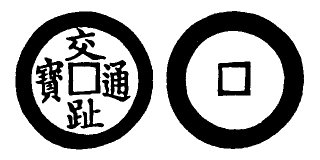
No. 39. (Barker: none)
Obverse: 交趾通寶 Giao-chi-thong-bao, or public currency of Giao-chi (Annam)
Reverse: plain. The metal employed for the casting of these cash was very bad and mixed with a great quantity of lead and sand. As they were not made in large quantities, specimens are very difficult to procure at the present day.
Towards the end of 1417, there appeared in the province of 爻安 Nghe-an the Annamese 黎利 LE-LOI, the chief of the party fighting for independence against the Chinese. His good fortune was by no means continuous, and be suffered several defeats; but his personal valour and his power over the Annamese armies kept up the movement and enabled him to inflict severe losses upon the Chinese army, and to force it to retire from the country.
In 1426 LE-LOI proclaimed a descendant of the TRAN Dynasty king of Annam under the name of 天慶 THIEN-KHANH, but his power was always eclipsed by that of LE-LOI, who in 1428, when Annam was freed from the invader, pro-claimed himself king, giving birth to the second 黎 Le Dynasty.
During LE-LOI'S rebellion several coins were cast for the payment of his followers. They are all of diminutive size, and the copper employed varies in colour according to the provinces wherein the coins were cast
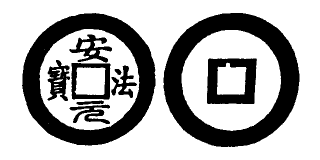
No. 40. (Barker: see 52.1-52.2)
Obverse: 安法元寶 An-phap-nguyen-bao. The character 元 Nguyen written in the seal form.
Plain Reverse.
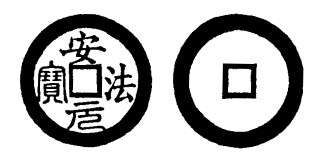
No. 41. (Barker: see 52.1-52.2)
Same as before, but having 元寶 Nguyen-bao written in seal characters
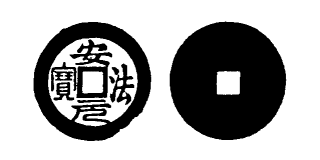
No. 42. (Barker: see 52.1-52.2)
Obverse: Same as before.
Reverse: without rim.
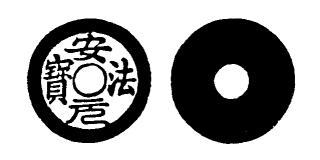
No. 43. (Barker: see 52.1-52.2)
Same as before, but having the hole in the middle round instead of square.
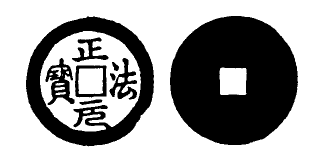
No. 44. (Barker: 125.1)
Obverse: 正法元寶 Chanh-phap-nguyen-bao The characters 元寶 Nguyen-bao, written in the seal style.
Reverse: without rim.
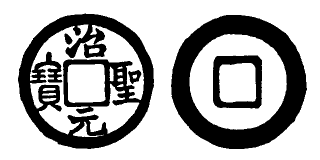
No. 45. (Barker: none)
Obverse: 治聖元寶 Tri-thanh-nguyen-bao. Only the character 寶 Bao is written in the seal form.
Reverse: plain.
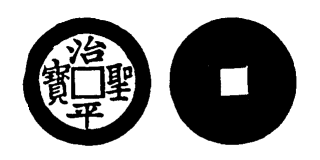
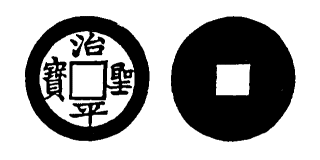
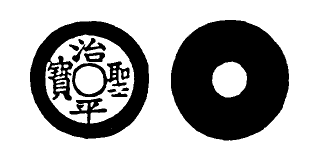
Nos. 46, 47 and 48. (Barker: none)
Obverse: same as before, but having 平寶 Binh-bao instead of 元寶 Nguyen-bao. The four characters written in plain form. No. 48 has the hole in the-middle round.
Reverse: without rim.
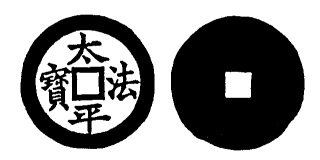
No. 49. (Barker: none)
Obverse: 太法平寶 Thai-phap-binh-bao.
Reverse: without rim.
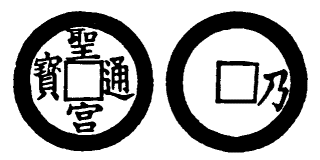
No. 50. (Barker: see 114.1)
Obverse: 聖宮通寶 Thanh-quan-thong-bao.
Reverse: The adversative particle 乃 noi, the meaning of which is uncertain. Coin made of tin and lead.