French Indochina 500 Piastres banknote designed by Vietnamese artists
Mai Ngọc Phát, Vietnam Numismatics #5 (10-2018), p.12-15
In September 1940, under a treaty signed between the French colonial authorities and the Japanese militarist government, Japanese troops entered Indochina. The government of the French State, led by Marshal Philippe Pétain under Nazi German control, ordered the Governor-General of Indochina, Decoux (who was also under Japanese control at the time), to print and issue new banknotes. During this period, Vietnamese artists took part in designing many banknotes, which were printed at the IDEO (Imprimerie d'Extrême-Orient) printing house in Hanoi. The banknotes were printed on lower-quality paper than before, in denominations of 1, 5, 20, 100, and 500 piastres.
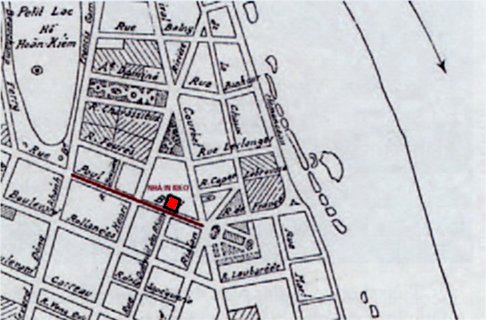
The IDEO printing house was established in 1907. Initially, it was only a one-story printing workshop on Paul Bert Street (now Tràng Tiền Street). In the 1920s, a six-story building was constructed at the front of the workshop, facing the street. At this point, the printing house became a fully equipped printing plant. The ground floor housed the machinery and paper storage areas, which extended to the rear of the building. The upper floors contained supporting departments, such as typesetting, proof correction, and administration. The main building of the IDEO printing house was an impressive example of modern architecture at the time. The building had a symmetrical design, with a six-story central block and two five-story blocks on both sides. The ground floor included the main hall and an entrance for vehicles. The remaining space extended to form a continuous area with the workshop at the rear of the building. Standing six stories high, the IDEO building was considered the tallest building in Hanoi during the French colonial period. It held this record until the 1990s, when the 11-story Hanoi Hotel opened.
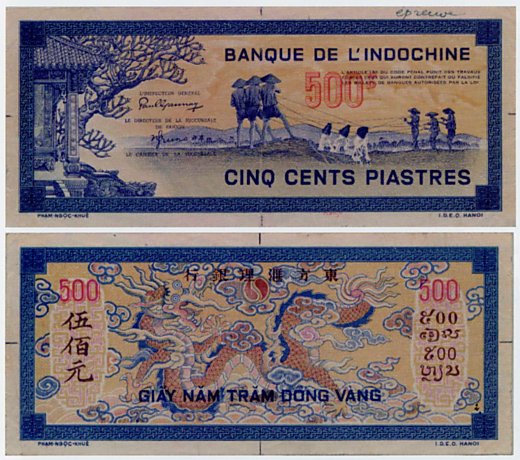
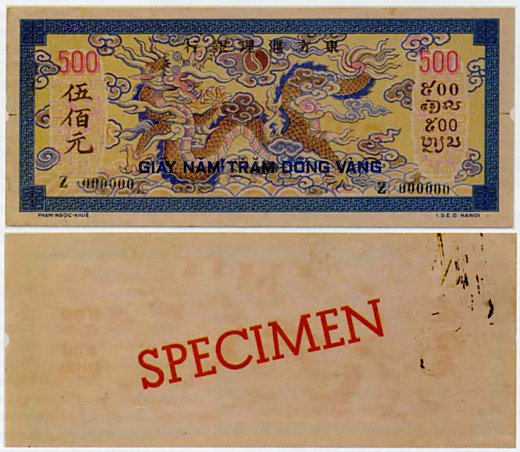
The 500-piastre banknote was first issued in 1944. The front shows Vietnamese farmers drawing water with a gầu sòng (a traditional water-lifting device), while the back features a dragon winding through the clouds. The main colors are red, yellow, and blue. The banknote measures 72x178 mm and was designed by artist Phạm Ngọc Khuê. He used the photograph "Drawing Water" to design the front of the banknote. The photograph was taken by Trương Trừng, a photographer from the ancient town of Hội An.
Photographer Trương Trừng was born in 1901 in Mông Lãnh village, Quế Sơn District, Quảng Nam Province, in a Confucian family. His father was the scholar Trương Trung Trực, who passed the regional bachelor's examination in Huế. Trương Trừng attended the Western-style school established by the French Protectorate government in Hội An. He was passionate about photography. With his knowledge of French, he studied photographic techniques through books and newspapers and became a major artistic photographer.
In 1940, the Governor-General of Indochina held a photography competition across Indochina, covering Vietnam, Cambodia, Laos, and the French colony of Cochinchina. Trương Trừng submitted a series of photographs to the competition. Suddenly, one day, the chief secretary official of Quảng Nam Province arrived at Trương Trừng's home with several attendants. He read out a decision sent from Hanoi by the Governor-General of Indochina, awarding first prize to the photograph "Drawing Water". Trương Trừng also signed a document granting the permission to use the photograph on Indochinese banknotes.
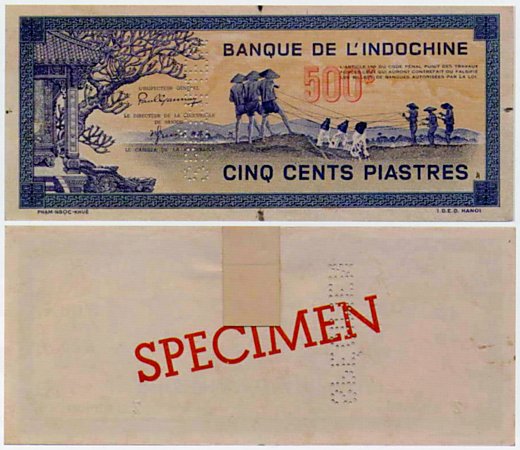
In 1941, the Bank of Indochina officially selected the photograph for the 500-piastre banknote. The banknote was printed using multi-color intaglio engraving at the IDEO Printing House in Hanoi. The engraving work was entrusted to Phạm Ngọc Khuê, a renowned engraver in Hanoi. During the engraving process, Phạm Ngọc Khuê consulted with the author multiple times to modify parts of the photograph's composition. The Z-shaped composition of the square photograph was modified to fit the rectangular banknote. The photograph was taken early in the morning in the rice fields of Cẩm Hà, on the outskirts of Hội An. The photograph was taken against the light. For the competition, the photograph was toned brown sepia.
After becoming involved with the Việt Minh, Trương Trừng was arrested by the French in 1947 and died in Hội An in 1948. Perhaps some families still have photographs taken at the Lệ Ánh photo studio, 78 Lê Lợi Street, Hội An. It was once the photo studio owned by Trương Trừng's family.
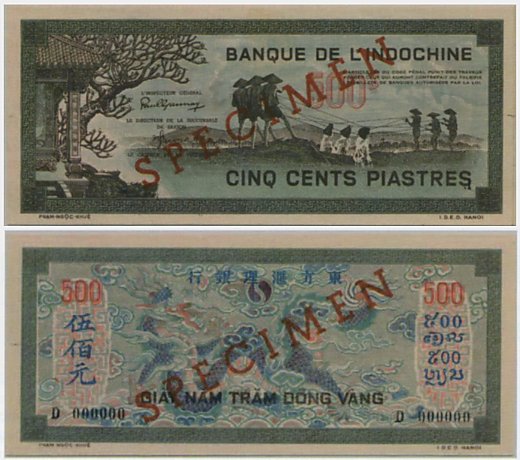
To serve Japanese interests in Indochina, the Bank of Indochina had to print more money, which increased inflation. On March 9, 1945, Japan staged a coup against France and ordered a second printing of the 500-piastre banknote to meet its needs. The size and design were the same as those of the 1944 banknote, but the colors were changed to red, dark green, and gray. The banknotes were printed on paper with a wavy watermark.
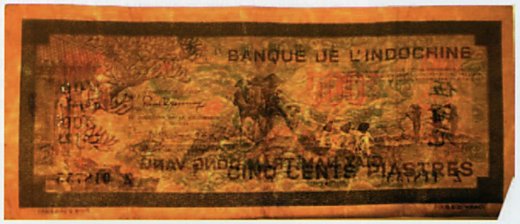
In September 1945, Allied forces entered Vietnam to disarm the Japanese troops. British forces were present in the South, while Chiang Kai-shek's troops were in the North. As the Việt Minh grew stronger, the French feared that if the branches of the Bank of Indochina fell into Việt Minh hands, they would use the piastres they seized to fight against France. A secret agreement was reached between the French and Chiang Kai-shek's forces: the Chinese troops would hold back the Việt Minh in exchange for 55 million piastres.
After weighing the pros and cons, the French High Commissioner in Saigon ordered the Bank of Indochina to transfer 45 million piastres to Chiang Kai-shek's troops in advance. Meanwhile, to drain the Việt Minh's existing funds, an official of the Bank of Indochina proposed recalling the 500-piastre banknotes issued by the Japanese. Although warned that this would cause disruption, the French High Commissioner in Saigon, lacking an understanding of the situation in the North, approved the decision on November 18, 1945, to withdraw the 500-piastre banknote. This angered the people, and even Chiang Kai-shek's troops did not support the decision. After several unsuccessful attempts to reach an agreement, Chiang Kai-shek’s troops backed a protest outside the Bank of Indochina headquarters, seeking to intimidate the French. On November 30, 1945, Chiang Kai-shek's troops demanded that the French pay an additional 15 million piastres and exchange their 500-piastre banknotes. The French refused, and Chiang Kai-shek's troops took two senior Bank of Indochina officials hostage. In the end, the French had to give in.
In response to the French decision to cancel the 500-piastre banknotes issued during the Japanese occupation, the Democratic Republic of Vietnam firmly refused to recognize the move, insisting that monetary affairs fell under its own sovereignty. On November 27, 1945, the Government issued a statement: "At 4 p.m. yesterday, November 16, 1945, merchants in Hanoi gathered at the bank to exchange 500-piastre banknotes. Although our people maintained perfect order, the French suddenly opened fire from inside the bank. The Government will take firm action in response to this brutal act by the French. Please remain calm."[1]
The 500-piastre banknote was designed entirely by Vietnamese, using Vietnamese patterns and images, and printed at the IDEO printing house in Hanoi. The banknote came into existence during a very special period in Vietnam’s history, in 1944-1945.
* Images of the banknotes courtesy of Bùi Mạnh Tuấn (Germany).
References:
- Nguyễn Kỳ Nam, 1971. Tiền tệ Việt Nam qua các triều đại. Đuốc Nhà Nam newspaper, Special Tân Hợi (1971) Lunar New Year issue, pp. 7, 10, 22, and 26.
- Mare Meuleau, 1990. Des pionniers en extrême-orient: Histoire de la Banque de l'Indochine 1875-1975.
[1] Dân Ý newspaper, Tuesday, November 27, 1945, front page.