Reward money of the Nguyễn Dynasty in the "Nguyễn Dynasty Treasures" collection of the National Museum of History
Part 3: Silver ingots and award coins of Thiệu Trị (1841-1847)
Nguyễn Đình Chiến, Trương Văn Thắng, Vietnam Numismatics #5 (10-2018), p.3-7
The reward coins in the Nguyễn Dynasty Treasures collection feature various inscriptions and are made of rare and precious materials. This collection was handed over by the Vietnamese Ministry of Finance to the Vietnam Museum of History on December 17, 1959. Subsequently, for security reasons, the museum packed and sealed the collection and deposited it with the State Bank of Vietnam. Since retrieving it back from the State Bank vault in 2007, the Vietnam Museum of History (now the Vietnam National Museum of History) has undertaken its preservation, inventory, and preliminary research. The Nguyễn Dynasty Treasures collection is an important part of Vietnam's national cultural heritage. The collection originated entirely from the treasury of the Huế Imperial Court, which was handed over to the revolutionary government after the August Revolution of 1945.
In Vietnam Numismatics #2, we introduced Part 1: Silver ingots from the reign of Emperor Gia Long. Issue #4 featured Part 2: Presentation money from the reign of Emperor Minh Mạng. Continuing the series of articles on Nguyễn Dynasty Treasures by Nguyễn Đình Chiến and Trương Văn Thắng, we present Part 3: Silver ingots and award coins from the Reign of Emperor Thiệu Trị. This study is limited to artifacts from the Nguyễn Dynasty Treasures collection of the National Museum of Vietnamese History.
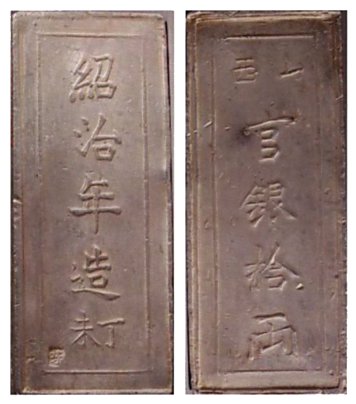
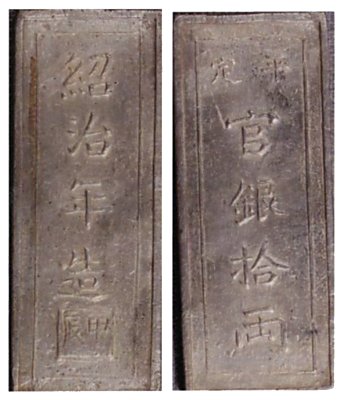
The production of rectangular silver ingots continued during the reign of Emperor Thiệu Trị. The front bears four characters Thiệu Trị Niên Tạo [紹治年造] and two smaller characters Đinh Mùi [丁未]. This ingot was made in the year Đinh Mùi of the Thiệu Trị reign (1847), catalog number LSb 35985 (Figure 1). Another type of silver ingot has characters Thiệu Trị Niên Tạo [紹治年造] and two smaller characters Giáp Thìn [甲辰] on the front. This ingot was made in the year Giáp Thìn (1844). The back features characters Quan Ngân Thập Lượng [官銀拾両] (official silver, ten taels). At the top there are characters Bình Định [平定], indicating that it was made in Bình Định province. Catalog number: LSb 35984 (Figure 2).
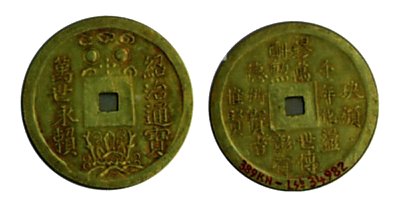
Round coins with square holes were also quite common during the reign of Emperor Thiệu Trị. They were made of various materials, including gold, silver, gold-plated silver, and copper. The obverse bears the title Thiệu Trị Thông Bảo [紹治通寶], read diagonally. The reverse bears an auspicious four- or eight-character phrase, such as Thiệu Trị Thông Bảo, Triệu Dân Lại Chi [紹治通寶兆民賴之] (The people benefit from Thiệu Trị Thông Bảo coins).
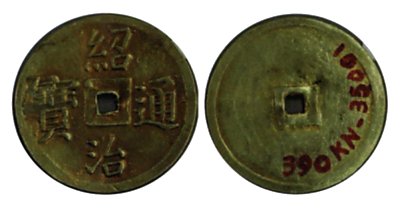
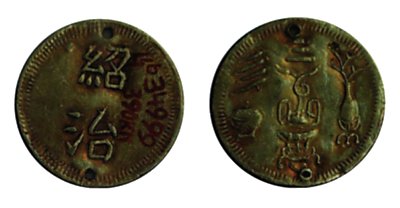
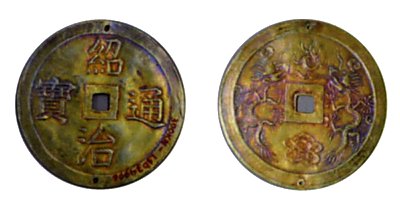
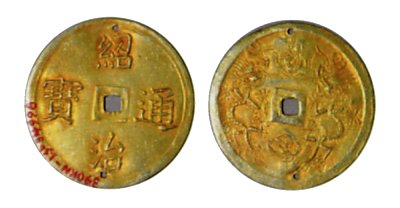
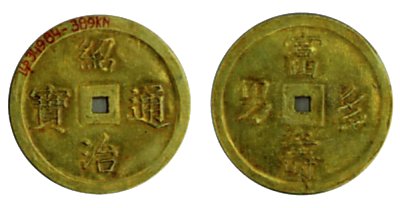
In addition, the reverse of the coins may be plain (Figure 3) or decorated with motifs such as two dragons facing the moon or sun, dragons among clouds, flowers, leaves, and plants. For example, the silver coin marked VN22-5 has a diameter of 4.5 cm. The front bears eight characters, Thiệu Trị Thông Bảo Triệu Dân Lại Chi [紹治通寶兆民賴之], and the reverse is decorated with dragons among clouds. Another example is the coin marked LSb.34999, made of gold-plated silver and measuring 2.3 cm in diameter. The front is inscribed with the characters Thiệu Trị [紹治], and the reverse features the characters Tam Đa [三多], a blessing for three things: good fortune, longevity, and many sons (Figure 4). The silver coin marked VN-8 is round, has no hole, and measures 2.4 cm in diameter. The front has characters, Thiệu Trị Thông Bảo [紹治通寶], read diagonally, with a sun surrounded by rays in the center. The reverse is decorated with flowing, intricate cloud patterns.
[1] {FOOTNOTE}