Leisure and entertainment in Saigon (1925)
Nguyễn Đức Việt, Vietnam Numismatics #4 (07-2018), p.55-59
Dear readers!
History is a long, continuous process, but historical records often have gaps for both objective and subjective reasons. These gaps motivate further historical research. Every piece of research, however small, is a brick that helps fill the gaps in historical records, even though we know they can never be complete...
For this reason, the Vietnam Numismatics editorial board has decided to create a new section, "Rediscovering the Past", as a place for researchers, both professional and amateur, to share their historical research and discoveries. Essentially, it can serve as a place to publish previously unpublished documents and collected artifacts on various topics, relating to cultural heritage from the past or things that have faded from memory over time...
However, perfection cannot be expected, so this section will certainly have some imperfections. The editorial board welcomes readers' critical comments as encouragement for our work and as a way to improve and clarify the articles in this section. We would also be very happy to receive articles from readers for publication in this section.
And why does this section appear in a numismatic magazine...? In fact, numismatics is also part of historical research. Who knows, an article in this section might be a missing piece in another author's numismatic study. We also have a modest hope of attracting readers who love history but do not yet collect coins. We hope to introduce them to the basics of coin collecting.
To inaugurate this section, we present a short excerpt titled Leisure and Entertainment in Saigon, taken from a handwritten notebook titled Nam Kỳ địa cảnh (Geography and Scenery of Cochinchina) by Paulus Nguyễn Văn Nghĩa. He began recording what he had seen and heard firsthand in Cochinchina around 1925... Original text following the author's notes, annotations by collector Nguyễn Đức Việt.
Our sincere thanks!
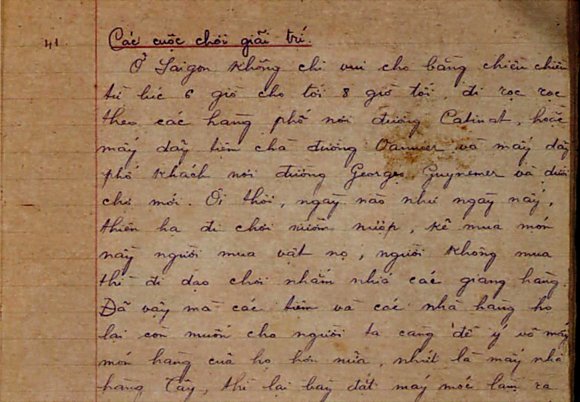
In Saigon, nothing is as enjoyable as strolling late in the afternoon, from 6 to 8 in the evening, along the rows of shops on Catinat Street[1], the tea shops on Vannier Street[2], the Chinese quarters on Georges Guynemer Street[3], and around the new market. Oh my, every day the same! Crowds of people come out for a stroll. Some buy this, others buy that, while those who buy nothing simply wander around, looking at the goods on display. On top of that, the shops and restaurants want people to pay even more attention to their goods. The Western restaurants in particular set up all kinds of mechanical devices to make mannequins that can look, smile, and move, or peacocks that dance, fountains that spray water in five colors, and so on, making everyone who comes by stop and stare in fascination. Shops lacking these mechanical novelties cleverly arrange their goods among bright blue and red electric lights, making the whole shop shine brightly and keeping visitors mesmerized.
Those who prefer tranquility and wish to avoid the crowds often head down to the riverbank, where temporary piers stand. They sit on the iron posts, looking out over the river and enjoying the breeze, watching the water and the moon, and observing people netting shrimp and fishing. This, too, is a great pleasure.
During the day, if one wants to go somewhere farther away, one can hire a car and drive around Bà Chiểu. The car travels out of the city and straight into the countryside, where one can enjoy some fresh air and cool breezes, refreshing oneself and easing the fatigue from a full day of work.
Those who cannot afford to hire a car for a long trip gather in groups of three or five and walk to Ông Thượng Garden[4] (Parc Maurice Long), where they find some green benches to sit and chat. That, too, is quite enjoyable. This garden is behind the Governor-General's Palace. The trees are large, with spreading branches that shade the entire garden. The ornamental flower beds are exceptionally beautiful, carefully arranged in straight rows. The garden also has many clean paths that wind back and forth, making it a popular place for visitors to stroll.
Even so, this garden is not as beautiful as the the Botanical and Zoological Gardens[5] near the Thị Nghè River (Jardin botanique). This botanical garden was established in 1864, over 60 years ago. It has all kinds of trees and plants, rare and curious local flowers and herbs, as well as exotic species from foreign lands, many never seen before. Each has a label with its name in three languages: French, Latin, and Vietnamese. Besides the plants, there are also animals, each kept in its own cage or enclosure. There are wild animals such as elephants, tigers, leopards, bears, wild boars, apes, and deer, reptiles such as snakes, crocodiles, turtles, lizards, and pythons, and birds such as peacocks, pigeons, wild fowl, pelicans, storks, and wild ducks, too numerous to count. The garden also has a lotus pond, with a pavilion built in the middle. Lotus flowers bloom on the water, while birds flutter and chatter among the branches above. It is truly a delightful place for those who appreciate beautiful scenery. After walking around the garden, those who get tired can stop at one of the stalls selling liquor and refreshments for a drink and a rest. Then they can find a green bench under the shade of the trees, sit down, and enjoy the view. What could be more pleasant than this?
At night, when the dew falls and the air cools, people can no longer stroll outdoors, so they can go to one of the theaters to see a show. Those who understand French can go to the French theater. Saigon has a municipal theater built to host performing troupes visiting from France. It is open for six months each year and closed for the other six. It is a magnificent building at the junction of Catinat and Bonard Streets. It was built at a cost of three million piastres and opened in 1900. It is spacious enough to accommodate 700 spectators without feeling crowded.
Nevertheless, many people complain that the French theater is expensive, so they go to the movies instead. Some go to Eden Cinéma, others to Casino, while Modern Cinéma seems to attract fewer viewers because it is not kept very clean.
Those who do not like going to the movies because they cannot understand French or because the flickering images give them headaches and dizziness can go to a traditional theater instead. This is a form of Vietnamese theater that our people greatly enjoy. These theaters are usually located around Chợ Đũi[6], Cầu Ông Lãnh, and Đất Hộ, areas where few French people live, because the French dislike living near these theaters, where loud nightly drumming disturbs their sleep.
Young people, however, prefer cải lương (reformed opera), because these troupes often perform romantic dramas about young love that easily captivate young people. However, these troupes do not stay in Saigon permanently. They come to perform from time to time, usually for a few weeks, before moving on to another province.
The same is true of circus troupes and magicians: whenever they come to perform in Saigon, crowds flock to see them, and tickets sell out faster than they can be issued.
Now let us turn to sports, which are beneficial to health, enhancing strength and vigor while offering great entertainment to spectators. With the government's support, sporting events in Saigon are becoming increasingly popular.
Every year, when the dry season arrives, there are usually about twenty horse races at the racetrack on Kerdum Street. The races are held every Sunday afternoon, and people bet large sums of money on the results.
There is also a motorcycle racetrack nearby, where races are held from time to time and attract many spectators. Recently, a newspaper organized long-distance motorcycle races, each covering 30 to over 100 kilometers. These races were warmly welcomed by both competitors and fans.
Football clubs are increasing in number every year. There are French clubs, Vietnamese clubs, and probably several dozen clubs in Saigon alone. The city has only a few large football fields where these clubs can compete. Of these, the Cercle Sportif[7] field in Ông Thượng Garden is the best, with a large playing area and a tribune for officials to watch the matches. Matches are held every Sunday afternoon. During the dry season, they play soccer, and during the rainy season, rugby. In the past, matches were free to watch, so large crowds came to see them. Now, although there are many fields and each spectator must pay ten cents to enter, attendance has hardly decreased at all. This shows just how passionate the people of Saigon are about football.
Recently, a boxing arena called Charles Boxing was set up right in front of the City Hall[8], where boxers could test their skills. Admission was very expensive, with even the cheapest tickets costing one piastre per person, yet large crowds still come to watch.
Ông Thượng Garden also has tennis courts, where French men and women regularly play, though few people seem interested.
The French have various other places for recreation, such as the Camp des lettrés (Jeu de boules) behind Notre-Dame Cathedral and the music hall of the Société Philharmonique near Bờ-rô Garden (Parc Maurice Long), where they often gather to eat, drink, and enjoy themselves.
At night, restaurants have music to entertain eating people. Sometimes they also hold dances, which the French greatly enjoy.
Those who prefer a refined atmosphere go down to the wine shop below the flagpole at Thủ Ngữ[9] (Pointe des Blagueurs), where they sit drinking and enjoying the breeze, feeling thoroughly content.
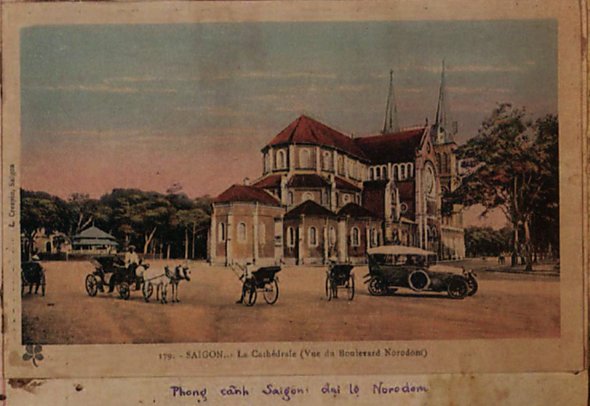
(attached inside the notebook with the author's commentary)
As for the Vietnamese, they have different ways of enjoying themselves. Those with money go to restaurants to eat Western food, drink spirits, and listen to traditional music. Those with less money go to eateries for Cantonese food and rose-flavored liquor, and are just as happy with life. If everyone stopped at that, it would be fine, even good. However, many seek excessive pleasure, bringing harm upon themselves. They eat and drink too much, get dead drunk, and then go to opium shops to lie back, cross-legged, and smoke away. The two harmful habits go hand in hand.
Some, once they have money, grow greedy and take to gambling all over the place. Some lose, some fall short. Creditors demand payment, wives and children complain, but they ignore it and keep gambling in secret. Only when the guards raid the den and lock them away do they repent.
Some people of good character avoid gambling for fear of shame of debt. Instead, they turn to other things like chasing women from one to another, wandering around brothel quarters, and helping the Madame's business grow more and more prosperous.
At night, just go around the Cầu Ông Lãnh[10] and Chợ Đũi areas and see how rudely and shamelessly the prostitutes treat their customers. Why, then, do respectable people still pursue them? They waste money and energy, risk diseases, and invite public disgrace.
These four habits are all costly and wasteful, commonly known as the four evils. Many people have lost their families and homes because of them. We should keep well away from these pursuits, lest we fall into them and find it impossible to quit.
Finally, I would like to mention one more form of entertainment, the most beneficial of all. I believe everyone knows it well, and it can be enjoyed by people in Saigon or the six provinces, French or Vietnamese, young or old: reading newspapers.
Reading newspapers broadens the mind, lets us hear wise and foolish words, and informs us of the latest events around the world. Even while staying in one place, our minds can travel across all five continents. Newspapers not only assist individuals in business, public administration, industry, and agriculture, but also briefly relieve the worries of those who are troubled and provide entertainment for those who have nothing to do, helping them pass the time.
For this reason, more and more newspaper publishers are being established in Saigon, especially French-language newspapers, such as L'Opinion, Courrier Saigonnais, Réveil Saigonnais, L'Impartial, and so on. Among these newspapers, two cover sports: Saigon Sportif and L'Echo des Sports, while Tourisme covers travel.
There are also quite a few Vietnamese-language newspapers. Three are published daily: Lục tỉnh tân văn[11], Công luận báo, and Trung lập báo. These are the newspapers most favored by the Vietnamese.
There is another newspaper, Nam Kỳ địa phận, established by the priests specifically for Catholics. It is published only once a week.
I hope the number of Vietnamese-language newspapers will continue to grow. This would mean that our people are reading newspapers more frequently. The more they read, the more their minds will expand, helping them distinguish right from wrong, avoid unreasonable extravagance, and care about the future of society and the nation. Only then will they become useful members of the community. Thus, the various forms of entertainment in Saigon have been explained clearly enough, requiring no further elaboration. All that remains is for us to use our judgment and choose those worthy of our standing.
[1] Catinat Street was named after the 17th-century Marshal of France Nicholas de Catinat. It is now Đồng Khởi Street.
[2] Vannier Street was named after Philippe Vannier (Vietnamese name Nguyễn Văn Chấn, 1762-1842), a French officer and adventurer who helped Nguyễn Ánh. It is now part of Ngô Đức Kế Street, between Hồ Tùng Mậu and Nguyễn Huệ Streets.
[3] Georges Guynemer Street was named after Georges Guynemer, a French flying ace who shot down 54 enemy aircraft during World War I. It is now Hồ Tùng Mậu Street.
[4] Today it is Tao Đàn Cultural Park.
[5] It is now the Saigon Zoo and Botanical Gardens (Thảo Cầm Viên).
[6] According to journalist Trần Nhật Vy in Từ Bến Nghé tới Sài Gòn (From Bến Nghé to Saigon), Chợ Đũi was in fact Chợ Điều Khiển, a market dating back to the 18th century. At that time, Chợ Đũi covered a large area extending from the Võ Văn Tần and Cách Mạng Tháng Tám area, around Huyện Sỹ Church (also known as Chợ Đũi Church, serving the Chợ Đũi parish), to the Phạm Ngũ Lão area. The words "Chợ Đũi" were clearly inscribed on the wall surrounding the railway station. Over time, the area became smaller in people's memories and through official definitions. Today, when people refer to Chợ Đũi, they think only of the area around the corner of Võ Văn Tần and Cách Mạng Tháng Tám Streets.
[7] The Saigon Sports Club, now the Labor Culture Palace (Cung Văn hóa Lao động).
[8] Designed by architect Fernand Gardès, the building was constructed between 1898 and 1909, modeled on the bell towers of northern France. During the French colonial period, it was known as the Hôtel de ville, or Dinh Xã Tây in Vietnamese. Today, it houses the Ho Chi Minh City People's Committee.
[9] The Thủ Ngữ flagpole was erected by the French in 1865. Made of steel, it stood about 40 meters tall. The French originally called it Mât des Signaux (Signal Mast). It was the first structure used to monitor naval traffic and display flags advising incoming vessels whether to enter port or wait.
[10] Cầu Ông Lãnh: The bridge was built by Military Commander Nguyễn Ngọc Thăng (Commander Thăng), who was stationed at the Cây Mai - Thủ Thiêm post. The original bridge was made of wood. In 1929, the French replaced it with a 120-meter concrete structure. In 1874, a fresh fruit market was built in this area and named Chợ Cầu Ông Lãnh (located on present-day Nguyễn Thái Học Street, District 1, Ho Chi Minh City, near the riverbank along Võ Văn Kiệt Street). In 1885, scholar Trương Vĩnh Ký wrote that the wooden bridge was erected by a local commander, undoubtedly Commander Thăng himself.
[11] Lục tỉnh tân văn [六省新聞] (News of the Six Provinces) was a Vietnamese-language newspaper published in Saigon. Its first issue appeared on January 15, 1907. It was one of the first non-Catholic newspapers written in Quốc ngữ (Latin-based alphabet), with its title printed in both Quốc ngữ and Chinese characters. Legally, the newspaper belonged to François-Henri Schneider, since only French citizens were permitted to publish newspapers, but it later came under the ownership of Gilbert Trần Chánh Chiếu.