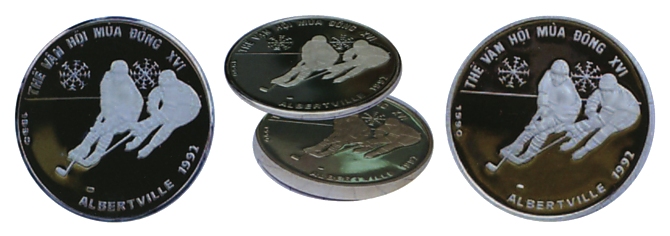
Piedfort coins
Nguyễn Hoàng Hải, Vietnam Numismatics #4 (07-2018), p.54
Different striking methods produce different types of coinage. In this article, I share information about Piedfort coins.
Piedfort coins originated in France around the 12th century and were later produced in England as well. It is believed that Piedfort coins were pattern coins used for design approval at the mint, so they were usually produced in small quantities.
Piedfort (Piédfort) is a French compound word derived from the words Pied (foot) and Fort (strong, heavy). The literal meaning of Piedfort is "heavy foot", and it is commonly understood to mean heavy weight. In numismatics and minting, the term Piedfort refers to coins that are thicker, heavier, and more beautiful and sharply detailed than circulating coins.
In the past, owning and collecting coins was a hobby that demonstrated the power and wealth of rulers. Because of their rarity, Piedfort coins became favored gifts among the nobility and prestigious diplomatic gifts.
Later, as demand for Piedfort coins among collectors increased, some countries' mints began producing them in larger quantities for commercial sale, as we see today.
To produce a Piedfort coin, mints use a planchet much thicker than standard and apply two to three times the normal striking pressure with a higher strike count (whereas standard circulating coins are struck twice, Piedfort coins are struck five to seven times). After that, each coin is polished, resulting in a piece that fully reveals the fine and intricate details of the design, with smooth, glossy surfaces and refined shapes and lines.
While France continued producing Piedfort coins, England stopped producing them in the 16th century, with the last production taking place in 1588.
Later, in the 1890s, the Monnaie de Paris began producing modern-style Piedfort coins more frequently and in larger quantities to meet collectors' demand.
It was not until the 1980s that the British Royal Mint resumed issuing British Piedfort coins for commercial sale to collectors. Later, the mint continued producing this type of commemorative coin for special occasions and major events.
Today, most mints around the world have commercialized the production of coins for commemorative and collecting purposes, developing various striking and finishing techniques. They also produce commemorative coins that are issued only as Piedfort, with no circulating versions. Distinctive characteristics of Piedfort coins include:
- Greater thickness than circulating coins;
- Weight typically double or triple that of circulating coins;
- The same diameter and design as circulating coins;
- Very limited mintage compared with circulating coins.
Vietnam also issued a silver commemorative coin in both Piedfort and regular versions: the 16th Winter Olympic Games - Albertville 1992 commemorative coin, which we would like to present to readers.