Credit notes of Trung Bộ (1947-1954)
Part 2: 20/50 Đồng
Mai Ngọc Phát, Vietnam Numismatics #4 (07-2018), p.44-53
In Vietnam Numismatics, Volume 2, January 2018, we introduced the first part of this series, covering the denominations of 1, 5, and 10 đồng. In this part, we present 20 and 50 đồng. We will introduce the other denominations in the following issues and invite our readers to stay tuned.
1. 20 đồng credit notes:
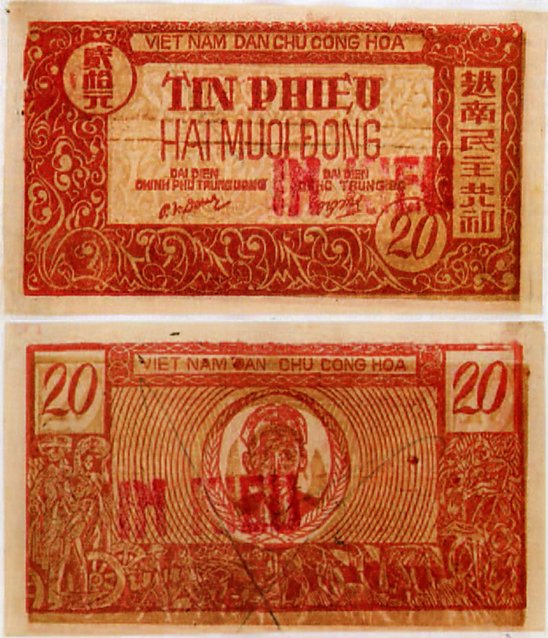
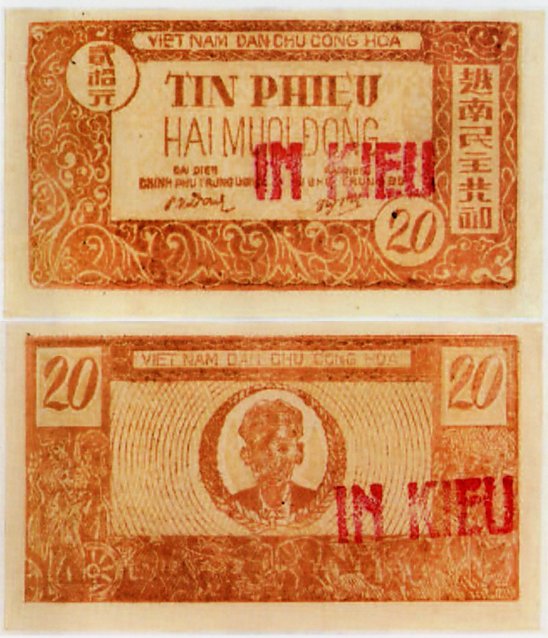
- Front: Text and numerals indicating 20 dong, framed by an ornamental decorative border. In Vietnamese and Chinese characters.
- Back: A portrait of President Hồ Chí Minh among willow branches in the center of the note, with a decorative border depicting scenes of labor, production, and fighting by workers, farmers, and soldiers.
- Dimensions: 122x65 mm, excluding the margins.
1.1. 20 đồng credit notes issued in 1947:
Printed on white American paper. Both sides printed in reddish-brown on a grayish-yellow background. Due to difficulties in obtaining printing ink, colors vary between print runs.
1.2. 20 đồng credit notes, color changed in June 1950:
The front is brown, and the back is green. The notes were printed on two types of paper: white American paper and straw paper produced in Vietnam, with a watermark of a star inside a circle. Due to difficulties in obtaining printing ink, colors vary between print runs.
2. 50 đồng credit notes:
2.1. 50 đồng credit notes - Type I: Issued from 1947 to 1951.
- Front: Portrait of President Hồ Chí Minh inside a circle. Text "Credit note fifty dong" in Vietnamese and Chinese characters. Decorative design depicting scenes of labor, production, and fighting by workers, farmers, and soldiers.
- Back: A boat with a sail bearing the red flag with a yellow star, sailing through the waves. Collectors commonly call this note "Sailing Boat".
- Dimensions: 130x70 mm.
This type was printed many times, in many batches and at many locations. Colors vary by print run and location. Printed on white American paper and watermarked straw paper produced in Vietnam. Due to printing in many places and in many batches, both specimen notes and circulating notes differ in small details: