Scientists on money: Isaac Newton
Lê Thị Hoài Thu, Vietnam Numismatics #4 (07-2018), p.40-43
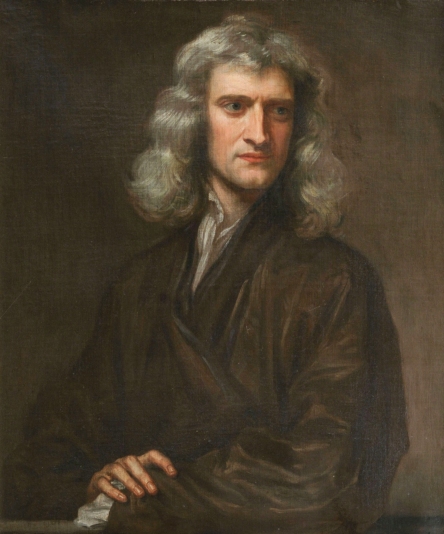
Isaac Newton (25 December 1642 - 20 March 1727) was an English physicist, mathematician, astronomer, philosopher, theologian, and alchemist. He is widely regarded as the greatest and most influential scientist in history. His work, Naturalis Principia Mathematica (Mathematical Principles of Natural Philosophy), published in 1687, described universal gravitation and the three laws of motion, which are considered the foundation of classical mechanics and dominated the concepts of physics and science for the next three centuries. He stated that the motion of objects on Earth and of celestial bodies was governed by the same natural laws. By demonstrating the unity between Kepler's laws of planetary motion and his theory of universal gravitation, he completely removed doubts about the heliocentric theory and advanced the Scientific Revolution. In mechanics, Newton proposed the principle of conservation of momentum (the law of inertia). In optics, he discovered the dispersion of light, explaining how white light passing through a prism is separated into many colors. In mathematics, Newton, together with Gottfried Leibniz, developed differential and integral calculus. He also introduced the generalized binomial theorem.
Recognition
-
Many laws of physics are named after Isaac Newton:
- Newton's laws of mechanics comprise three fundamental principles, also known as Newton's laws of motion:
- Newton's First Law: An object remains at rest or continues to move in a straight line at constant speed unless acted upon by a net external force.
- Newton's Second Law: The acceleration of an object is in the same direction as the force acting on it. Its magnitude is directly proportional to the force applied and inversely proportional to the object's mass.
- Newton's Third Law: For every action force exerted by object A on object B, object B exerts an equal force back on object A. These two forces are equal in magnitude but opposite in direction.
- Law of Universal Gravitation: The gravitational force between two bodies is directly proportional to the product of their masses and inversely proportional to the square of the distance between them. In this formula, the sizes of the objects are considered to be very small compared with the distance between them.
- Newton's Law of Viscosity: Applies to viscous fluids obeying Newton's internal friction law, where shear stress and velocity gradient share a linear relationship. The proportionality constant between them is called the viscosity. - The unit of force is named after Newton: One Newton is the force that gives an object with a mass of one kilogram an acceleration of one meter per second squared.
- Statues of Newton have been erected in many places, including universities and museums throughout Great Britain.
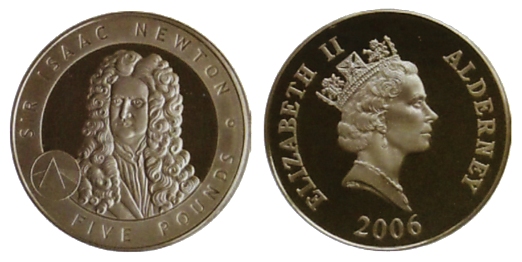
- Coin: 5 Pounds, Alderney, issued in 2006.
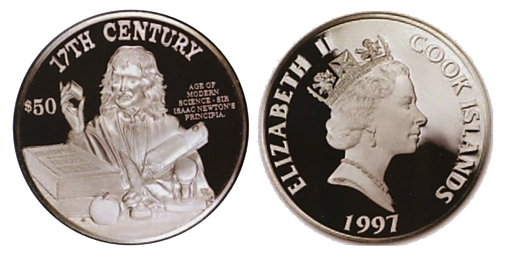
- Coin: 50 Dollars, Cook Islands, issued in 1997.
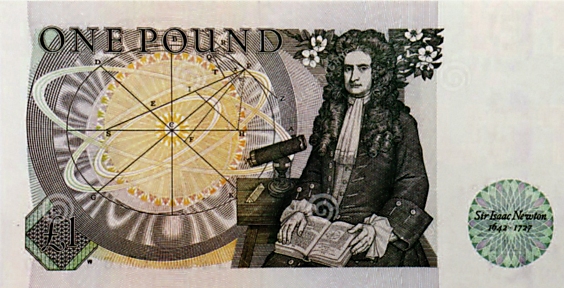
- From 1978 to 1988, Newton's portrait appeared on the £1 banknote, designed by Harry Ecclestone and issued by the Bank of England. Newton is depicted on the reverse holding a book, with a telescope, a prism, and a map of the Solar System.
Life and Career
Isaac Newton was born in Woolsthorpe, Lincolnshire, England. Newton spent his early school years in a state of gloom, away from home, his education frequently disrupted by family misfortunes. Fortunately, in 1661, after finishing school, he continued his studies at Trinity College, Cambridge, on a scholarship that required him to serve students who paid tuition. Newton's initial goal at Cambridge University was to obtain a law degree with a curriculum heavily focused on Aristotle's philosophy, but he was soon attracted to Descartes' mathematics, Galileo's astronomy, and Kepler's optics. However, most of the advanced mathematical knowledge available at that time was acquired by Newton through additional reading, especially after 1663. These included Euclid's Elements, William Oughtred's Clavis Mathematica, Descartes' La Géométrie, Frans van Schooten's Geometria a Renato Des Cartes, Wallis' Algebra, and the works of François Viète.
Immediately after receiving his degree in 1665, he had to return home for two years because the university was closed due to the spread of the plague. These two years witnessed a series of important developments by Newton, although they were not published immediately, including his completely new method of differential and integral calculus, which unified and simplified many different calculation methods of that time to solve seemingly unrelated problems such as finding areas, tangents, curve lengths, and extrema of functions. His mathematical talent was quickly recognized by the head of Cambridge when the university reopened. He became a lecturer at the university in 1670, after completing his master's degree, and began researching and teaching optics. He first demonstrated that white light was actually composed of many colors, and introduced an improvement to the telescope by using mirrors instead of lenses to reduce image blurring caused by the dispersion of light through glass. It was during this period that his observation of a falling apple inspired him to develop his comprehensive Theory of Universal Gravitation. This work definitively removed any remaining skepticism surrounding heliocentrism.
The people who influenced the publication of Newton's works were Robert Hooke and Edmond Halley. After a debate with Hooke about the orbit of a particle falling from space to Earth, Newton became interested in applying his law of universal gravitation and mechanics to calculate Johannes Kepler's orbital paths. These results impressed Halley, and he persuaded Newton to publish them. From August 1684 to the spring of 1688, Newton completed the work that later became one of the most important foundational works in physics of all time, Philosophiae Naturalis Principia Mathematica (Mathematical Principles of Natural Philosophy).
In Book 1 of this work, Newton introduced the definitions and the three laws of motion, later commonly known as Newton's laws. Book II presents Newton's new scientific methodologies, replacing Descartes' philosophy. The final book contains the applications of his dynamical theory, including explanations of tides and the theory of the Moon's motion. To verify his theory of universal gravitation, Newton asked the astronomer John Flamsteed to check whether Saturn slowed down each time it passed close to Jupiter. Flamsteed was astonished to discover that this effect was real and that the measurements matched Newton's calculations. Newton's equations were further supported by observations of the Earth's flattened shape at the poles, instead of being bulging at the poles as predicted by the Cartesian school. Newton's equations also approximately described the motion of the Moon and accurately predicted the return time of Halley's Comet. In his calculations of the shape of an object that creates the least resistance when placed in the flow of a liquid or gas, Newton also formulated and solved the world's first problem in the calculus of variations.
Newton created a very general scientific method. He presented his methodology as four rules of scientific reasoning. These rules were stated in Philosophiae Naturalis Principia Mathematica as follows:
1. Natural phenomena must be explained by a minimal system of true, sufficient, and rigorous laws.
2. Similar natural phenomena must have the same causes.
3. The properties of matter are the same throughout the universe.
4. A conclusion drawn from observations of nature is considered true only until another experiment contradicts it.
These four concise and general rules for scientific research were truly a revolution in thinking at that time. By applying these rules, Newton formulated general laws of nature and explained almost all scientific problems of his time. Newton went beyond simply proposing rules for reasoning; he described how to apply them in solving a specific problem. The analytical method he created surpassed the more philosophical methods of Aristotle and Thomas Aquinas, which were based more on philosophy than on scientific accuracy. Newton perfected Galileo Galilei's experimental method, creating a synthesis method that is still used in science today.
Newton developed the theories of classical mechanics and optics, and created calculus many years before Gottfried Leibniz. However, he did not publish his work on calculus before Leibniz, which led to a dispute between England and continental Europe that lasted for many decades. Newton discovered the generalized binomial theorem for fractional powers, but he allowed John Wallis to publish it. Newton found a formula for the speed of sound, but it did not agree with his experimental results. The reason for this discrepancy was thermal expansion, a concept that was not known at that time.
Newton was elected to the Royal Society of England in 1672 and began to face objections from Huygens and Hooke regarding his particle theory of light. His optics and color theory faced intense criticism, leading to a severe nervous breakdown in 1678. In 1679, Newton and Hooke engaged in a new debate about the orbits of celestial bodies in a gravitational field. According to the book Opticks, which Newton hesitated to publish until after Hooke's death, Newton observed that white light was separated into a spectrum of many colors when passing through a prism (the glass of the prism has a refractive index that varies depending on the color). Newton's particle view of light originated from the experiments he conducted with prisms at Cambridge. He found that the images after passing through the prism were oval rather than circular as predicted by the theories of light at that time. He also observed for the first time the interference rings now known as Newton's rings. He concluded that light traveled faster in glass, a conclusion contrary to Christiaan Huygens' wave theory of light.
In Query 31 of Opticks, Newton outlined his original chemical theory. This was also a particle theory, in which "elements" were considered different arrangements of small, hard atoms like billiard balls. He explained chemical reactions based on the affinities between the components involved in the reactions. In his later years, he carried out many inorganic chemistry experiments but did not obtain specific results.
In 1685, English politics changed under the reign of King James II, and Cambridge University had to comply with unreasonable laws, such as being forced to grant a degree to a cleric without examination. Newton strongly opposed these interventions, and after King William III came to the throne, Newton was elected to the English Parliament due to his political efforts. In 1693, after many years of unsuccessful chemical experiments and a serious decline in health, Newton abandoned science and left Cambridge to take a position in the government in London. In 1703, Newton was elected president of the Royal Society of England and held this position for the rest of his life. He was knighted by the Queen in 1705. He died on March 31, 1727, in London. After Newton's death, a large amount of mercury was found in his body, possibly due to exposure during his experiments. This could well explain Newton's eccentric behavior.
Newton alone contributed more to science than any other figure in human history. He surpassed all the great scientific minds of the ancient world, creating a description of the universe that was self-consistent, beautiful, and more intuitive than any previous theory. Newton specifically introduced the principles of the scientific method that could be generally applied to all fields of science. While earlier scholars such as Galileo and John Philoponus employed empirical techniques, Newton was the first to systematically formalize the scientific methodology. His method balanced theory and experiment, mathematics and mechanics. He mathematized all natural sciences, simplifying them into rigorous, general, and logical steps, creating the beginning of the Age of Reason. The principles introduced by Newton therefore remain valid to this day. After his passing, his methods led to scientific achievements far beyond anything he could have imagined during his lifetime. These achievements formed the foundation of the technology we enjoy today. It is not an exaggeration to say that Newton was the most important figure contributing to the development of modern science.