Bimetallic coins
Lê Khánh Ngọc Anh, Vietnam Numismatics #4 (07-2018), p.36-39
Bimetallic coins are coins made up of at least two distinct pieces of metal or alloy. Coins made from a uniform piece of an alloy containing two or more metallic elements are not considered bimetallic. Historically, bimetallic coins were introduced primarily to reduce the amount of precious metal in each coin. Additionally, they were intended to serve other purposes in coin issuance, such as:
- Changing the value of the coin (increasing or decreasing) without changing the size, while keeping it in circulation at its face value.
- Issuing high-denomination coins without making them too large for circulation.
- Issuing high-denomination commemorative coins.
- Preventing counterfeiting.
- Preventing coins from being melted down for metal: unlike regular coins, bimetallic coins cannot be easily melted and separated. Moreover, different metals melt at different temperatures, and if they mix when the entire coin is melted, separating them becomes very difficult. This happened during times of high inflation, when the price of the metal rose far above the face value of the coin. Under such conditions, many people tend to melt down coins to recover the metal.
Around the world, bimetallic coins have been produced in the following types: wedges, plugs, cladding, coating or plating, and outer rings.
1. Wedge-type bimetallic coins
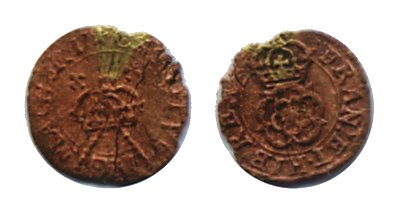
During the reign of King Charles I of England (1625-1649), a series of Royal Farthing Tokens were issued, including a special piece known as the Rose Farthing. This piece has a rose on the reverse, instead of the harp that appeared on all contemporary royal coins, which gave it its name. It was considered a revolution in metal and coin-making technology.
These pieces were made of pure copper with a brass wedge inserted into the planchet before it was struck into a coin. These coins were issued from 1636 to 1644 (when production was temporarily halted by the Civil War) and were virtually impossible to counterfeit. Therefore, this can be considered a bimetallic copper coin with a brass wedge.
2. Plug-type bimetallic coins
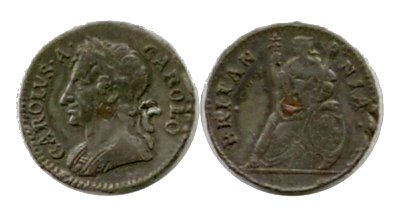
In the early years of King Charles II's reign (1660-1685) in Britain, a major monetary reform was instituted, introducing copper halfpennies and farthings of standard weight.
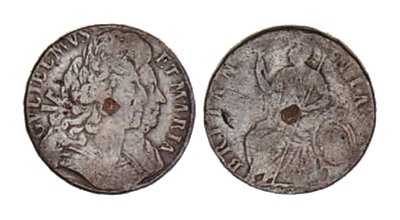
However, during this period, the price of tin dropped, causing tin mines in Cornwall to fall into crisis, resulting in major financial losses for the king. To support the tin industry (and increase the king's revenue), the British government decided to mint all halfpennies and farthings in tin. To prevent counterfeiting, as tin was relatively easy to cast, a square piece of copper was inserted into the center of the coin's planchet before striking. Therefore, these can be considered bimetallic coins made of tin and copper. They were issued from 1684 to 1692 during the reigns of King Charles II, King James II, and King William and Mary.
In 1792, there were many efforts in the United States to establish the United States Mint. On April 2, 1792, the U.S. Congress passed the Mint Act and the Coinage Act, establishing the United States Mint. The above acts also specified which denominations would be minted and gave officials of the United States Mint the authority to decide on the format and design of the coins.
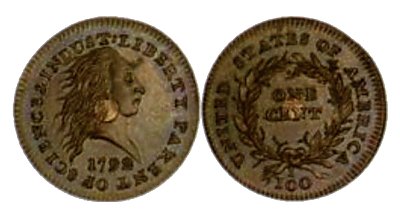
For the one-cent denomination, one of the main coins produced in 1793, four experimental types were tested: the first was struck from a large copper planchet (the "Birch" cent); the second was struck on a smaller copper planchet with a silver core (the Silver-center cent); the third was made of a silver-copper alloy and was the same size as the second type (the Fusion alloy cent); and the fourth was made of pure copper and was the same size as the second and third types. Ultimately, the fourth type was selected for production, which began in 1793.
The second type, struck from a copper planchet with a silver core, was produced experimentally on December 17-18, 1792. The mint workers made the copper planchets, then punched a small hole and inserted a silver plug before the coins were struck. Though never mass-produced, this pattern is considered an early example of bimetallic coinage.
3. Clad-type bimetallic coins
A coin made from a planchet consisting of two or more layers of metal or alloy bonded together, usually with a less expensive metal in the core. It is produced by passing metal sheets through a pair of rollers under sufficient pressure to join the layers together.
Examples of this type of coin are the U.S. quarter and half-dollar. One-dollar coins such as the Sacagawea dollar and the presidential dollar coins are also made by this method. They have a pure copper layer and outer cladding made of an alloy of zinc, manganese, and nickel.
Another example is the Kennedy half dollar. Its silver content was reduced by using outer layers of 80% silver and a core of 21% silver and 79% copper. This resulted in a silver content of only 40% (in half-dollar issued from 1965 to 1970). After 1970, half-dollars adopted the copper-nickel clad composition used for dimes and quarters.
4. Plated bimetallic coins
Another type of coin often considered bimetallic is made by coating a metal or alloy core with another metal or alloy. This protects metal cores that are vulnerable to environmental damage. It also reduces the coin's value by lowering its precious metal content while retaining its face value.
Governments do this to increase the money supply in circulation. This method has been used in coin production for a long time. Today, many circulating coins are also made this way. For example, the 1-, 2-, and 5-euro-cents are all copper-plated steel. Vietnamese coins are made this way as well. The 1,000- and 2,000-đong coins are brass-plated steel, and the 200- and 500-đong coins are nickel-plated steel.
5. Ring-type bimetallic coins
This type usually consists of an outer ring made of one metal or alloy and a center made of another metal or alloy. It is similar to the plug type, but the central core is much larger and precisely struck, with the same size and position on each coin. Ring-type bimetallic coins are the most common type in modern circulation. Historically, this method dates back to antiquity. The earliest known examples date to the reign of Emperor Hadrian (AD 117-138). The Roman Empire produced large ceremonial medals with a bronze center and a brass outer ring.
Between 1830 and 1849, British medal manufacturer Joseph Moore produced large quantities of bimetallic tokens known as "Penny Model" and "Half Penny Model", intended to replace circulating penny and halfpenny coins. With a silver center, these tokens were smaller than official pennies while retaining the same value, making them more convenient for circulation. Although unofficial, Moore's tokens circulated widely and were accepted by the vast majority of merchants at the time. Despite the popularity of these tokens, the Royal Mint did not accept the idea and kept official coin dimensions unchanged.
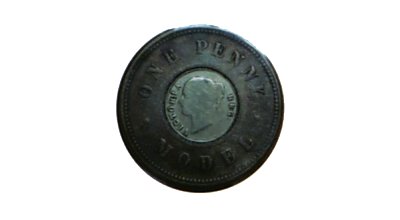
During the late 19th and 20th centuries, many bimetallic medals and tokens were produced in various countries. However, the first bimetallic coin to circulate widely was Italy's 500 lire coin, issued in 1982. This was followed by Morocco's 5 dirham coin in 1987, France's 10-franc coin, Monaco's 10-franc coin, and Thailand's 10-baht coin in 1988, which also followed the Italian bimetallic coin-minting process. France and Monaco also issued tri-metallic 20-franc coins in 1992, with three metallic sections. Today, roughly 150 countries and territories have issued bimetallic coins, and this number continues to grow.
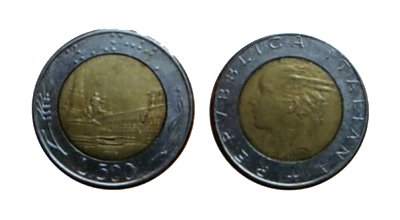
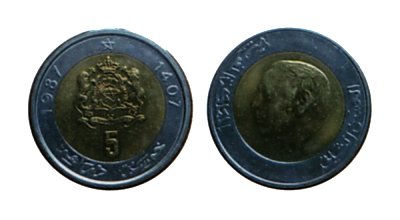
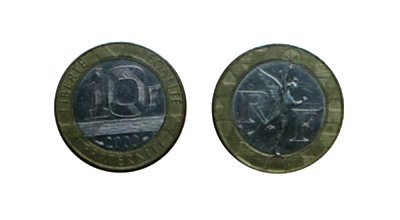
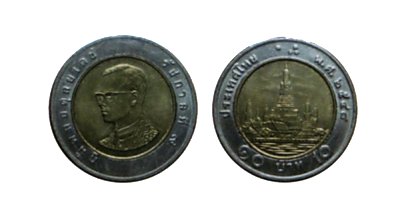
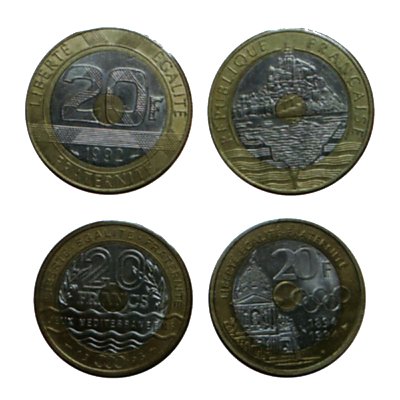
High-denomination coins or coins with high production costs are usually limited in circulation, so bimetallic coins are often issued as commemoratives and are sometimes made of precious metals. The metal combinations commonly used to produce these coins include gold-silver, silver-titanium, silver-copper, copper-nickel, and aluminum-copper alloy-nickel.
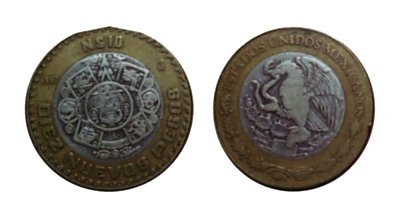
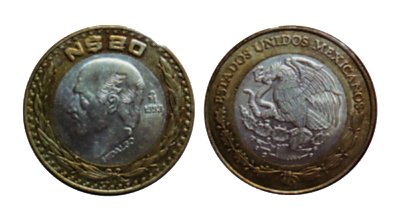
6. Manufacturing bimetallic coins
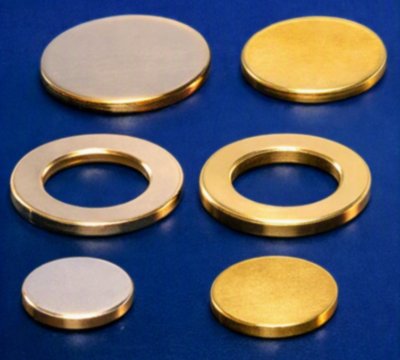
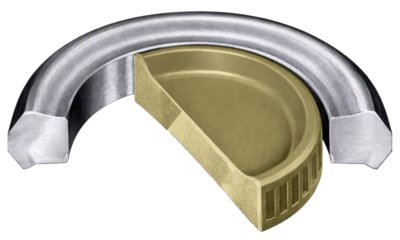
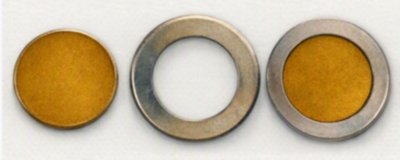
The production of ring-type bimetallic coins is similar to that of ordinary coins. The only difference is that the two metal pieces (the inner core and outer ring) are produced separately, and striking deforms their contacting edges to lock them together.
The process consists of the following steps:
- Producing the outer rings by punching them out of a metal sheet.
- The inner core disc is also punched from its own metal sheet.
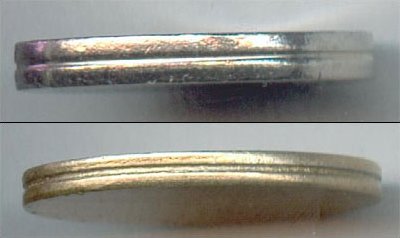
- Milling horizontal or vertical grooves on the edge of the inner core, depending on the minting technology used in each country.
- The inner core and outer ring are fitted together and struck simultaneously in the coin press to form the coin. The pressure during striking forces the metal on the inner edge of the outer ring to flow into the grooves of the core, locking the two pieces together.
(images from https://fleur-de-coin.com
The Worldwide Bimetallic Collectors Club (WBCC) is the first online club dedicated to collecting bimetallic coins. It provides a place for enthusiasts to learn more about this type of coin and to display their bimetallic and trimetallic coins and medals. Interested collectors are invited to visit the site and apply for membership at https://wbcc-online.com.