An overview of printing techniques for Vietnamese banknotes
Part 2: 1951-1991
Nguyễn Đức Việt, Vietnam Numismatics #4 (07-2018), p.27-32
In Part 1 of this article, the author described in detail the history of the printing industry, printing techniques, and the most basic knowledge of printing, such as color mixing, halftones, and pixels. The author also analyzed the printing techniques used to print early Vietnamese currency. In Part 2, the author will continue to analyze the printing techniques used for the banknote issues from 1951 to 1991. The author would greatly appreciate comments and feedback from collectors, researchers, printing experts, and readers.
1. 1951 banknote series
The printing method was offset printing, with only one color on each side[1]. The security features were incorporated into the printing plates. I will analyze this aspect in detail in a dedicated article on banknote security features.
2. 1958 banknote series
The printing method was still offset, but two colors were printed on each side. The 10 đồng note was an exception, with three colors printed on the front side. Similar to the 1951 banknote series, the security features were incorporated into the printing plates. I will analyze this series in detail in a future article.
However, specifically on the front of the 10 đồng note, a technique was used that, in the end, still follows Principle No. 1: not mixing four basic colors to create another color. This overprinting technique uses two mixed colors to print the pattern surrounding the figure 10 on the front. It covers a relatively small area, about 10% of the note surface. However, it still has special features that we identified, which are always present in the banknotes we have examined (Figures 28 and 29).
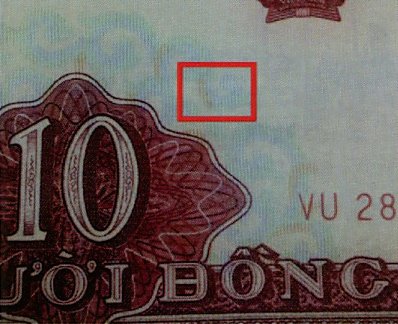
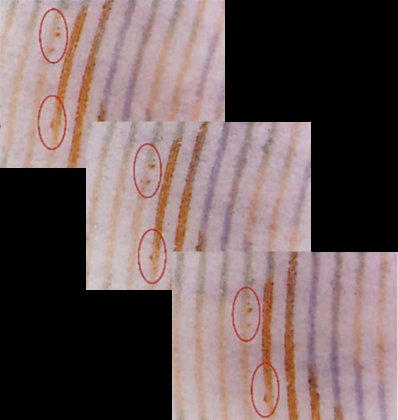
Moreover, this color overprinting is very precise. Among more than 300 notes examined by the author, across widely separated serial numbers, not a single note with misaligned colors was found, demonstrating an exceptionally high-quality post-printing inspection process. This may also be partly because, as the highest denomination, it was printed in the smallest quantity, making quality control easier to ensure. For the same reason, the printing house applied the color overprinting technique when printing the banknotes.
3. Paper money series from 1964 to 1980
Similar to the 1958 series, each side of the banknotes was printed using one to four premixed colors. There was also nothing special about the printing techniques. Any color variations, if present, used a two-color halftone technique, as in flexographic printing. The number of printing colors increased, mainly because the designs became more complex and used different shades of the banknote's main color.
From 1951 to the 1980s, Vietnam was in a period of war and postwar recovery, which placed many restrictions on banknote printing. There was no investment in research to improve printing methods or in importing advanced printing technologies from other countries.
There are only three notable characteristics of banknote printing during this period:
3.1. Using two different numbering styles to print serial numbers
It is possible that during production, the numbering machines were damaged and had to be replaced. However, the replacement set differed from the original, resulting in different serial number styles on banknotes of the same design. Collectors use the terms small serial and large serial to denote differences in serial number font size.
In the 1976 series, the 50 đồng note has two distinct serial number sizes. However the difference this not too obvious and requires close inspection to notice (figure 30). The large serial type matches the specimen notes, while no specimen note of the small serial type has been found.
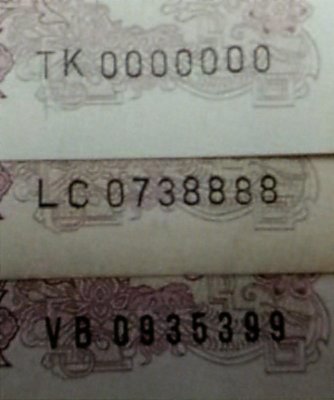
The 30 đồng and 100 đồng notes printed in 1980 show this feature very clearly. The characters in the two serial number types differ in size by more than twofold (Figure 31). Experienced collectors believe that the notes with larger serial numbers were printed in the former Soviet Union, while those with smaller serial numbers were printed later in Vietnam. This hypothesis appears sound, as specimen collectors only possess the 100 đồng specimen notes with the larger serial size, implying that the large serial notes preceded the small serial ones.
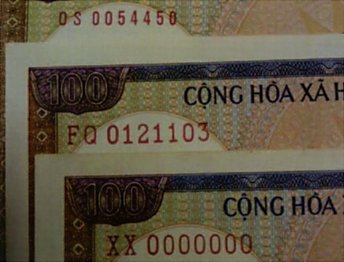
In terms of collectible value, there is almost no difference between the two serial number types, except for the issued 30 đồng note with large serial number, which is very rare and is one of the few issued banknotes that is worth more than its specimen counterpart.
3.2. Misalignment in two colors resulting in different background coloration
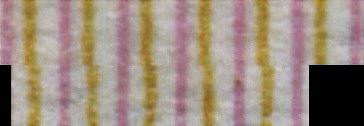
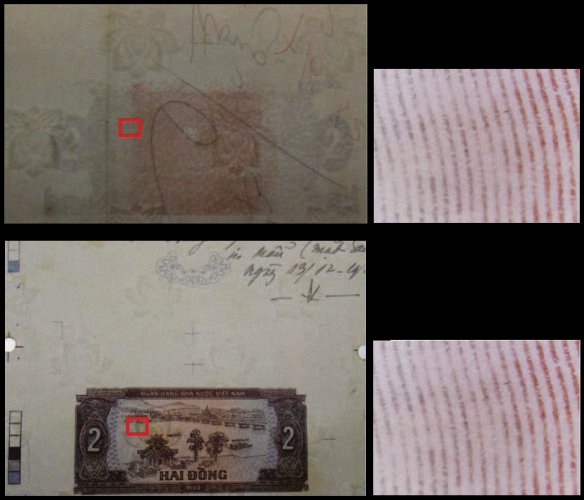
We can see that the backgrounds of the two banknotes in Figure 32 look different. However, examining the magnified background in Figure 33 reveals that the paper color, yellow ink, and pink ink are identical. But while the pink lines are aligned, the yellow lines are misaligned. Thus, the difference in perceived color intensity is caused by color misalignment.
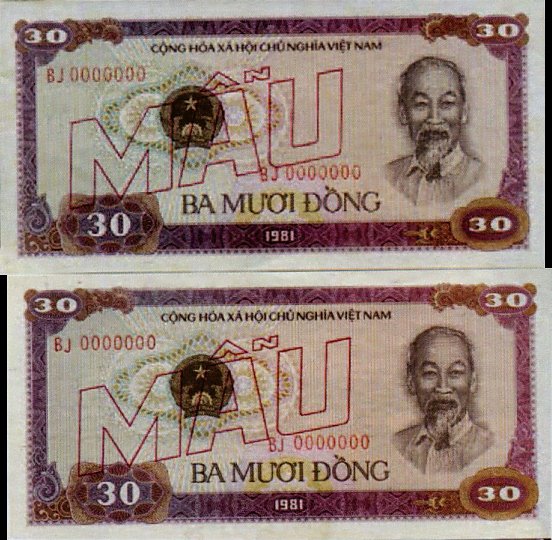
More specifically, on the lower banknote, the yellow and pink stripes are evenly spaced, so the white stripes between them are even. On the upper banknote, the yellow stripes are printed closer to the pink stripes on the left, making the white stripes on the right wider than those on the lower banknote. This creates an optical illusion that makes the background of the upper banknote appear lighter.
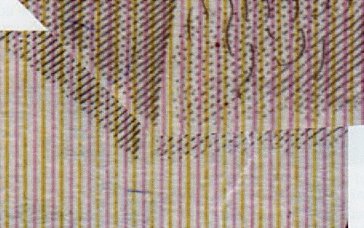
3.3. Smudged printing resulting in different image shades
The portraits of President Hồ Chí Minh on the two banknotes in Figure 32 differ in tone. Examining the enlarged image in Figure 34, we can see that the black lines forming Hồ Chí Minh’s portrait on the upper banknote are blurred, while those on the lower banknote are clear and sharp. Thus, it is reasonable to conclude that the image appears darker because blurring increases the area covered by black ink.
4. A breakthrough from the 1980 2 đồng note to the 1994 banknote series
This milestone centers on simultaneous two-color printing from a single plate. This is a rather special technique that may still be used exclusively for banknote printing. It is so unusual that many printing experts in Hồ Chí Minh City, when asked for their opinion, said that it was impossible. However, based on the specimens in my possession and particularly after reviewing several hundred videos of operating banknote printing presses, I managed to capture valuable stills proving the existence of this technology. Upon careful examination of these images and videos, the printing experts I consulted finally admitted: it can indeed be printed this way!
This technology was tested on banknotes printed in 1976, officially adopted for the 1980 2 đong note, and subsequently rolled out across the 1985 and 1991 series, as well as the polymer series currently in circulation.
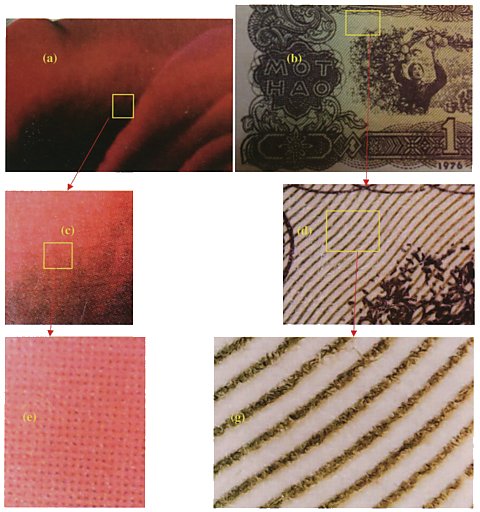
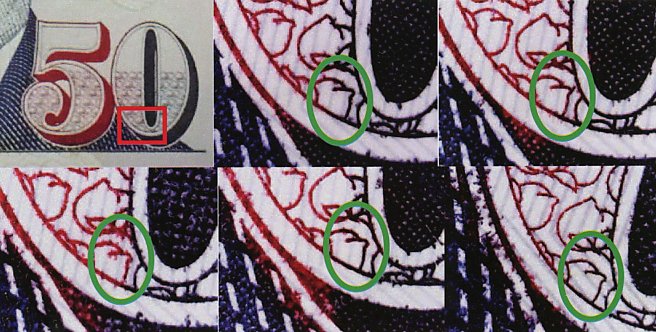
First, let us contrast the results of standard offset printing with this advanced method. Figures 35 (a, c, e) show the results of offset printing with a color gradient from red to black. When enlarged, the transition areas show black halftone dots that are initially large and numerous, then gradually become smaller and disappear as the color changes from black to red.
When printing two colors simultaneously, the color gradient closely mirrors a painter's gradual hand-mixing. As a result, halftone dots are absent, as is the overprinting seen in Figure 29. The most distinctive feature of this technique is that no two notes are identical, because the ink blending in the gradient zone is entirely random and varies each time. See Figure 35 (b, d, g).
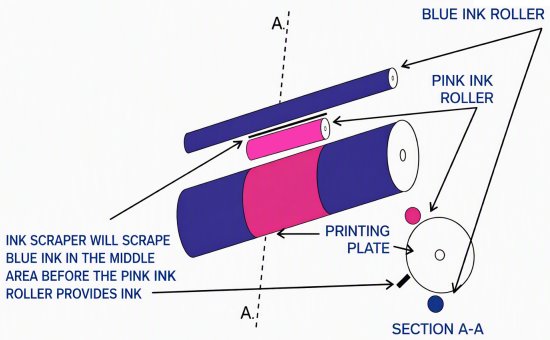
In principle, this printing technique employs two ink rollers feeding different colors to a single printing plate. After the first color (blue) is applied to the plate, a scraper clears the blue ink from the middle zone, allowing a second roller carrying another color (pink) to ink the newly cleared area of the plate (Figure 36).
At this point, this technique branches into two different approaches.
If inks with the same base are used (both water-based or both oil-based), the two inks will mix (blend) where they meet, creating random colors. As a result, the colors in these adjacent areas will vary randomly from one print to another, so no two banknotes will be identical (Figure 37).
If inks with different bases are used (one water-based and the other oil-based), the two inks repel each other. As a result, the inks do not mix where they meet but remain separate, although the boundaries between them vary randomly. The prints still differ from one another, but each color remains distinct, with no intermediate colors produced by mixing the inks (Figure 38).
However, when printing many copies continuously, if two inks with the same base are used, they will quickly mix together on the printing plate, producing a uniform blend of the two colors instead of a random color transition. If two inks with different bases are used, they will not mix, but the ink areas that repel each other will gradually break into smaller parts, leading to a similar result. To overcome this problem, after a few printing cycles, the printing plate is moved to one side to remove all excess ink. It is then returned to its original position and supplied with fresh ink before printing continues.
For this reason, printing speed is reduced. In the worst case, the plate must be cleaned after every printing cycle, reducing the printing speed by at least half. In addition, frequent cleaning of the printing plate increases ink waste. Because of the slow printing speed, high ink waste, and the need to manufacture dedicated printing machines in small quantities, the investment cost is high. Furthermore, this feature cannot be detected with the naked eye on printed materials. Therefore, the technique of printing two colors simultaneously on a single printing plate is not appropriate for mass printing and is only suitable for banknote production.
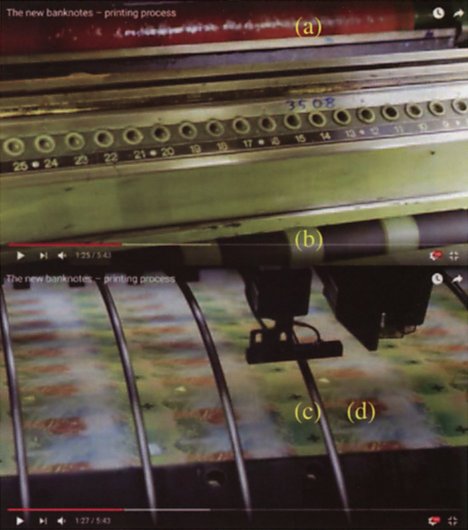
In the banknote printing videos, the author extracted images of a printing machine with a brown ink roller (Figure 39, position a) and a yellow ink roller (Figure 39, position b) operating simultaneously. The area with the random brown-yellow color transition lies between positions (c) and (d) in Figure 39.
The use of this printing technique is further confirmed by the color test prints shown in Figure 40.
[1] art-hanoi.com: Apparently, here and in the next section author is talking about the underprint, which, indeed, uses one color on the 1951 series and two/three colors on the 1958 series. The color of the main design is not counted.