Notes on currency in the History of the Kingdom of Tonkin by Alexandre De Rhodes
Father Vinhsơn Trần Minh Thực, Vietnam Numismatics #4 (07-2018), p.23-26
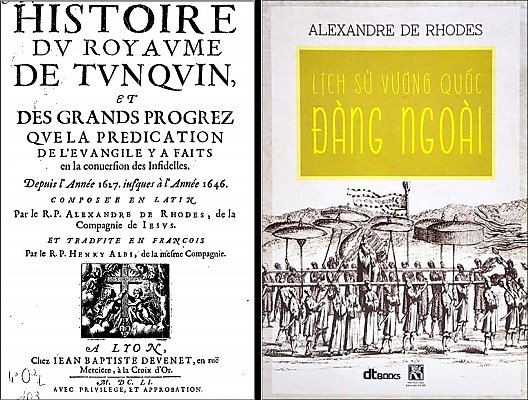
Upon returning to Europe in 1649, Father Alexandre de Rhodes brought back extensive notes regarding his time working in Asia, particularly in Cochinchina and Tonkin. In the following years, the missionary published many works, including Histoire du Royaume de Tunquin[1], which contains a wealth of information about almost every aspect of life in Tonkin at that time. What is particularly fascinating is that the author devoted an entire chapter of this book to the subject of currency. In this article, we will examine the text, dating, and content, and provide a translation of the chapter on currency.
About the text
The introduction to the 1994 Vietnamese translation of the work states that the Italian edition was printed in 1650, the French edition in 1651, and the Latin edition in 1652[2]. In fact, the title of the work in the Italian edition is quite long: Relazione de' felici successi della Santa Fede predicata da' Padri della Compagnia di Giesù nel Regno di Tunchino, alla Santità di N. S. PP. Innocenzio Decimo. Di Alessandro de Rhodes Avignonese della medesima Compagnia, e Missionario Apostolico della Sacra Congregatione de Propaganda Fide (Report of the happy successes of the Holy Faith preached by the Fathers of the Society of Jesus in the Kingdom of Tonkin, to the Holiness of Our Lord Pope Innocent X. By Alexandre de Rhodes of Avignon, of the same Society, and Apostolic Missionary of the Sacred Congregation for the Propagation of the Faith). This edition was published in Rome in 1650.
The full title of the French edition is also quite long: Histoire du Royaume de Tunquin, et des grands progrez que la prédication de l'evangile y a faits en la conversion des Infidelles. Depuis l'Année 1627. iusques à l'Année 1646. Composée en Latin par le R. P. Alexandre de Rhodes, de la Compagnie de Iesus. Et traduite en Francois par le R. P. Henry Albi, de la mesme Compagnie (History of the Kingdom of Tonkin, and of the great progress that the preaching of the Gospel has made there in the conversion of the Infidels. From the year 1627 until the year 1646. Composed in Latin by the Reverend Father Alexandre de Rhodes, of the Society of Jesus, and translated into French by the Reverend Father Henry Albi, of the same Society). This edition was published in Lyon in 1651.
We do not have the Latin text itself, but only the title of this edition[3]: Tunqinensis historiae libri duo, quorum altero status temporalis huius regni, altero mirabiles evangelicae praedicationis progressus referuntur coeptae per patres Societatis Jesu, ab anno 1627 ad annum 1646. Authore P. Alexandro de Rhodes, Avenionensi, eiusdem Societatis presbytero, eorum quae hic narrantur teste (History of Tonkin in Two Books, the first on the temporal state of this kingdom, and the second on the marvelous advances of the preaching of the Gospel initiated by the Fathers of the Society of Jesus, from the year 1627 to the year 1646. By Father Alexandre de Rhodes, of Avignon, priest of the same Society, a witness of the things that are narrated here). Lacking access to the Latin edition, we have retained the spelling and grammatical errors exactly as cited in the referenced work. The Latin edition was published in Lyon in 1652.
In the Introduction, translator Hồng Nhuệ also notes that a manuscript report written by Alexandre de Rhodes in 1636 is preserved in Macao[4]. Information from the titles of the texts themselves allows us to make the following observations:
- On his journey back to Europe, which began in late 1645, Father Alexandre de Rhodes composed a report on what he and his fellow missionaries had done, to be presented to Pope Innocent X. This text must have been written in Latin, which had long been the language commonly used in the Catholic Church.
- Upon his arrival in Rome in June 1649, Rhodes' report was translated into Italian and published in 1650.
- The Latin text was then translated into French and published in Lyon in 1651.
- Finally, the Latin text itself was published in Lyon in 1652.
Regarding the date of composition
As noted above, the Italian, French, and Latin editions were successively published from 1650 to 1652. Naturally, the text must have been written prior to these dates.
The first period to note is the time when Father Alexandre de Rhodes lived in Tonkin. The text itself indicates that Rhodes, accompanied by Father Pierre Marquez, arrived in Thanh Hóa in March 1627[5]. After three years of living and preaching there, both priests were expelled from the region in May 1630[6].
Thereafter, lacking the opportunity to return to Cochinchina or Tonkin, Father Alexandre de Rhodes taught theology in Macao for nearly ten years. During this time, in 1636, he composed the report that is still preserved in Macao. Perhaps based on this text, Alexandre de Rhodes completed the report on his way back to Europe, from 1645 to 1649, so that the work could be published soon after he arrived in Rome in 1650. The Italian title of the work still remains Report.
Additionally, it should be noted that the book's title indicates that the described events span from 1627 to 1646. However, the latest dates mentioned within the text actually extend into 1647: specifically March 11, 1647, concerning the official document sent by Lord Trịnh to Father Felix Morelli, and October 1647, regarding letters sent by Father Jean Cabral to the Superior General[7]. Alexandre de Rhodes must have read the letters from Father Jean Cabral after arriving in Rome in June 1649. Based on these points, we may tentatively conclude that the work was composed between 1636 and 1649.
Regarding the content
Although titled History of the Kingdom of Tonkin, the work is not merely a history book, but rather an encyclopedia of Tonkin.
As noted above, the Latin title indicates this work consists of two books. The French edition is also divided into two separate books. Book I consists of 31 chapters and covers all aspects of the social, military, political, and religious life, as well as the history, customs, language, and culture of Tonkin. Book II consists of 51 chapters and recounts the places that Father Alexandre de Rhodes and his fellow missionaries visited, the people they met, the work they carried out, and the events that took place during their missionary work. Because Fathers Alexandre de Rhodes and Pierre Marquez had the opportunity to interact with almost every level of society at the time, from Lord Trịnh to the lowest-ranking people in society, and their activities extended from Kẻ Chợ to Bố Chính[8], this work provides a comprehensive view of Tonkin society in the first half of the 17th century.
Notably, in Book I, Alexandre de Rhodes devoted Chapter 17 to currency and the commercial usage of gold and silver in Tonkin at the time. While his descriptions of the monetary system are remarkable, the information remains somewhat constrained because the author could not read Chinese characters. Since Hong Nhue's translation contains several inaccuracies, we provide here a new translation of the entire chapter.
Thus, History of the Kingdom of Tonkin provides us with particularly interesting information about Tonkin in the first half of the 17th century through European eyes. This work is an important historical source that helps fill many gaps concerning aspects of social life that Vietnamese historical sources from this period hardly mention.
CURRENCY CIRCULATING IN THE REALM[9]
In this kingdom, people do not mint coins as in China, except for copper coins. Although the people of Tonkin use gold and silver to trade important goods, they do not use precious metals as struck or cast coinage; instead, after melting them in a furnace, they simply cut them into pieces or rectangular bars. Regarding the rectangular silver bars in use, those traded commercially are quite large, worth approximately ten écus[10]. Gold ingots, on the other hand, are much lighter, and their value varies according to weight.
Furthermore, as for silver, they never accept it without first testing on a touchstone. The weighing is done as follows: once the merchants have agreed on how much silk is to be paid, say fifteen or twenty cân[11] for each silver bar worth ten écus, they use a scale to weigh fifteen or twenty cân of silk. Then, using the same scale, they weigh the silver bar to verify that it weighs precisely one cân. This is done in a convenient manner and without fraud. Should anyone doubt the purity of the gold or silver, they have the right to cut it into pieces for better examination.
Copper coins circulating among the people of Tonkin are of two types: large and small. Large coins are commonly used throughout the kingdom, and most are brought from elsewhere by Chinese merchants, and in earlier times also by Japanese merchants. By contrast, small coins are used only in the capital and the four surrounding provinces, but not in the other provinces of the kingdom, nor in Cochinchina. This must have developed when the four main provinces separated from the others as a result of the rebellion mentioned above. All these copper coins, large or small, are smooth and round, with four characters on only one side, and all have a hole in the center, so that they can be strung together according to local custom. Thus, each string contains six hundred coins, or ten groups of sixty, with markings to distinguish each group of sixty coins. This is very convenient for them to sling over their arm or shoulder when going to the market, without needing a money bag like we do, but simply using strings of coins. As for the exchange value of these coins, it is rarely fixed or stable, fluctuating according to the sole rule of the abundance or scarcity of silver within the kingdom. So, a few years ago, one thousand one hundred large coins were worth only one gold écu; at that time, three large coins were worth five small coins. At other times, however, the value of these coins rose, because there was less silver in the country.
[1] This work was translated into Vietnamese by Hồng Nhuệ under the title Lịch sử vương quốc Đàng Ngoài (History of the Kingdom of Tonkin), published by the Ho Chi Minh City Committee for Religious Solidarity in 1994.
[2] See Alexandre de Rhodes, History of the Kingdom of Tonkin (Vietnamese version by Hồng Nhuệ), Ho Chi Minh City, 1994, p. IX.
[3] See. Chantal Paisant (ed.), La mission en textes et images. XVIe-XXe siècle, Karthala, 2004, p. 81.
[4] See Alexandre de Rhodes, History of the Kingdom of Tonkin (Vietnamese version by Hồng Nhuệ), Ho Chi Minh City, 1994, p. IX.
[5] See A. de Rhodes, Histoire du Royaume de Tunquin, Lyon, 1651, p. 128.
[6] See A. de Rhodes, Histoire du Royaume de Tunquin, Lyon, 1651, p. 254.
[7] See A. de Rhodes, Histoire du Royaume de Tunquin, Lyon, 1651, pp. 319-322.
[8] Present-day Thăng Long (Hanoi) and northern Quảng Bình.
[9] This chapter is translated from A. de Rhodes, Histoire du Royaume de Tunquin, Lyon, 1651, pp. 58-60, with reference to the Italian text.
[10] Each gold écu weighs 3.2 grams, equivalent to 720 deniers. Ten écus roughly correspond to one gold tael in the traditional Vietnamese weight system.
[11] The original French text reads livre. Prior to 1667, France used two principal units of the livre: the livre parisis and the livre tournois. One livre parisis equaled 5/4 livre tournois and was defined as 240 deniers, equivalent to 409 grams. We have translated this term using the Vietnamese word cân, meaning approximately 378 grams.