Thiệu Trị Thông Bảo coins
紹治通寶
Mai Ngọc Phát, Bùi Tiến Đạt, Vietnam Numismatics #4 (07-2018), p.14-20
1. Historical overview
1.1 Life and reign
Unlike Gia Long, Minh Mạng chose his eldest son, Prince Dởng[1], from among his 78 sons, to succeed to the throne. Prince Dởng was named Nguyễn Phúc Miên Tông [阮福綿宗], when he ascended the throne, his name was changed to Nguyễn Phúc Tuyền [阮福璇]. He was the son of Minh Mạng and Empress Hồ Thị Hoa, born on the 11th day of the 5th month of the year Đinh Mão [丁卯] (June 16, 1807) in Huế. His mother died just 13 days after his birth, and from then on, he was raised in the palace by his grandmother, Empress Thuận Thiên Cao.
The National History Office of the Nguyễn Dynasty wrote: "Tân Sửu [辛丑], the first year of Thiệu Trị (1841) (the 21st year of the Qing Daoguang [道光] reign), spring, the first month (before the 19th day of that month was the 22nd year of Minh Mạng; from the 20th day onward was the first year of Thiệu Trị)"[2], and "Tân Sửu [辛丑], the first year of Thiệu Trị (1841), spring, the first month, the day Bính Ngọ. He ascended the throne as King at the Thái Hòa Palace. A general amnesty was declared. The reign title was changed. An edict was issued to the people"[3]. At the time of his accession, King Thiệu Trị was 34 years old.
Thiệu Trị was known as a gentle and benevolent king. There were no major changes during his reign, and most of the policies used to govern the country during his short reign closely followed those of Minh Mạng. His father's high-ranking officials, such as Trương Đăng Quế, Lê Văn Đức, Nguyễn Tri Phương, and Doãn Uẩn, were all retained and valued by him to help govern the country. However, during his short reign, the Thiệu Trị government also addressed some of the problems left unresolved by Minh Mạng, such as restoring the dike system in the North and resolving conflicts with Cambodia in the western frontier provinces in the south, in order to stabilize the country at that time. In addition to governing the country, he was also known as an outstanding poet. Two of his famous Chinese poems are Vũ Trung Sơn Thủy (Scenery in the Rain) and Phước Viên Văn hội lương dạ mạn ngâm (Poem Recited on a Fine Night at Phước Viên). In particular, his poem cycle Thần Kinh Nhị Thập Cảnh describes 20 famous scenic places in the imperial capital of Huế, which were often depicted on glass paintings and commissioned porcelain.
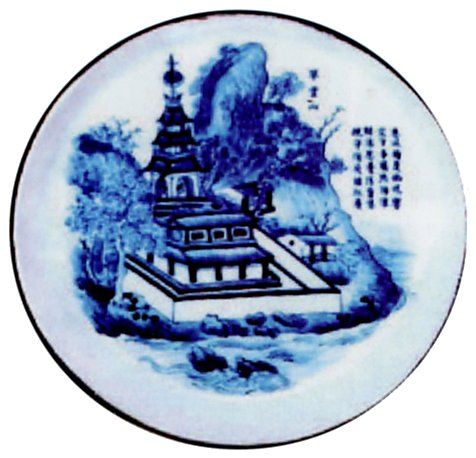
Thiệu Trị fell ill and died on the 27th day of the 9th month of the Đinh Mùi [丁未] year (November 4, 1847), at the age of 41. His temple name was Hiến Tổ [憲祖]. After his death, the king's ancestral tablet was placed in the Thế Miếu Temple for worship. His tomb, Xương Lăng, is located in Cư Chánh Village, Thừa Thiên Huế.
1.2 Monetary policies under the reign of King Thiệu Trị
Throughout his nearly seven-year reign, economic policies and monetary management under Thiệu Trị largely mirrored those of the Minh Mạng era. Any reforms or policy adjustments were mainly made to suit the circumstances of the time. Looking through the official chronicles of the Nguyễn Dynasty, we occasionally find passages mentioning the use of the monetary system at the time: "Tân Sửu [辛丑], the first year of Thiệu Trị (1841), third month: 86,000 quan of small copper coins were issued to the provinces of Bắc Kỳ, with Gia Long and Minh Mạng coins accounting for half each (the five major provinces, Hà Nội, Nam Định, Hải Dương, Sơn Tây, and Bắc Ninh, each received 10,000 quan; the two medium-sized provinces, Hưng Yên and Ninh Bình, each received 6,000 quan; and the six small provinces, Hưng Hóa, Tuyên Quang, Thái Nguyên, Lạng Sơn, Cao Bằng, and Quảng Yên, each received 4,000 quan). Later, because the boatmen lost the entire shipment, the King ordered Hà Nội Province to mint more than 20,000 quan of copper coins according to the original design and reissue them to the provinces"[5]. From this historical record, it is clear that large quantities of Gia Long and Minh Mạng coins were still available and stored in the warehouses in the imperial capital, from where they were sent to the provinces when needed.
Likewise, the Thiệu Trị court standardized the values of the gold and silver coins from the Minh Mạng and Thiệu Trị reigns. This passage in the official chronicles suggests that, as early as the first year of his reign, gold and silver reward coins bearing the Thiệu Trị reign name had already been minted, both to reward merit and to circulate within the monetary system of the time: "Tân Sửu [辛丑], the first year of Thiệu Trị (1841), eleventh month: the values of the gold and silver coins of the Minh Mạng and Thiệu Trị reigns were established. All purchases and exchanges outside the court were to follow the established rates. If anyone voluntarily deposited these coins into the state treasury, they would be repaid in cash coins; if they used them to pay taxes, they would be accepted at their full official value.
1. Minh Mạng era coins: the gold coin Vạn Sự Như Ý weighed about 1 tiền and was valued at 10 quan; the gold coin Tam Đa weighed 1 tiền 6 phân and was valued at 13 quan, 1 tiền 7 phân was valued at 14 quan, 1 tiền 8 phân and was valued at 15 quan, and 1 tiền 9 phân and was valued at 17 quan; the gold coin Phú Thọ Tam Đa weighed 5 tiền and was valued at 43 quan, 4 tiền and was valued at 34 quan, and 3 tiền and was valued at 26 quan.
2. Thiệu Trị era coins: the large Phi Long gold coin weighed 7 tiền 2 phân and was valued at 60 quan; the small type weighed 3 tiền 5 phân and was valued at 30 quan. The large Song Long gold coin weighed 7 tiền and was valued at 60 quan; the medium type weighed 3 tiền 5 phân and was valued at 30 quan; and the small type weighed 2 tiền and was valued at 17 quan. The Tam Đa, Bát Bảo, and Vạn Sự Như Ý gold coins each weighed 1 tiền and were valued at 10 quan. The Song Long large silver coin weighed 7 tiền and was valued at 4 quan; the medium type weighed 3 tiền 5 phân and was valued at 2 quan; the small type weighed 2 tiền and was valued at 1 quan. The Phi Long large silver coin weighed 7 tiền 2 phân and was valued at 2 quan; the small type weighed 3 tiền 5 phân and was valued at 1 quan. The Tam Đa, Vạn Sự Như Ý, and Nhật Nguyệt Tinh Vân silver coins each weighed 1 tiền and were valued at 3 tiền"[6].
The precious metal coins was also minted many times, for example: "Nhâm Dần [壬寅], the second year of Thiệu Trị (1842), fifth month: an order was issued to the Ministry of Revenue to mint additional Phi Long silver coins"[7].
A typical example was the modified standard for casting Thieu Tri silver ingots: "Giáp Thìn [甲辰], the fourth year of Thiệu Trị (1844), seventh month: models of the newly made silver ingots were issued to local authorities both in the capital and in the provinces. The old design was somewhat thick, making it easy for fraudsters to mix in counterfeit pieces. Consequently, the old design was replaced with a new one, which was somewhat thinner than the old type."[8] The use of zinc coins to supply the palaces during this period is also recorded: "Giáp Thìn [甲辰], the fourth year of Thiệu Trị (1844), eleventh month: Prince Hồng Hưu was ordered to deliver 10,000 quan of zinc coins to the Từ Thọ Palace. The rate of loss for melted silver was re-established (for every 10 lạng of silver, 1 tiền 4 phân was lost)."[9]
Like Minh Mạng, Thiệu Trị continued to mint copper coins with auspicious inscriptions for use as rewards and for circulation at higher denominations. The National History Office recorded: "Bính Ngọ [丙午], the sixth year of Thiệu Trị (1846), second month: large copper Thiệu Trị coins with auspicious inscriptions were minted, 10,000 coins in all, of 40 types"[10], including 23 eight-character and 17 four-character inscriptions.
Overall, during this period, the circulation of money and the regulations for minting coins were mainly based on the standards established during the reign of Minh Mạng. Any adjustments were made mainly to suit the actual conditions of the country at the time. Throughout Thiệu Trị’s reign, the country remained relatively stable and prosperous.
2. Artifacts and discussion
Much like the era of his father, Thieu Tri inherited a relatively stable economic, political, and social environment during his brief governance. Although he assumed the throne at a mature age, his gentle temperament and reluctance to make changes, most of his monetary policies and the minting of Thiệu Trị Thông Bảo [紹治通寶] coins followed the regulations established during the reign of Minh Mạng.
2.1. Official imperial coinage
2.1.1. Copper coins
Among the currency issues of the early Nguyễn Dynasty during the period of independence from 1802 to 1883, the coins bearing the inscription Thiệu Trị Thông Bảo [紹治通寶] were perhaps the least varied. However, we can see that surviving specimens differ in both diameter and calligraphy, showing that Thiệu Trị Thông Bảo coins were minted mmultiple times. The chronicle records: "Tân Sửu [辛丑], the first year of Thiệu Trị (1841), third month: Thiệu Trị Thông Bảo coins were minted (large copper coins weighing 9 phân; small copper coins and new zinc coins each weighing 6 phân). Ministry of Revenue requested to cast new pattern coins to clearly manifest new governance decrees. The King agreed with the proposal. He ordered trial casting of new pattern coin. The regular and hired craftsmen, main and auxiliary mints were all supplied by the Ministry according to the regulations of the 16th year of Minh Mạng (1835)."[11] In the fourth year (1844), minting was carried out again: "Giáp Thìn [甲辰], the fourth year of Thiệu Trị (1844), twelfth month: the King ordered Arsenal Director Vũ Khổ and Ministry of Revenue Vice Director Trần Văn Nguyện to go to Hanoi to cast trial coins. During the reign of Minh Mạng, the rules for minting copper and zinc coins had already been established. In the 21st year, the rate of minting loss was revised. Previously, Military Commander Trần Dật had overseen the work for one year, and it had also achieved good results. Later, Kiều Đức Tường and Nguyễn Văn Hóa continued to oversee the work, but the clerks and craftsmen deliberately wasted materials, resulting in huge losses. Governor-General Mai Công Ngôn and Provincial Administration Commissioner Lê Nguyên Trung said that minting coins was difficult and troublesome. They stopped minting for one year, which was reported to the Ministry of Revenue. The King then ordered copper and zinc from the imperial warehouses to be used to mint trial coins made from a mixture of the two metals (copper and zinc), and the coins turned out bright and attractive. The officials of the Ministry reported the matter of minting coins from the mixed alloy to the King. The King said that currency minting was vital for nation's economic vitality and state administration. Leaving Hanoi to operate independently would lead to failure. He therefore ordered Trần Văn Nguyện and Dương Vạn Sách to bring craftsmen from the capital and work together with the provincial officials, using copper and zinc from the provincial treasury. Following the same method, they were to cast trial Thiệu Trị coins weighing 9 phân and 6 phân. The amount of raw materials and the loss in the process were to be examined, and a report submitted so that regulations could be established. Minting was to begin in the first month, after the opening of the official seal, with Văn Nguyện remaining to oversee the work."[12]
Thus, in contrast to the reigns of Gia Long and Minh Mạng, the different types of Thiệu Trị Thông Bảo coins were minted at nearly the same time, including large 9 phân copper coins and 6 phân copper-zinc coins, all following the regulations established in the 16th year of Minh Mạng (1835). Therefore, the size and weight of all types of Thiệu Trị Thông Bảo coins were similar to the corresponding types of Minh Mạng Thông Bảo. The calligraphy on the coins was in regular script, and the coins were finely and precisely minted. In terms of the surviving specimens, we can identify the following types of copper coins:
- Copper coins with a diameter of 24.5-25 mm: these are the large copper coins weighing 9 phân mentioned above. They were minted to a very high standard, with good-quality copper and regular script calligraphy that shows little variation (Figure 2).
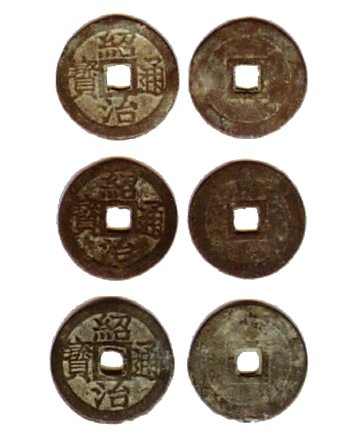
The large Thiệu Trị Thông Bảo copper coins were much fewer in number than the smaller coins of the same reign. Likewise, the relatively small number of 9 phân and 1-tiền coins compared with Minh Mạng Thông Bảo can partly be explained by the ruler's reluctance to make changes. More importantly, the number of 9 phân and 1 tiền coins minted during the reign of Minh Mạng was already so large that it was sufficient to meet the monetary needs of the following reigns. For this larger-diameter type, differences usually appear on the reverse side, such as the types with a double rim reverse (Figure 3).
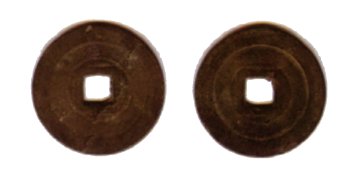
- Copper coins with a diameter of 23-23.5 mm: corresponding to the 6 phân copper coin type, minted in a fairly large quantity compared with the larger 9 phân type of the same reign.
- Type 1: The calligraphy is very similar to the large 9 phân type, with precise and standardized minting. Its composition corresponds to that of the larger-diameter type and Minh Mạng Thông Bảo. Based on the changes in calligraphy seen on surviving specimens, it can be seen that these coins were minted many times, like the 9-phân coins mentioned above (Figure 4).
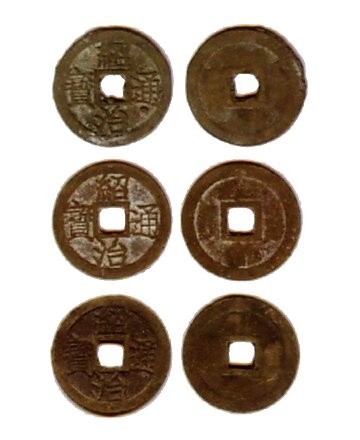
- Type 2: In addition to the coins with the characteristic calligraphy found on the 9 phân and 6 phân types mentioned above, during the course of collecting specimens, another series of Thiệu Trị Thông Bảo coins from the 6-phân type, 23 mm in diameter, was also found, with clearly different calligraphy. Overall, the composition of the coins is quite similar to the types mentioned above, and the calligraphy is also in regular script. The characters are broader and more rounded than those on the other types of the same reign discussed above. The characters are usually separated from the coin rim, and the overall layout is noticeably more attractive. The Bảo [寶] character has a rounder and shorter Bối [貝] radical than those on the types mentioned above (Figure 5).
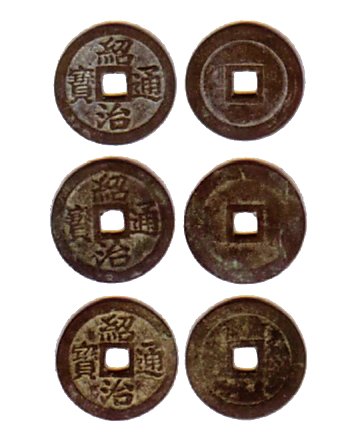
Official chronicles do not provide detailed records or clear illustrations for each minting, so correlating the records with the specimens is very difficult. However, the record mentions: "Quý Mão [癸卯], the third year of Thiệu Trị (1843), second month: 6 phân Thiệu Trị Chế Tiền coins were minted, totaling 80,000 quan"[13]. To further determine whether this historical record refers to this series of specimens, more scientific and historical evidence, as well as expert opinions from collectors and researchers, is needed. Nevertheless, this historical record shows that 6 phân coins received more attention and were minted more often than the larger 9 phân coins during the Thiệu Trị reign.
2.1.2. Zinc coins
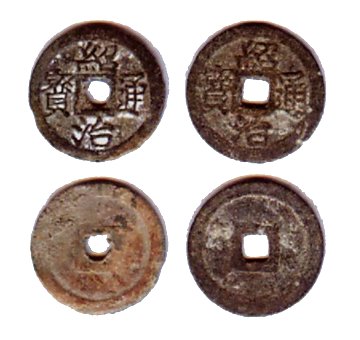
Like his predecessors, Thiệu Trị paid close attention to minting zinc coins bearing his reign title. These coins were mentioned together with the minting of copper coins in the historical records cited above, such as: "Quý Mão [癸卯], the third year of Thiệu Trị (1843), second month: previously, Director Vũ Khổ was ordered to establish a mint to produce 50,000 quan of zinc Thiệu Trị Chế Tiền coins; at this time, he was ordered to continue minting them"[14]. The practice of supplying zinc coins to the palaces for daily use was also occasionally mentioned in official records: "Giáp Thìn [甲辰], the fourth year of Thiệu Trị (1844), eleventh month: Prince Hồng Hưu was ordered to deliver 10,000 quan of zinc coins to Từ Thọ Palace"[15]. Overall, zinc Thiệu Trị Thông Bảo coins also have the two characteristic calligraphy styles found on the 6 phân copper coins, with diameters of 23.5-24 mm. Their molds are similar to those used for Minh Mạng Thông Bảo zinc coins (Figure 6). Although historical records indicate that a relatively large number of Thiệu Trị zinc coins were produced, the number of surviving specimens is currently not as large as that of the zinc coins bearing the reign names of the previous Nguyễn kings.
2.2. Privately cast coins
Thanks to the strict monetary policies of Minh Mạng to prevent counterfeiting and private minting (as discussed in our article Minh Mạng Thông Bảo Coins in Volume 3 of the magazine), during his more than six years on the throne, Thiệu Trị and his court rarely had to worry about illegal coin minting, unlike during the previous reign. However, in practice, perhaps due to the profits involved, some copper Thiệu Trị Thông Bảo coins believed to be counterfeit or privately cast were still put into circulation during the same or later reigns. Here are some typical examples that we have found:
- Thiệu Trị Thông Bảo type, diameter 23.5 mm, with the Thông [通] character having a triangular head and one stroke, the Bảo [寶] character with a V-shaped bottom, broad and bold strokes, and a wide rim. This type is more rarely encountered than other calligraphy types (Figure 7). We can see that the composition of this coin does not correspond to that of official coins of the dynasty. The color of the metal indicates a composition similar to that of red copper coins, suggesting that the content of impurities such as zinc and lead is relatively high.
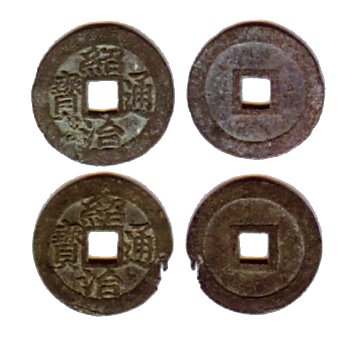
- Thiệu Trị Thông Bảo type, diameter 23.5 mm, thickness 1.8 mm, with the Manchu inscription on the reverse. The coin is rather thick, and the calligraphy on the obverse is characteristic of the official 9 phân and 6 phân coins. However, the reverse is quite different, featuring a very wide rim and the Bảo Tuyền inscription in Manchu script (Figure 8). This type was perhaps cast at the same time as the corresponding Minh Mạng Thông Bảo mentioned earlier. mentioned earlier.
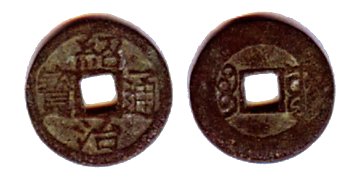
- Thiệu Trị Thông Bảo type, diameter 23.2-24 mm: This type of coin has many subtypes. The coins are very thin, of low purity, and have broad strokes. There are two types of the character Thông [通] with triangular and square head. This is a series of counterfeit coin cast by Chinese and put into circulation from the late Tự Đức period onward (as mentioned in the previous two articles) (Figure 9).
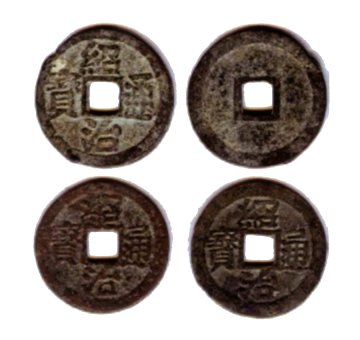
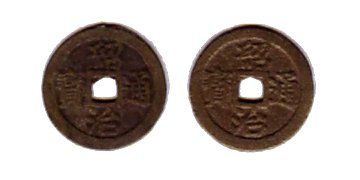
- Thiệu Trị Thông Bảo” type, diameter 23 mm: The coins are thin, with shallow strokes (Figure 10). Considering the overall characteristics, from the material to the calligraphy, this type of coin is similar to the official 6 phân coins. Returning to the official historical records, as mentioned in the section on official court coins, the order to "send Lang trung Vũ Khổ, Trần Văn Nguyện, and Dương Vạn Sách to Hanoi to test coin casting" (part of quotation [12]) shows that coin casting at the Bảo Tuyền Mint in Hanoi was facing major problems with both quality and standards. However, we do not have enough evidence to confirm that these are non-compliant official coins. On the other hand, due to the deviations in diameter and weight, we temporarily classify them as privately cast coins for further study, and partly consider them specimens of defective official coins, while leaving them as a question for researchers and collectors to answer.
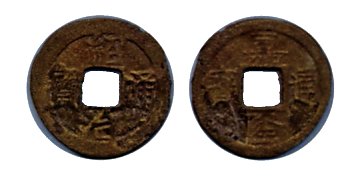
- Thiệu Trị Thông Bảo / Gia Long Thông Bảo type (Figure 11): The chronicle states: "In the second year of Thiệu Trị (1842), in the eighth month, the Ministry of Revenue reported: Last year, 86,000 quan of small Gia Long and Minh Mạng coins stored in the capital treasury were issued and allocated to the provinces of Bắc Kỳ for deposit in their treasuries. Later, due to storms and floods, transportation was inconvenient, leaving a shortage of more than 20,000 quan. Therefore, we request permission to wait until next year to continue transporting them. The king then ordered Hanoi Province to follow the proper method and recast coins under various reign titles, dividing and distributing them to the provinces of Bắc Kỳ for storage and use, to ease the difficulties of transportation."[16] Through this historical record, it can be seen that the number of small 6 phân Gia Long Thông Bảo and Minh Mạng Thông Bảo coins recast during the Thiệu Trị reign was relatively large (20,000 quan), making it possible that the dies were mistakenly assembled, combining the two sides of two different coin types. Furthermore, based on the material and calligraphy of the coins, it can be seen that they have the style of official coins corresponding to the relevant types. However, as with the specimen above, considering the tolerances in size and weight, we temporarily classify the specimen as a defective coin or a privately cast coin, and will continue to consider feedback and criticism from all sides.
3. Conclusion
Being someone who did not want changes, during his reign, King Thiệu Trị made few reforms to the policies governing the country or to the currency; almost everything followed the old practices of his father, King Minh Mạng. This is clearly demonstrated by the official coins. The common copper currency system consisted of only two denominations: 9 phân (d=24.5-25 mm) and 6 phân (d=23-24 mm). The calligraphy was in regular script and changed little; when changes did occur, they mostly appeared on the 6 phân coins. The 6 phân zinc coins completely followed the standards of Minh Mạng coins. Overall, official "Thiệu Trị Thông Bảo [紹治通寶] coinage was minted with high standardization, good metal quality, sharp relief, and consistency across issues, reflecting a period of relative economic and political stability. In addition to official issues, our research uncovered non-standard specimens exhibiting stylistic or dimensional deviations from official mint specifications. We have provisionally classified these as private mintages, contemporary or later counterfeits, or official minting errors. These specimens raise several unresolved numismatic questions that exceed our current state of knowledge. With the desire to study these remaining issues more deeply, we hope to receive opinions from researchers and collectors so that we can learn more and better understand the issues we have not yet been able to resolve.
Resources:
1. Dr. R. Allan Barker (2004). The Historical Cash Coins of Vietnam. Singapore.
2. National Museum of Vietnamese History (2005). Tiền kim loại Việt Nam (Coins of Vietnam). Hanoi.
3. Anonymous. (1943). 東洋古銭図録 - 安南銭之部 (Catalog of Ancient Oriental Coins: Annam Section). Japan.
4. Ding Fubao [丁福保], and Ma Dingxiang [馬定祥] (1992). 歷代古錢圖譜 (Illustrated Catalog of Ancient Coins through the Ages). Shanghai Classic Publishing House, Shanghai.
5. Đỗ Văn Ninh (1992). Tiền cổ Việt Nam (Ancient Coins of Vietnam). NXB Khoa học Xã hội, Hanoi.
6. Hội đồng trị sự Nguyễn Phúc tộc (1995). Nguyễn Phúc tộc thế phả (Genealogy of the Nguyen Phuc Clan). NXB Thuận Hóa, Huế.
7. Nguyễn Anh Huy (2010). Lịch sử Tiền tệ Việt Nam - sơ truy và lược khảo (History of Vietnamese Currency: Preliminary Research). NXB Văn hóa Sài Gòn, TP. HCM.
8. Nguyen Dynasty Cabinet, (1993). Khâm định Đại Nam hội điển sự lệ (Imperially Commissioned Administrative Statutes of Đại Nam). NXB Thuận Hóa, Huế.
9. Tominaga Masayoshi [富永正三] (1994). 穴銭入門 - 手類銭稿 (Introduction to Cash Coins: A Study of Coin Types). Japan.
10. Nguyễn Dynasty National History Bureau (1821-1945). Đại Nam thực lục (Veritable Records of Đại Nam). Translated from Hán-Nôm by Nguyễn Ngọc Tĩnh, 2004. NXB Giáo dục, Đà Nẵng.
11. Nguyễn Dynasty National History Bureau (1821-1945). Minh Mạng chính yếu (Essentials of Minh Mạng's Reign). Translated from Hán-Nôm, 1994. NXB Thuận Hóa, Huế.
12. Lục Đức Thuận and Võ Quốc Kỳ (2009). Tiền cổ Việt Nam. Nxb Giáo Dục, Đà Nẵng.
13. Quỳnh Cư and Đỗ Đức Hùng (2003). Các triều đại Việt Nam. Nxb Thanh niên, Hanoi.
14 Trung tâm bảo tồn Di tích cố đô Huế (1997). Thần kinh nhị thập cảnh - thơ vua Thiệu Trị, Nxb Thuận Hóa, Huế.
[1] Các triều đại Việt Nam, 2003, Nxb Thanh niên, Hanoi, p. 363.
[2] Đại Nam thực lục, 2004, Nxb Giáo dục, Đà Nẵng, vol. 6, p. 21.
[3] Đại Nam thực lục, 2004, Nxb Giáo dục, Đà Nẵng, vol. 6, p. 33.
[4] Thần kinh nhị thập cảnh, tập thơ của vua Thiệu Trị, 1997, Nxb Thuận Hóa, Huế, p. 147.
[5] Đại Nam thực lục, 2004, Nxb Giáo dục, Đà Nẵng, vol. 6, p. 123.
[6] Đại Nam thực lục, 2004, Nxb Giáo dục, Đà Nẵng, vol. 6, pp. 247-248.
[7] Đại Nam thực lục, 2004, Nxb Giáo dục, Đà Nẵng, vol. 6, p. 356.
[8] Đại Nam thực lục, 2004, Nxb Giáo dục, Đà Nẵng, vol. 6, p. 624.
[9] Đại Nam thực lục, 2004, Nxb Giáo dục, Đà Nẵng, vol. 6, p. 675.
[10] Đại Nam thực lục, 2004, Nxb Giáo dục, Đà Nẵng, vol. 6, p. 839.
[11] Đại Nam thực lục, 2004, Nxb Giáo dục, Đà Nẵng, vol. 6, p. 839.
[12] Đại Nam thực lục, 2004, Nxb Giáo dục, Đà Nẵng, vol. 6, pp. 689-690.
[13] Đại Nam thực lục, 2004, Nxb Giáo dục, Đà Nẵng, vol. 6, p. 468.
[14] Đại Nam thực lục, 2004, Nxb Giáo dục, Đà Nẵng, vol. 6, p. 468.
[15] Đại Nam thực lục, 2004, Nxb Giáo dục, Đà Nẵng, vol. 6, p. 675.
[16] Đại Nam thực lục, 2004, Nxb Giáo dục, Đà Nẵng, vol. 6, p. 402.