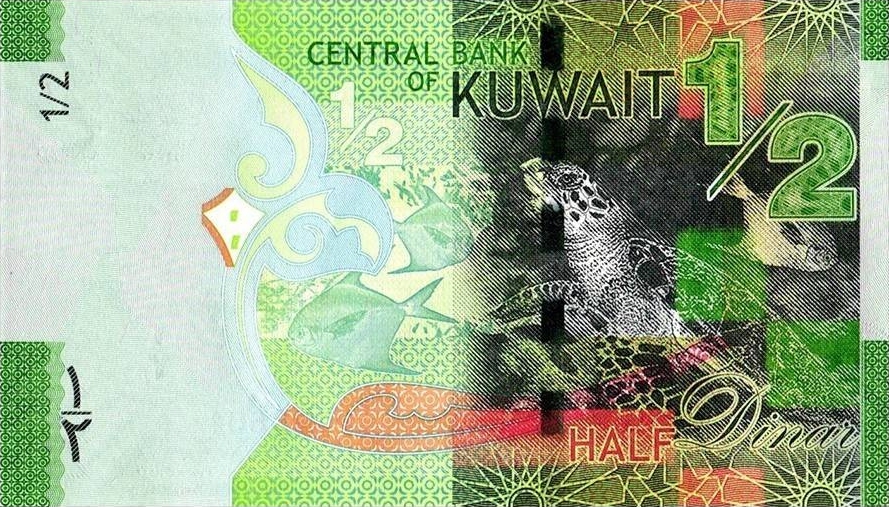
Fractional denomination with the World's highest value
Nguyễn Sỹ Đức, Vietnam Numismatics #4 (07-2018), p.13
You may be surprised to learn that many countries around the world have used quite unique currency denominations, not standard whole numbers, but rather fractions. One of those countries is Kuwait. Its currency has the highest exchange rate in the world today.
Kuwait is a constitutional emirate, a country with a semi-democratic political system. The Emir is the head of state, with the power to appoint the Prime Minister, who in turn has the power to appoint the ministers, while Parliament is elected. The Parliament is usually strict about the government's responsibilities, and ministers are frequently questioned. Kuwait has a more accountable and transparent government than other Gulf countries.
The Constitution of Kuwait states that Islam is the official religion. The majority of Kuwait's population follows Islam. People of other religions are free to worship as long as they do not show prejudice against Islam.
Kuwait has an area of about 17,818 km², with mostly flat terrain. It has nine islands, of which the three largest are Failaka, Bubiyan, and Warba, but none of the islands has permanent residents. Geographically, it borders Iraq to the north and west, Saudi Arabia to the south and southwest, and the Persian Gulf to the east.
Kuwait is a country with large oil reserves in the Middle East, and its official language is Arabic. The currency is the Kuwaiti Dinar (KD). This currency is considered one of the highest-valued currencies in the world. Its exchange rate is always fluctuating, with 1 KD worth approximately 3.5 USD. The exchange rate at the Bank for Foreign Trade of Vietnam (Vietcombank) on January 22, 2018 was 1 KD = 78,401.74 VND.
The KD has a high value because the country's economy is mainly based on oil exports. According to the Constitution, all natural resources within the country are national property. Kuwait has large oil and gas reserves, and petroleum products account for approximately 95% of total export revenue and nearly 80% of government revenue. For many years, their KD has not lost value but has instead tended to appreciate thanks to the government's monetary regulation, very large foreign exchange reserves, and trade surpluses from oil exports.
This country uses both banknotes and coins. The coins include denominations of 5, 10, 20, 50, and 100 fils, while the banknotes have denominations of ¼, ½, 1, 5, 10, and 20 Dinars. One Dinar is equivalent to 1,000 fils.
The unique feature of the banknotes is the existence of two fractional denominations: ¼ KD (equivalent to 250 fils) and ½ KD (equivalent to 500 fils). If you travel to this country, be sure to exchange these unique banknotes as souvenirs for your friends and family.