Calligraphy on early coins of the Lê Dynasty
Đào Phi Long, Vietnam Numismatics #3 (04-2018), p.44-46
Under the pretext of "Support the Trần and destroy the Hồ" the Ming dynasty (the Yǒnglè [永乐] Emperor) launched an invasion of Đại Việt. After defeating the Hồ dynasty, the Ming annexed Đại Việt and renamed it to its ancient name Jiāozhǐ [交趾] (Giao Chỉ). With a highly oppressive rule, the Ming dynasty sought to assimilate the people of Đại Việt and aimed to erase everything associated with it. It therefore issued an order: "When the army enters that country, except for scriptures and printing blocks of Buddhism and Daoism which are not to be burned, all books and printing blocks, including even rustic children's writing books such as Thượng đại nhân and Khưu ất dĩ, every page and every character must be burned. Throughout that country, at all sites and relics, steles erected by China shall be preserved, while all steles erected by An Nam must be completely destroyed, leaving not a single character remaining". After 20 years of Ming domination, together with the catastrophe of 1371, when "the Cham invaders stormed into the capital... and burned the palaces and houses to the ground. As a result, books and records were completely wiped out". at the beginning of the Lê Dynasty, books, documents, and literary works from the previous dynasties had suffered enormous losses. The art of calligraphy during this period suffered the same fate.[1]
The calligraphy appearing on the coins of the Lê Dynasty from 1428 to 1527 can be divided into two periods:
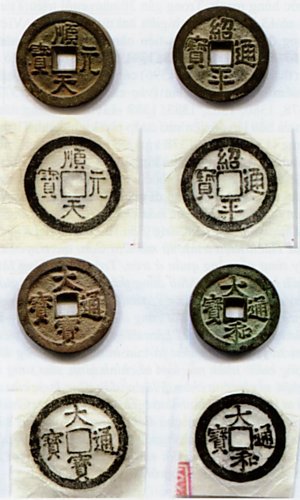
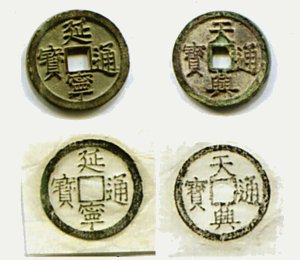
The first period began with the first year of Thuận Thiên [順天] era (1428) and continued through the subsequent eras including Thiệu Bình [紹平] (1434-1439), Đại Bảo [大寶] (1440-1442), Đại Hòa [大和] (1443-1453), Diên Ninh [延寧] (1454-1459), and Thiên Hưng [天興] (1459-1460).
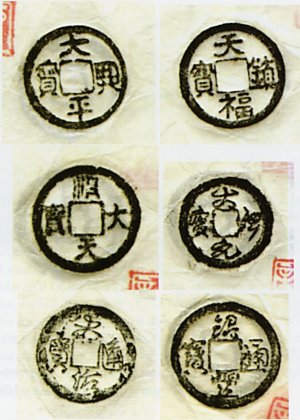
In the first period, the calligraphy on coins still followed the old style of Regular Script (Chữ Chân / 楷書), as seen on coin names such as Thái Bình Hưng Bảo [太平興寶] (Đinh Dynasty), Thiên Phúc Trấn Bảo [天福鎮寶] (Former Lê Dynasty), and Thuận Thiên Đại Bảo [順天大寶] (Lý Dynasty). The Trần Dynasty also continued this style, except for coin names such as Đại Trị [大治] and Thiệu Phong [紹豐] (Trần Dynasty), which also included Seal Script, Cursive Script, and Running Script styles.
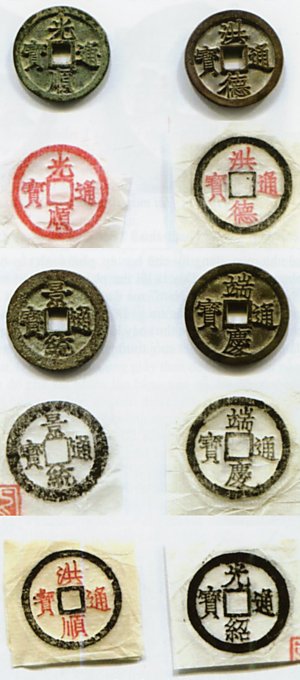
The second period began in the 9th year of Quang Thuận [光順] (1468) and continued through the reign titles Hồng Đức [洪德] (1470-1497), Cảnh Thống [景統] (1498-1504), Đoan Khánh [端慶] (1505-1509), Hồng Thuận [洪順] (1510-1516), and Quang Thiệu [光紹] (1517-1522).
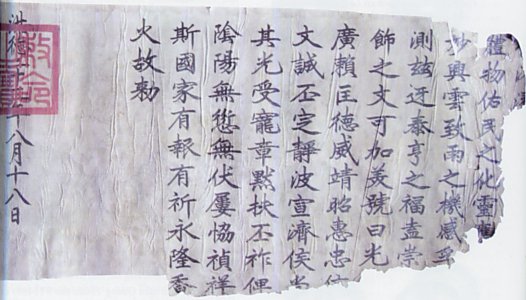
From the 9th year of Quang Thuận (1468), under Emperor Lê Thánh Tông, reforms were carried out to standardize the official writing styles. This was implemented by an edict in the 9th year of Quang Thuận: "An imperial decree of the Ministry of Rites regulating popular writing forms, issued throughout the realm". In the second month of the 8th year of Hồng Đức (1477), an edict stated: "All guard units and offices are to use the signatory hoa áp script, and must respectfully and diligently obey and carry it out". This was a completely new calligraphic style: "Nam tự" - the Southern script, mentioned by the scholar Phạm Đình Hổ at the end of the Lê Dynasty.[2] The main characteristics of the signatory script (or edict script) are flat horizontal strokes with hidden beginnings and endings, and final strokes that generally flick upward.[3] The script style developed and lasted for nearly 200 years, and it was still used in the early Mạc Dynasty on coins bearing the reign titles Minh Đức [明德], Đại Chính [大正], and Quảng Hòa [廣和]. This script style is most clearly seen when comparing two Quang Thuận Thông Bảo [光順通寶] coins (Figure 5). The first coin still follows the style of the first period, while the second follows the style adopted after the introduction of the hoa áp script.
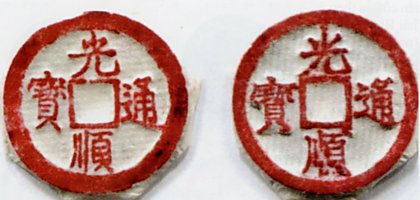
In this article, I discuss only the calligraphy found on early Lê coinage. Therefore, I have included only scans and rubbings of the obverse, since coins of this period have no inscriptions on the reverse. During this period, discoveries of ancient coins have also revealed coin types that do not follow the hoa áp calligraphic style, such as Hồng Đức [洪德] and Cảnh Thống [景統] coins... I will present the coin types of the second period of the Lê Dynasty that bear different calligraphic styles in future articles.
[1] Nguyễn Sử (2017). Lịch sử Thư pháp Việt Nam. Nxb Nhã Nam. p. 123.
[2] Nguyễn Sử (2017). Lịch sử Thư pháp Việt Nam. Nxb Nhã Nam. p. 137.
[3] Nguyễn Sử (2017). Lịch sử Thư pháp Việt Nam. Nxb Nhã Nam. p. 123.