Hidden Treasure of King Trần Phế Đế
Phương Tú, Vietnam Numismatics #3 (04-2018), p.43
The Trần dynasty replaced the Lý dynasty and stabilized the economic and political situation that had become chaotic in the late Lý period. In its early period, the Trần dynasty led Đại Việt to become a prosperous and powerful state; its economy, education, culture, and other fields all developed strongly. In particular, the Trần dynasty's three victories over the Mongol armies (in 1258, 1285, and 1287) made a great impact in the history of Đại Việt and world history. However, by the reign of King Trần Dụ Tông, the Trần dynasty began to weaken in both economic and military terms. Meanwhile, Champa under King Chế Bồng Nga had become a powerful state. In the final 30 years of the Trần dynasty, there were 13 conflicts between Champa and Đại Việt; during this period Đại Việt launched five southern campaigns (in 1367, 1376-1377, 1383, 1391, and 1396). Of these, only one brought a minor victory (in 1396), while four ended in defeat. The Cham launched seven northern campaigns (in 1371, 1377, 1378, 1380, 1382, 1383, and 1389-1390), of which they won five times, and on four occasions they advanced and plundered the capital Thăng Long (in 1371, 1377, 1378, and 1383). After the Trần dynasty's capital was plundered by Cham forces in 1378, fearing another Cham attack, King Trần Phế Đế ordered soldiers and civilians to hide the copper coins. The Đại Việt sử ký toàn thư records: "In the 9th month of the year Kỷ Mùi [己未] (1379), the 3rd year of his reign, [the King] ordered soldiers and civilians to carry copper coins and hide them in Thiên Kiện Mountain[1] (formerly called Địa Cận Mountain; legend says there was an ancient pine tree, with a dragon coiled above it. King Trần Thái Tông once built a temporary palace there)." In the winter, in the tenth month, money was buried at Khả Lãng cave[2], in Lạng Sơn, out of fear that Cham forces might burn the royal palace". Historian Ngô Sĩ Liên commented on this: "As the Son of Heaven, who possesses all within the four seas, the state treasuries and storehouses belong to him. When the country is at peace, one should enforce proper laws and uphold rites and moral order, like a bird gathering mulberry roots to bind its nest, then no one would dare to disrespect it. Yet fearing the disaster of Champa burning and robbing, they carried money and valuables to hide deep in mountains and caves as a way to avoid the enemy, that is inviting the enemy to come, making future generations ridicule them, and it can be said that there were no capable men in the country".
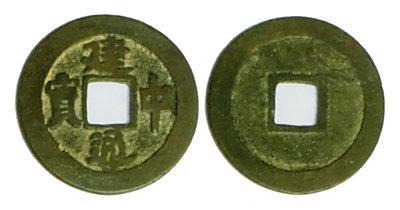
In 1390, after Chế Bồng Nga died in battle, the Cham forces began to weaken, and large-scale wars between Champa and Đại Việt came to an end. Realizing that the capital was no longer under threat, King Trần Thuận Tông ordered the excavation of the caves to retrieve the money hidden during the reign of King Trần Phế Đế. The Đại Việt sử ký toàn thư says: "In the 10th month of the winter of Canh Ngọ [庚午] (1390), the King ordered stonemasons from An Hoạch[3] to excavate the caves at Thiên Kiện and Khuẩn Mai mountains to recover the buried assets. At that time, both mountains had collapsed, and the cave entrances were sealed, so they could not be excavated and the plan was abandoned".
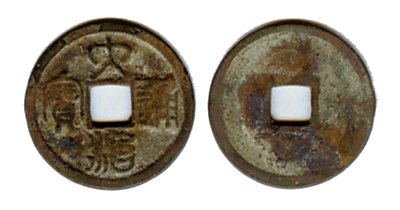
When King Trần Phế Đế ordered the treasury to be hidden, it likely included not just copper coins, but also gold, silver, and jewels. However, since the capital Thăng Long had been plundered by Cham forces the previous year (1378), there were probably not many valuables left to hide. The decision to hide the money proved prudent when, in 1383, Cham forces entered the capital Thăng Long once again. Yet, by the time King Thuận Tông attempted to recover the wealth, nature had intervened; landslides had permanently sealed the caves, forcing him to abandon the search. So the money was not lost to enemy raids, but to natural disasters. Perhaps it was simply fate. Should the location of this hoard ever be rediscovered and excavated, it would represent a monumental numismatic find, potentially revealing rare Trần dynasty coin types never before documented in history.
[1] Thiên Kiện Mountain is located in Châu Village, Kiện Khê Town, Thanh Liêm District, Hà Nam Province.
[2] Kha Lãng is a commune of uncertain location; its colloquial name was likely Kẻ Lãm.
[3] An Hoạch refers to Nhồi Village or Nhuệ Thôn in Đông Sơn District, Thanh Hóa Province.