Hansatsu (Japan)
Châu Ngọc Đức, Vietnam Numismatics #3 (04-2018), p.30-35
1. History of Hansatsu
During the period of Japanese history from 1185 to 1867, Japan was ruled by the Emperor, but he held little real power. The Imperial Court was merely symbolic. Alongside the Emperor was the Shogunate (Bakufu), which served as both the military headquarters and the government of Japan's warrior class. Normally, the headquarters was the residence and command center of the head of the military government, that is, the Commander-in-Chief - Shogun. The Shogunate can be compared to the governments of the Trịnh and Nguyễn Lords during the late Lê dynasty in Vietnam.
Under the Shogunate were the feudal lords (daimyō), who ruled individual domains (han). The term "daimyō" was sometimes also used for the heads of clans. The feudal lords constantly threatened to destroy one another under the pretext of protecting the Emperor, hoping to receive the powerful title of Shogun. To protect the position of the Shogun, the Shogunate employed samurai warriors to defend the government against rebellions by local lords.
In 1600, after the Battle of Sekigahara, Tokugawa Ieyasu - a lord who had previously served the renowned general Hideyoshi - emerged as a powerful force and defeated rival lords in western Japan. He claimed to protect the Emperor and was granted the title of Shogun, beginning the Tokugawa Shogunate, also known as the Edo period. Tokugawa Ieyasu reorganized the domains, leaving only about 200 to 300 daimyō to govern the han, which were ranked according to their rice production. The han producing more than 10,000 koku (50,000 bushels) of rice were allowed to remain independent, while smaller ones were merged. He also classified the daimyō based on their relationship with the Tokugawa family: Shinpan were relatives of the Tokugawa; Fudai were former vassals of the Tokugawa or allies during the wars; and Tozama were those who had opposed the Tokugawa before the battle (not necessarily fighting against them) and had their houses destroyed and lands confiscated and redistributed to loyal followers.
The Japanese economy in the 17th century was largely based on agriculture and trade in major cities, while economic activities were controlled by feudal lords. The Tokugawa government opened trade with foreign countries but maintained a monopoly on minting metal coins, including gold, silver, and copper. Trade developed to the point that European merchant ships took advantage of this opportunity to spread Christianity in Japan. They did not want to visit the capital Edo, but instead chose southern ports far from the capital. This could cause the government to lose control over southern Japan, especially if local lords rebelled by forming alliances with Europeans. The Tokugawa government introduced a policy of national isolation and tightened monetary control, placing a huge financial burden on the feudal clans.
Trade within the domains became more difficult due to a shortage of currency. Therefore, in 1661, merchants of the Fukui clan tried printing a type of money for exchanging and trading goods within their domain. The people gradually accepted using it instead of the heavy coins. Recognizing the advantages of paper money, other lords also began issuing trial paper money for their own domains. This type of paper currency was known as Hansatsu.
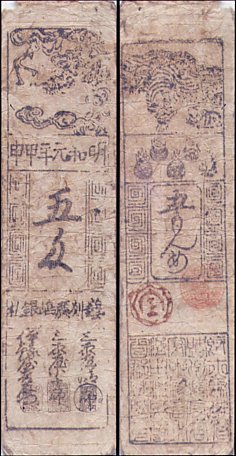
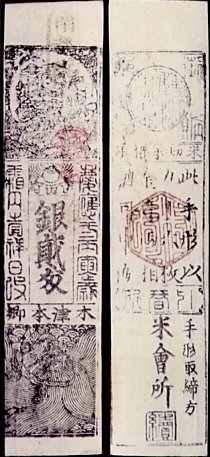
Hansatsu was printed in a vertical format and was relatively long. It used coarse, thick paper produced by local artisans using traditional methods. Both sides were printed in black ink and bore red or blue authentication seals. They featured many different designs and styles and commonly used Japanese Kanji characters in printed or handwritten forms. In total, about 300 domains issued Hansatsu money.
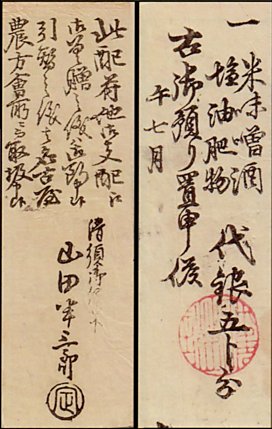
Besides reducing the shortage of coins, Hansatsu also generated financial income. They helped feudal rulers balance their finances, created a monopoly system, and provided relief funds for poor samurai and common people. Some domains had strong economies and could make large profits by purchasing goods with Hansatsu and reselling them in other domains in exchange for Japanese coins.
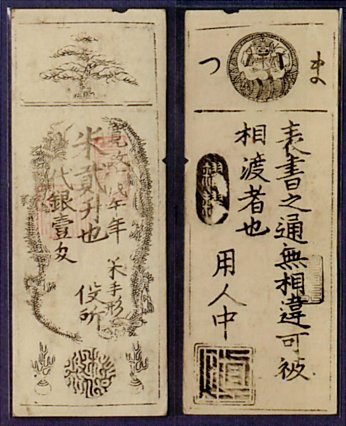
Most Hansatsu issued by different han (with a few exceptions) could be exchanged for Tokugawa gold, silver, and copper coins, but a small number were valued in rice, sake, oil, or fish. Anyone who counterfeited Hansatsu would face the death penalty or other punishments, depending on the domain. Complex techniques such as subtle shading and hidden watermarks were used on Hansatsu. In fact, the craftsmen who produced paper money had to sign a secret blood oath, promising not to reveal any secrets about printing methods or security details; otherwise, they would be punished.
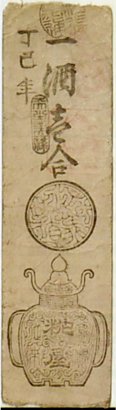
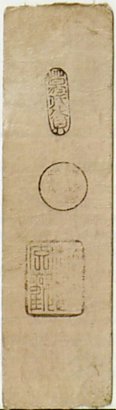
In 1707, the Tokugawa Shogunate banned the use of paper money because it feared that too much would be printed. However, in 1730, the official issuance of Hansatsu resumed.
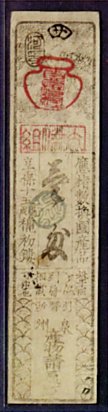
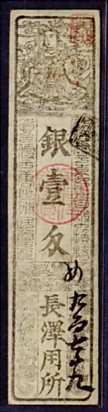
In 1867, Tokugawa Yoshinobu resigned as Shogun. After a civil war, the Tokugawa Shogunate was overthrown in 1869, and imperial rule was restored.
2. Interesting facts about Hansatsu
Collecting Hansatsu is fascinating because they were produced in an eclectic style, unlike any other kind of paper money. Much of their appeal lies in the mystery of their designs. Many Japanese speakers cannot even read the Kanji used on them.
When Hansatsu was in circulation, it was not the only medium of exchange. Alongside it, there were also coins and some commodities such as rice, fish, oil, sake, and other goods. Rice was certainly considered more valuable than Hansatsu and was even used to pay wages to many people. For example, lords accepted taxes paid in rice, which they could then sell to obtain money or other goods.
The dating of Hansatsu is also quite different from that of modern paper currency. Besides using the 60-year zodiac cycle (as in the Vietnamese lunar calendar), Hansatsu also used a Japanese era-name system called Nengō, similar to the reign titles of Vietnamese emperors. For example, Vietnamese historical books often record dates such as: "... the year Canh Ngọ, the 9th year of Gia Long (1810)..." The zodiac calendar system corresponds to the year Canh Ngọ, while the Nengō system corresponds to the 9th year of Gia Long. The year 1810 was added later by converting the Hán Nôm date into the modern dating system.
Table 1: Monetary and weight units
| 1 Monme 匁 | 3.75 grams |
| 1 Hyakume 百目 | 100 Monme 匁 |
| 1 Kin 斤 | 160 Monme 匁 |
| 1 Kan 貫 | 1000 Monme 匁 |
| 1 Kanme 貫目 | 1000 Monme 匁 |
| 1 Kanmon 貫文 | 1000 Mon 文 |
| 1 Shu 朱 | 1000 to 1750 copper or iron cash coins |
| 1 Bu/Fun 分 | 4 Shu |
| 1 Ryo 両 | 4 Bu (until 1870) |
| 1 Sen 銭 | 10 Rin (厘 or 文) |
| 1 Yen 圓 or 円 | 100 Sen (from 1870) |
Table 2: Japanese numerals
| Kanji | Hiragana | Value |
|---|---|---|
| 一 or 壱 | いち | 1 |
| 二 | に | 2 |
| 三 | さん | 3 |
| 四 | し、よん | 4 |
| 五 | ご | 5 |
| 六 | ろく | 6 |
| 七 | しち、なな | 7 |
| 八 | はち | 8 |
| 九 | きゅう | 9 |
| 十 | じゅう | 10 |
| 十一 | じゅういち | 11 |
| 十二 | じゅうに | 12 |
| 十三 | じゅうさん | 13 |
| 十四 | じゅうし、じゅうよん | 14 |
| 十五 | じゅうご | 15 |
| 十六 | じゅうろく | 16 |
| 十七 | じゅうしち、じゅうなな | 17 |
| 十八 | じゅうはち | 18 |
| 十九 | じゅうきゅう | 19 |
| 二十 | にじゅう | 20 |
| 五十 | ごじゅう | 50 |
| 百 | ひゃく | 100 |
| 千 | せん | 1000 |
Table 3: Monetary conversion rates
| Mon and Kanmon are units of monetary value, | |
| Monme and Kanme are units of weight. | |
| Gold coinage (金) | |
|---|---|
| 1 Ryō (両) | 4 Bu (分) |
| 1 Bu (分) | 4 Shu (朱) |
| 1 Shu (朱) | |
| Copper coinage (銅) | |
| 1 Mon (文) | |
| 1,000 Mon (文) | 1 Kanme (貫目) or 1 Fun (分) |
| Silver coinage (銀) | |
| 1/10 Monme (匁) | 1 Fun (分) |
| 1 Monme (匁) | 3.75 grams |
| 1,000 Monme (匁) | 1 Kanmon (貫文) |
| Gold exchange rates | |
| 1 Ryo 両 | 60 Silver monme (匁) |
| 1 Ryo 両 | 4 Copper kanmon (貫文) |
Table 4: 60-year calendar cycle
| 10 Heavenly Stems | 12 Earthly Branches | ||||
|---|---|---|---|---|---|
| 甲 | Kinoe | Wood (Yang) | 子 | Ne | Rat |
| 乙 | Kinoto | Wood (Yin) | 丑 | Ushi | Ox |
| 丙 | Hinoe | Fire (Yang) | 寅 | Tora | Tiger |
| 丁 | Hinoto | Fire (Yin) | 卯 | U | Rabbit |
| 戊 | Tsuchinoe | Earth (Yang) | 辰 | Tatsu | Dragon |
| 己 | Tsuchinoto | Earth (Yin) | 巳 | Mi | Snake |
| 庚 | Kanoe | Metal (Yang) | 午 | Uma | Horse |
| 辛 | Kanoto | Metal (Yin) | 未 | Hitsuji | Goat |
| 壬 | Mizunoe | Water (Yang) | 申 | Saru | Monkey |
| 癸 | Mizunoto | Water (Yin) | 酉 | Tori | Rooster |
| 戌 | Inu | Dog | |||
| 亥 | I | Boar | |||
Table 5: Nengō era year reference
| Kanji | Romaji | Year | Duration | |
|---|---|---|---|---|
| 寛文 | Kanbun | 1661 | 12 | Hansatsu first authorization |
| 延宝 | Enpō | 1673 | 8 | also romanized as Enho |
| 天和 | Tenna | 1681 | 3 | also romanized as Tenwa |
| 貞享 | Jōkyō | 1684 | 4 | |
| 元禄 | Genroku | 1688 | 16 | |
| 宝永 | Hōei | 1704 | 7 | |
| 正德 | Shōtoku | 1711 | 5 | |
| 享保 | Kyōhō | 1716 | 20 | |
| 元文 | Genbun | 1736 | 5 | |
| 寛保 | Kanpō | 1741 | 3 | also romanized as Kanho |
| 延享 | Enkyō | 1745 | 4 | |
| 寛延 | Kan'en | 1748 | 3 | |
| 宝暦 | Hōreki | 1751 | 13 | also romanized as Horyaku |
| 明和 | Meiwa | 1764 | 8 | |
| 安永 | An'ei | 1772 | 9 | |
| 天明 | Tenmei | 1781 | 8 | |
| 寛政 | Kansei | 1789 | 12 | |
| 享和 | Kyōwa | 1801 | 3 | |
| 文化 | Bunka | 1804 | 14 | |
| 文政 | Bunsei | 1818 | 12 | |
| 天保 | Tenpō | 1830 | 14 | also romanized as Tenho |
| 弘化 | Kōka | 1844 | 4 | |
| 嘉永 | Kaei | 1848 | 6 | |
| 安政 | Ansei | 1854 | 6 | |
| 万延 | Man'en | 1860 | 1 | |
| 文久 | Bunkyū | 1861 | 3 | |
| 元治 | Genji | 1864 | 1 | |
| 慶応 | Keiō | 1865 | 3 |
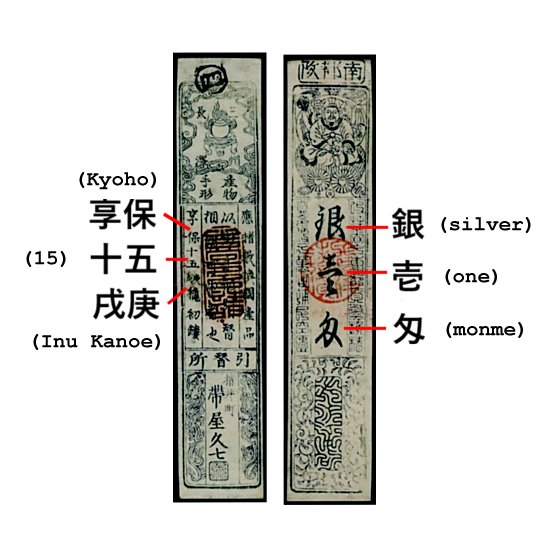
In the example above, the front of the note indicates that this Hansatsu has a denomination of one monme of silver, or in other words, it is worth 3.75 grams of silver.
The reverse shows that the note bears the era name Kyōhō. Referring to Table 5, we find that the first year of the Kyōhō era was 1716. Below that are the Kanji characters 十五 (fifteen), indicating the 15th year. Thus, this note would be issued in 1716 + 15, which equals 1731. Note that this calculation is incorrect. The correct method is to count the years consecutively: if 1716 is the first year of the Kyōhō era, then 1717 is the second year. Following this sequence, the 15th year corresponds to 1730, not 1731.
Indeed, this can be verified by calculating the year using the Gregorian calendar system. The next two characters are Inu Kanoe (the Year of the Metal Dog). By searching Google (remember to search using the Kanji characters 戌庚), we can find that the most recent corresponding year was 1970. Counting backwards by 60 years, we obtain the years of Inu Kanoe as 1910, 1850, 1790, 1730, 1670, and 1610.[1] By referring to Table 5, we can see that the Kyōhō era lasted from 1716 to 1735, leaving only 1730 as the matching year.
This dual method is very useful when we own these centuries-old notes but the part showing the year is missing, torn, or faded. For example, if we can only read "Kyōhō era" and "Inu Kanoe", while the Kanji characters 十五 (fifteen) are faded, then using the method above, we can easily determine that the year must be the 15th year of the Kyōhō era.
In addition, based on Tables 1 and 3, we can draw another interesting conclusion: although Hansatsu used gold, silver, or copper standards, all of them had fixed exchange rates for conversion. More interestingly, when paper money from different domains was exchanged with each other, even if they used different standards, they still had fixed exchange rates. However, when exchanging paper money for copper or iron coins, the exchange rate varied.[2]
[1] art-hanoi.com: See https://art-hanoi.com/chronology/庚戌
[2] According to Table 1, it is clear that 1 Shu (朱 - a gold coin) could be exchanged for 1,000 to 1,750 copper coins or iron coins. Table 3, on the other hand, only deals with the conversion between paper money of different monetary standards.