Scientists on money: Sofia Kovalevskaya
Lê Thị Hoài Thu, Vietnam Numismatics #3 (04-2018), p.26-27
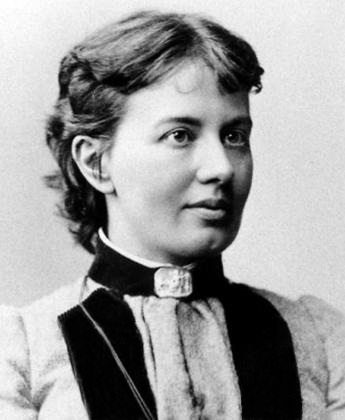
Sofia Vasilyevna Kovalevskaya (January 15, 1850 - February 10, 1891) was known as the "princess of science". She was an exceptionally talented scientist from Russia in particular and from the world in general. She had a deep expertise in many fields, ranging from mathematics to astronomy, as well as philosophy and literature. In mathematics, she made important contributions to the fields of statistics, differential equations, and mechanics. She was the first woman to be granted a full professorship in Northern Europe. She was also one of the first women to work for a European scientific journal as an editor. An extraordinary woman who transcended all boundaries. Sofia Kovalevskaya was not only a scientist and writer, but also a strong advocate for women's rights in the 19th century. Her struggle for access to the best education helped open the doors of universities to women.
Recognition
- Her name has been given to many annual programs and awards established by scientific associations and foundations to encourage and discover young talents, with a particular focus on women.
- The Sonya Kovalevsky High School Mathematics Day is an annual program sponsored by the Association for Women in Mathematics (AWM) through seminars held across the United States, designed to encourage female students to explore mathematics.
- The Sonya Kovalevsky Lecture is also sponsored annually by the AWM to highlight the significant contributions of women to the fields of applied or computational mathematics.
- The Alexander von Humboldt Foundation in Germany awards the Sofia Kovalevskaya Prize twice a year to promising young researchers.
- Asia has the Kovalevskaya Prize, which is dedicated to honoring contemporary outstanding female scientists.
- A crater on the Moon is named Kovalevskaya.
- Furthermore, her life serves as an inspiring example of unceasing determination to overcome the barriers of fate and era to contribute to science; as such, she has become the protagonist of numerous feature films and novels.
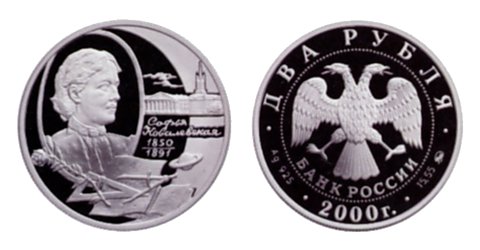
- She was featured on a commemorative 2-ruble coin of the Russian Federation (KM57), minted in 2000 to mark the 150th anniversary of her birth. The coin was made of 92.5% silver. Mintage: 5,000 pieces. Weight: 17 g. Diameter: 33 mm.
Sofia Vasilyevna Kovalevskaya (born Korvin-Krukovskaya) was born in Moscow. Her father was a lieutenant general of artillery serving in the Imperial Russian Army. Her mother, Yelizaveta Fedorovna Schubert, was an educated woman of German origin. They were the ones who ignited her passion for mathematics and hired a tutor (A.N. Strannoliubskii, a well-known advocate for women's access to higher education) to teach her arithmetic. Although her mathematical talent was already clearly evident, she was unable to complete her studies in Russia because the Tsarist government did not allow women to attend universities. In order to study abroad, she entered into a "marriage of convenience" with Vladimir Kovalevsky, then a student of paleontology, and they left Russia in 1867.
In 1869, Kovalevskaya attended classes as an auditor at Heidelberg University in Germany. After two years studying mathematics and physics at the University of Heidelberg, where she attended lectures by renowned professors such as Hermann von Helmholtz, Gustav Robert Kirchhoff, and Robert Wilhelm Bunsen, she moved to Berlin, where she studied privately under the mathematician Karl Weierstrass, since the university did not allow her to attend lectures as either a regular or auditing student. Her intelligence greatly impressed her teacher, even though at that time she was still unknown in the scientific community. In 1873, she published her first research work on partial differential equations, extending earlier work by Augustin-Louis Cauchy. From then on, the Cauchy problem, one of the most fundamental problems in differential equations, became known as the Cauchy-Kovalevskaya theorem. This theorem is included in all standard textbooks on mathematical analysis. From this point on, the scientific community began to recognize her as a creative talent.
This initial success motivated her to devote herself even more passionately and persistently to further research work. By 1874, she had produced three major works, one of which, "Supplement and Remarks on the Study of the Shape of Saturn's Rings and Elliptic Integrals", was accepted by the University of Göttingen as her doctoral thesis. With the support of Karl Weierstrass, she was awarded a doctorate in mathematics with highest distinction, without having to take the usual courses or required examinations. From then, she became the first woman in Europe to receive this academic degree.
In 1874, the Kovalevsky family returned to Russia, but she was not granted a professorship due to her somewhat radical political views. Regarding Kovalevskaya's personal situation, the Tsarist government did not provide her with conditions necessary to continue her research and develop her scientific talent. Disappointed, they returned to Germany, where they were warmly welcomed by Professor Weierstrass once again. He helped her return to science. Upon arriving in Paris, she was elected a member of the Paris Mathematical Society. In 1883, with the help of the Swedish mathematician Gösta Mittag-Leffler, a former student of Karl Weierstrass, Kovalevskaya was appointed as a Privatdozent at Stockholm University in Sweden. A year later (1884), she was appointed to the position of Professor extraordinarius. She devoted eight years to teaching at Stockholm University, wrote twelve textbooks, and became an editor of the scientific journal Acta Mathematica.
In 1888, she was awarded the Prix Bordin by the French Academy of Sciences for her work "Mémoire sur un cas particulier du problème de la rotation d'un corps pesant autour d'un point fixe, où l'intégration s'effectue à l'aide des fonctions ultraelliptiques du temps" (Memoir on a special case of the rotation of a rigid heavy body about a fixed point, where the integration is performed using ultra-elliptic functions of time). This work contains a famous result that is now known as the "Kovalevskaya theorem". In 1889, she was appointed Professor ordinarius at Stockholm University, becoming the first woman to hold this position at a university in Northern Europe. After actively campaigning for changes to the Academy's charter, she was awarded a seat as an Academician at the Russian Academy of Sciences, honoring her as its first female academician. Her final published work was a short paper titled "Sur un théorème de M. Bruns" (On a theorem of Mr. Bruns), in which she presented a new, simpler proof of Bruns' theorem on the properties of the potential function of a homogeneous body.
Kovalevskaya was a remarkably versatile woman; in addition to her scientific research, she also wrote poetry, prose, and plays, including the memoir "Childhood in Russia", a play written in collaboration with Countess Anne Charlotte Edgren-Leffler, and a semi-autobiographical novel "The Nihilist Girl" (1890). She constantly faced negative attitudes and had to struggle for the right to study and conduct research, while also lacking support throughout her life.
Tragically, at the beginning of 1891, at the age of 41 and at the peak of her mathematical creativity and glory, Kovalevskaya passed away from the flu. She was buried in Solna, Sweden. Her death left the scientific world in profound mourning and earned her the boundless admiration of humanity.
The Kovalevskaya Award is an annual prize presented to female individuals and groups with outstanding achievements in scientific research and the application of science to practical life, bringing benefits in the economic, social, and cultural fields.
In Vietnam, this award is presented by the Vietnam Women's Union. Nguyễn Thị Bình, former Vice President of Vietnam, served as Chair of the Kovalevskaya Award Committee in Vietnam from 1985 to 2016, and the current Chair is Professor Dr. Nguyễn Thị Doan, also a former Vice President of Vietnam.