Revolutionary bond of the Vietnam Restoration League
Mai Ngọc Phát, Vietnam Numismatics #3 (04-2018), p.18-21
1. Vietnam Restoration League
The Vietnam Restoration League (Việt Nam Quang Phục Hội, 越南光復會) was a revolutionary organization founded in 1912 by Phan Bội Châu, based on democratic ideals, with the aim of expelling the French from Indochina. Its guiding principle was to restore Vietnam and establish a Vietnamese republic.
After the success of the 1911 Revolution in China, the Qing dynasty came to an end, and democratic ideas convinced Phan Bội Châu to follow a new path instead of his earlier constitutional monarchy position. However, he still recognized Prince Cường Để[1] as President of the Association and simultaneously as Minister of General Affairs of a new organization called the Vietnam Restoration League. Phan Bội Châu served as Vice President and representative of Central Vietnam, Nguyễn Thượng Hiền represented Northern Vietnam, and Nguyễn Thần Hiến represented Southern Vietnam. The three of them formed the "Deliberative Council" (similar to a modern parliament) of the organization.
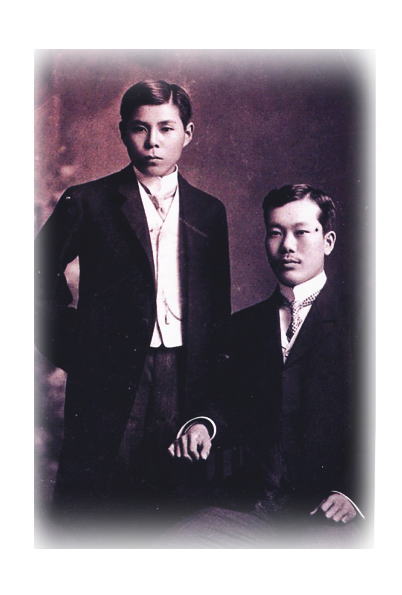
Ten other members formed the "Executive Department" to handle administrative affairs, including:
Commissioners for Military Affairs: Hoàng Trọng Mậu and Lương Ngọc Quyến;
Commissioners for Economic Affairs: Đặng Tử Mẫn and Mai Lão Bạng;
Commissioners for Foreign Affairs: Lâm Đức Mậu and Đặng Binh Thành;
Commissioners for Cultural Affairs: Phan Bá Ngọc and Nguyễn Yên Chiêu;
Commissioners for Secretarial Affairs: Đinh Tế Dân and Phan Quý Chuân (from Taiwan).
The association's headquarters were established in Guangzhou, China.
Within the country, three commissioners were responsible for activities in the three regions: Đặng Xung Hồng (Đặng Hữu Bằng) for Northern Vietnam, Lâm Quảng Trung (Võ Quang) for Central Vietnam, and Đặng Binh Thành for Southern Vietnam.
A military force was also established under the name Quang Phục Army (光復軍). Its regulations, titled "Strategy of the Quang Phục Army", comprised more than 100 pages and were compiled by Phan Bội Châu and Hoàng Trọng Mậu.
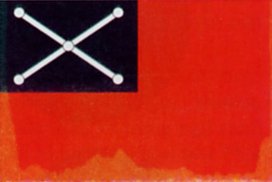
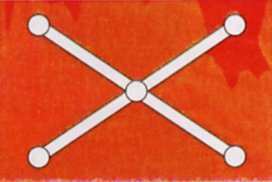
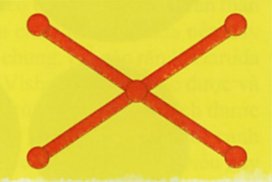
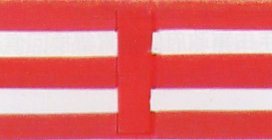
The Vietnam Restoration League adopted a red flag with a dark rectangular field in the top left corner containing five white stars arranged in the shape of an "X", called "five connected pearls", as its organizational flag. The five stars symbolized Northern Vietnam, Central Vietnam, Southern Vietnam, Laos, and Cambodia. The national flag was a yellow flag with five red stars. The military flag of the Quang Phục Army was a red flag with five white stars. The stars here were merely round dots withour points. The yellow color symbolizes the Vietnamese people; the red color represents the southern direction and the Fire element; and the white color represents the righteous cause. The military flag used white stars to clearly express the aim of overthrowing the French colonial government. In his autobiography, Phan Bội Châu wrote about the design of the military flag and the national flag.
After both were expelled from Japan, Phan Bội Châu and Cường Để were no longer closely connected in their activities. Even when the Vietnam Restoration League was founded in 1912, cooperation between Cường Để and Phan Bội Châu was only nominal. When commenting on the newly established organization, Cường Để wrote: "However, without its own financial resources and relying only on external support, it is difficult to achieve good results. Therefore, Phan's activities at that time, although initially lively, gradually faded and by the end of the year there was almost nothing left".[2]
Despite remaining the nominal President, Cường Để had almost no involvement in the activities of the Vietnam Restoration League. When referring to the 1916 uprising, in which Emperor Duy Tân agreed to participate, Cường Để also claimed not to know about it (or pretended not to know?), and stated that the uprising had been organized by the Vietnam Restoration League inside the country. Cường Để also made no mention of the Thái Nguyên uprising (1917), led by Lương Ngọc Quyến (his comrade with whom he had studied for a time at the Tokyo Shinbu School), under the name of the Vietnam Restoration League. From 1912 until Phan Bội Châu's arrest in 1925, Cường Để and Phan Bội Châu no longer truly shared the same goals or worked together.
"In 1925, Phan Bội Châu was arrested and placed under house arrest in Bến Ngự. Cường Để continued to serve as President of the Vietnam Restoration League until 1939. The Vietnam Restoration League was later reorganized into the Vietnam Restoration National Alliance, commonly abbreviated as the Vietnam Phục Quốc Association. According to the new platform, the Association advocated the establishment of a constitutional monarchy, and the future king would be none other than Cường Để, who held the position of lifelong Chief Commissioner in the Central Executive Committee of the Vietnam Restoration League. The national flag was no longer the "five connected stars" flag (of 1912) but a white flag with a red character 王 (king)".[3] The Quang Phuc Army continued to exist, but it did not achieve any significant impact. By 1940, it ceased operations following the firm repression by the French colonial protectorate authorities.
2. Issuance of military bonds
From the time the Vietnam Restoration League was founded, Phan Bội Châu and his associates hoped to launch a revolutionary armed uprising that would, as he wrote in his autobiography Tự phán, "achieve a glorious victory". However, an armed uprising required manpower, material resources, and, inevitably, initial financial support. Under those difficult circumstances, Tô Thiếu Lâu, a friend of Phan Bội Châu from Guangdong, China, proposed issuing revolutionary bonds. The revolutionary bonds would be issued in Liang Yue (the two provinces of Guangdong and Guangxi), with a portion also issued in Vietnam. The revolutionary bonds were sold with only the promise that, once the revolution succeeded, they would be redeemed for silver.
"Phan Bội Châu entrusted Hoàng Trọng Mậu and Tô Thiếu Lâu with secretly traveling to Hong Kong to print the revolutionary bonds on Chinese paper in four denominations: $5, $10, $20, and $100".[4] The monetary unit on the revolutionary bonds was the viên, equivalent to the Chinese yuan, the piastre, or the đồng when issued in Vietnam. During the organization's early days, funds had to be raised through donations. "Admiral Trần Kỳ Mỹ in Shanghai donated 4,000 đồng and 30 artillery shells".[5] Later, thanks to the sale of the revolutionary bonds, "many people became supporters and applied to join. An assembly of nearly 200 people was convened, and they purchased revolutionary bonds with real money, contributing more than $1,000 in support".[6] "At that time, the Governor of Guangdong, Trần Quỳnh Minh, was very supportive, allowing the Vietnam Restoration League to operate freely, and several thousand đồng were raised through the sale of the revolutionary bonds".[7]
To date, no documents have recorded the number of revolutionary bonds issued. However, based on the number that were sold, we may still hope to find examples of all the denominations issued by Phan Bội Châu.
3. The $100 Revolutionary Bond from the collection of Bùi Mạnh Tuấn
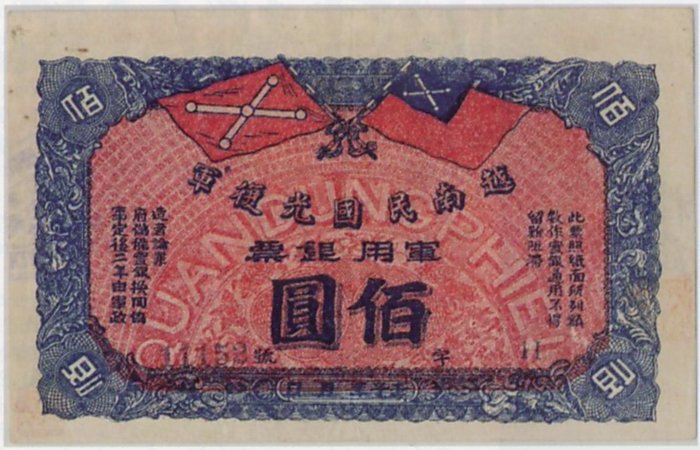
Bùi Mạnh Tuấn, a German-Vietnamese collector of Vietnamese currency, sent me images of a $100 Military Bond. His wish is for Vietnamese collectors to work with him to study this bond in greater depth.
Every time I look at the image of this note, I am reminded of the "debt" I owe to Bùi Mạnh Tuấn. I sincerely hoped to find images of other denominations to complete the information, but ten years have passed and I have not been able to find any others.
In a letter to me, Bùi Mạnh Tuấn wrote: "For many years, I have tried to follow international auctions, especially in Singapore, Shanghai, and Hong Kong, and have also asked a well-known old coin dealer in Hong Kong to help search for them. Unfortunately, I have not found the remaining pieces".
Therefore, I would like to introduce the $100 note to fellow collectors, in the hope that somewhere in the world a collector will publish images of the other denominations.
3.1. Obverse of the Bond:
The obverse bears Vietnamese and Chinese text. The design is very similar to that of Republic of China banknotes. At the top left is the military flag of the Restoration Army; at the top right is the organizational flag of the Vietnam Restoration League. The words "QUÂN DỤNG PHIẾU" (Military Bond) are printed in Vietnamese in the same color as the background. Above them is the following inscription in Chinese:
越南民國光復軍 = Restoration Army of the Republic of Vietnam
軍用銀票 = Military Silver Voucher
佰圓 = 100 Yuan
字號 = Serial Number (No. 11152)
壬子年 月 日 = Year of Nhâm Tý (1912), Month ..., Day ...
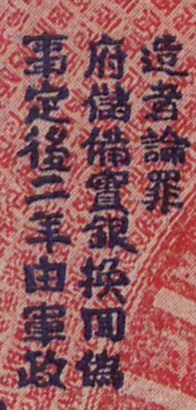
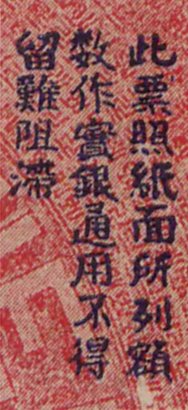
Chinese inscription on the left (Figure a):
事定後二年由軍政府儲備實銀換回偽造者論罪
= Within two years after the revolution succeeds, the military government will redeem this note with silver from its reserves. Counterfeiters shall be prosecuted.
Chinese inscription on the rigt (Figure b):
此票照紙面所列額數作實銀通用不得留難阻滯
= This note shall be accepted as silver according to the denomination stated on its face, and no one may delay, obstruct, or refuse it.
3.2. Reverse of the Bond:
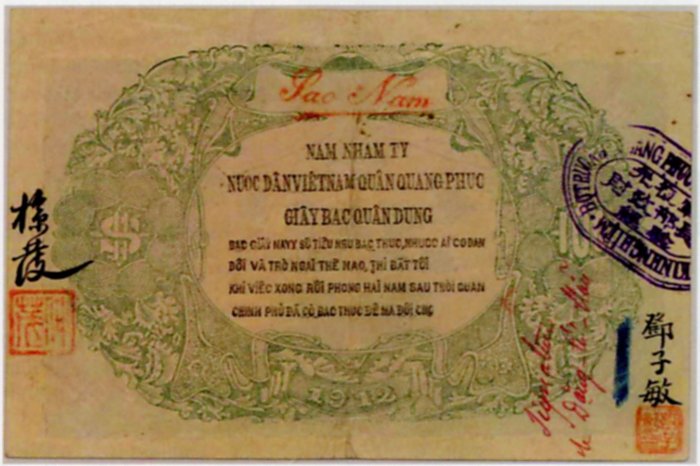
At the top is "Sào Nam" in red - Phan Bội Châu's pseudonym, used as his signature.
Vietnamese textin the center:
NĂM NHÂM TÝ = The year of NHÂM TÝ (1912)
NƯỚC DÂN VIỆT NAM QUÂN QUANG PHỤC = Vietnam Restoration Army
GIẤY BẠC QUÂN DỤNG = Military Note
Bạc giấy này y số tiêu như bạc thực. Nhược ai có gian dối và trở ngại thể nào thì bắt tội.
= This bill shall be accepted at its stated value as real silver. Anyone who acts fraudulently or obstructs its acceptance shall be punished.
Khi việc xong rồi phỏng hai năm sau thời quân Chính phủ đã có bạc thực để mà đổi cho.
= When the undertaking is completed, about two years later, the military government will have real silver to redeem it.
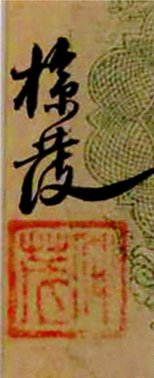
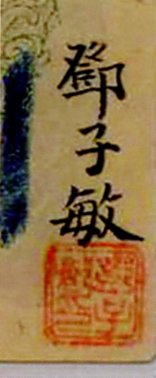
On the left is a seal bearing the characters Trọng Mậu (the name of Hoàng Trọng Mậu) (Figure c). On the right is the seal of Đặng Tử Mẫn (Figure d). Đặng Tử Mẫn was from Hành Thiện village, Xuân Trường phủ, Nam Định Province. He had a special talent for manufacturing gunpowder and was a leader of the combat forces. He was arrested and executed by firing squad in Yunnan, China.[8]
At the bottom of the obverse and reverse is the year of issue - 1912.
To date, some collectors have identified a Revolutionary Bond as having a denomination of $1, but we do not agree with this interpretation. The Revolutionary Bond was a means of raising funds, not a currency for daily transactions; therefore, it did not have small denominations, and no mention of them can be found in historical documents. To date, only the $100 Revolutionary Bond from the collection of Bùi Mạnh Tuấn fully matches all the characteristics, both in form and content, described in historical documents.
Images of the $5, $10, and $20 Revolutionary Bonds remain undiscovered... We await further comments and research from collectors and scholars on this unique Revolutionary Bond.
We sincerely thank Mr. Võ Khắc Vãng of Huế for translating the Chinese inscriptions used in this article.
Resources:
- Phan Bội Châu, 1956. Tự phán. Nxb Anh Minh, Huế.
- Phạm Giật Đức, 1960. Năm mươi năm cách mạng hải ngoại, hồi ký của Hoàng Nam Hùng. Nxb Ấn quán Hồng Phát.
- Trần Viết Ngạc. Kỳ Ngoại Hầu Cường Để (1882 - 1951), mặc Hoàng bào dù chẳng được làm vua! Chim Viet Canh Nam journal.
- Hoàng Cơ Thụy, 2002. Việt sử khảo luận. Nxb Nam Á, Paris.
- Phan Bội Châu, 1990. Phan Bội Châu toàn tập. Nxb Thuận Hóa, Huế.
(*) Image of the Revolutionary Bond from the collection of Bùi Mạnh Tuấn, Germany.
[1] Cường Để belonged to the main line of Emperor Gia Long and was a descendant of Crown Prince Nguyễn Phúc Cảnh. Unfortunately, the Crown Prince died early and could not succeed to the throne. Emperor Gia Long chose his fourth son, Prince Nguyễn Phúc Đảm, as successor instead of his eldest grandson, Nguyễn Phúc Đường (Mỹ Đường), whom most high-ranking officials supported. Cường Để's paternal grandfather was the son of Mỹ Đường, Duke Cảm Hóa Lệ Chung (Duệ Chung). Duke Hàm Hóa Hương, son of Cảm Hóa, was Cường Để's father.
[2] Trần Viết Ngạc. Kỳ Ngoại Hầu Cường Để (1882-1951).
[3] Trần Viết Ngạc. Kỳ Ngoại Hầu Cường Để (1882-1951).
[4] Phan Bội Châu. Tự phán, p. 168.
[5] Hoàng Cơ Thụy. Việt sử khảo luận, p. 1663.
[6] Hoàng Cơ Thụy. Việt sử khảo luận, p. 1663.
[7] Hoàng Cơ Thụy. Việt sử khảo luận, p. 1664.
[8] Phạm Giật Đức. 50 năm cách mạng hải ngoại.