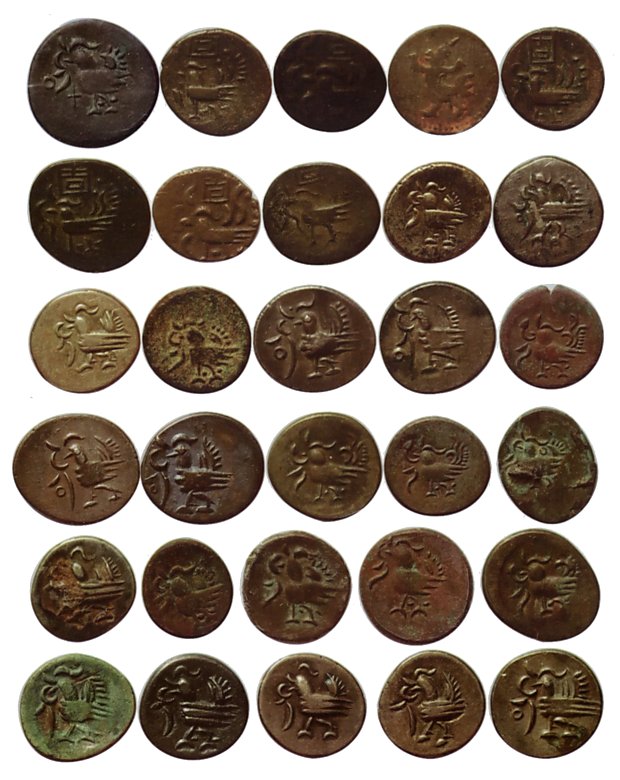
Hamsa and Garuda coins
Lê Khánh Ngọc Anh, Vietnam Numismatics #3 (04-2018), p.9-17
"Chicken coins"
Hamsa and Garuda coins were minted in Cambodia, but are found in large numbers in Vietnam, especially in the provinces of An Giang, Tiền Giang, and others. Collectors commonly call them "chicken coins". There have been different views among Vietnamese coin collectors on how to classify these coins. Some collectors place them in the group of foreign trade coins, while others disagree. However, it is certain that they were once used as a means of payment in some areas that are now part of Vietnam.
Among coin collectors in Vietnam, there is hardly anyone who has not heard of "chicken coins" over the years. This term gives a familiar, friendly, and very everyday feel. So, what are "chicken coins"? Within the scope of this article, we would like to introduce to readers the basic concepts and some typical examples of "chicken coins". This article is translated from the Hamsa and Garuda coins pages on the https://coincoin.com website by Scott Semans, for readers' reference and further discussion. It is intended to help collectors add to and strengthen their basic knowledge of these coins. Scott Semans offers a highly distinctive perspective on both history and collecting. He does not even use the Standard World Coins Catalog, which is widely used by coin collectors. There will still be many different views and debates surrounding this issue. Within the scope of this article, we respectfully ask readers to consider Scott Semans' views and research, while also contributing their own comments and suggestions. This will help us continue to refine and expand the material on the “chicken coins" series in future issues of the magazine.
I. Overview of the historical formation and development of Cambodia in relation to the emergence of chicken coins
1. Period 1600-1870 (under Siamese domination)
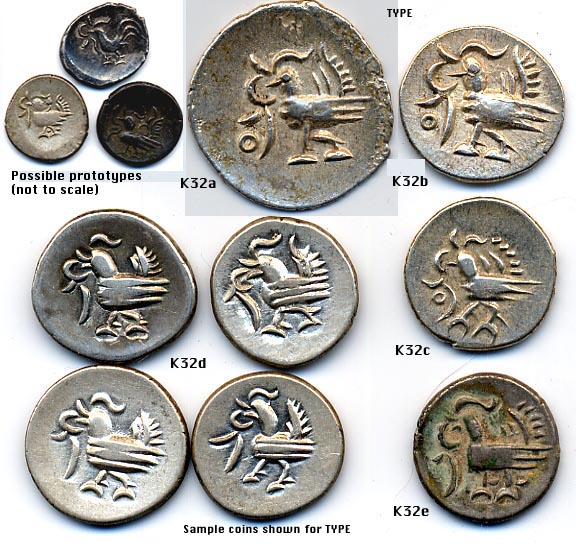
Joe Cribb suggests that during this period there was only one basic type: the Hamsa bird coin (K27, K32). He also notes the development of both the metal composition and the style. He believes that there were two separate lines: the silver Fuang and the Pe, made of billon or silver-plated metal, known as takung takom. The silver content of Fuang decreased in the early varieties. However, it then appeared to remain unchanged, although the weight of the coins stayed nearly the same. The billon Pe type has four varieties. Their weights vary over a wide range, suggesting that they were token coins. However, he is not certain whether Pe was issued before, after, or at the same time as Fuang.
Design details of the Fuang coin: a Hamsa bird standing and facing left, with its body in the center of the coin divided into three lines running from head to tail. The tail is formed by three vertical lines (curved or straight), and the tail feathers consist of five horizontal lines. Both the right and left legs have spurs and are attached to the body. The beak is a single line, and a raised dot represents the eye (which may not be visible when the coin is worn). At the top are two curved lines depicting the upper crest. A third C-shaped curve represents the tip of a grape branch held in the Hamsa's beak. The two lower curved lines may represent either the lower part of the grape branch or the bird's lower crest. The bird designs vary in size, with the head being the most notable difference. However, these variations have no relation to changes in silver content, nor to the position or outer shape of the coins. The outer shapes of the coins vary greatly and follow no fixed rule. They may be round or disc-shaped, with different thicknesses, sometimes concave like a shallow bowl or flat. Sizes range from 17 mm to 12.5 mm. The average weight is about 1.53 g, and it is independent of the silver content, the overall size of the coin, and the size of the bird design.
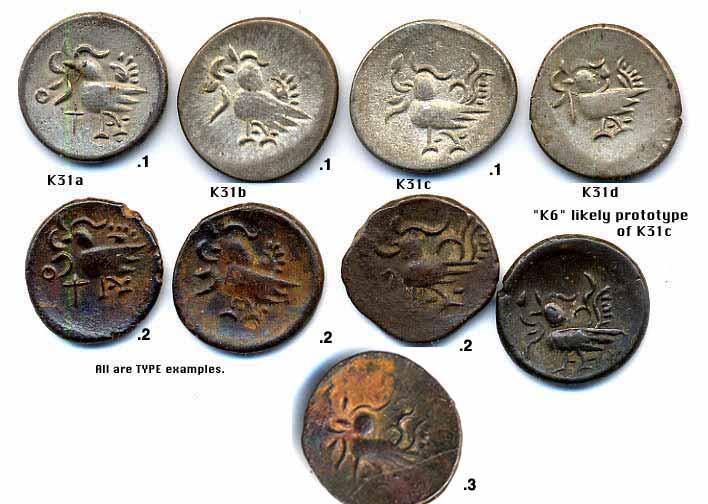
K31a.1 Hamsa Pe (Circle & Cross variety): Hamsa standing and facing left, with a square body at the front and, above the tail feathers, a design merging into a forward-pointing tuft, with five horizontal bar marks behind. The cross on the coin may suggest a Christian influence. This is the rarest of the four types (K31). Based on the recorded specimens, this type is about 11-14 mm in diameter and weighs 0.89-1.46 g. Most of these pieces are made of billon or pure copper.
K31a.2 Hamsa Pe (Circle & Cross variety): Made mainly of copper or low-grade billon.
K31b.1 Hamsa Pe (without the Circle & Cross variety): Hamsa bird with the same basic style, but cruder and less detailed. This type may have been issued later, with billon being more common than copper.
K31b.2 Hamsa Pe (without the Circle & Cross variety): copper, with a crude Hamsa bird design and thinner-than-usual flans.
K31b.3 Hamsa Pe (without the Circle & Cross variety).
K31c.1 Hamsa Pe (variety based on tail differences): This variety has a rather unusual style, with a bud emerging at the tip of the vine branch and the second vertical tail feather split in two. Made of billon or silver-plated.
K31c.2 Hamsa Pe (variety based on tail differences): copper, with cruder minting quality.
K31c.3 Hamsa Pe: Thin flan, with the bird's head bulging into a round shape and separated from the body, in a cruder style. This type may represent the final phase of this coin series.
K31d Hamsa Pe (variety based on the vine branch behind the bird's neck and tail-feather variation): The tail feathers are similar to those on the silver Fuang coins.
KA31 Hamsa 2 Pe (variety based on the vine branch behind the bird's neck): Larger size, 14-15.5 mm, weighing about 2.70 g, with a clear standard indicating a two-unit coin. Copper is more common than billon, and the striking style is cruder, suggesting this may represent the final phase of this coin series.
K32a Hamsa Fuang: With a circle and three straight tail feathers, larger in size and with higher silver content.
K32b Hamsa Fuang: With a circle and three straight tail feathers, smaller in size and with lower silver content (KM32.1).
K32S1 Hamsa Fuang: Includes all three forms of K32a and K32b, ranging from large to medium and small, in both silver content and coin size.
K32c Hamsa Fuang: Two straight tail feathers with five distinct horizontal bars. The bird's body is formed by three separate lines, with a small head and no clearly visible eye. Lower silver content. Thick flan, diameter about 13-14 mm, weight 1.58 g.
K32d Hamsa Fuang (without the circle in front of the bird): The second part of the crest has become the upper part of the beak, with the vine branch between them. Lower silver content, about 0.500-0.600, size 12-13.5 mm, weight 1.77 g, noticeably heavier, perhaps to compensate for the lower silver content. The varieties of this type include three or two straight tail feathers merged into one; four or five horizontal tail bars (sometimes three or six also occur); and the right or left leg positioned at the center of the bird's body. Differences in weight are not related to variation in type.
K32d.1 Hamsa Fuang: The Hamsa bird design is intermediate in style between K32b and K32d. This is a typical example of the group without the circle in front of the bird's body.
K32e Hamsa Fuang: Crude design, billon, about 13 mm in diameter and weighing about 1.76 g. The bird's body is solid and square at the front, with the head projecting forward. In 2006, a specimen of this type weighing 5.63 g was found, which may represent a 4-Fuang coin.
K32e.1 Hamsa Fuang: Smaller in size and lighter in weight, with several other features suggesting this may be the final form of this Fuang type. Diameter about 12 mm, weight 1.22 g.
KA33 Hamsa 4 Fuang: Crude design, billon alloy, estimated silver content about 0.400-0.500, diverse just like K32e, diameter 13 mm, weight 5.63 g.
2. French Protectorate period
The first national coinage of Cambodia was struck at Udong using European dies and machinery. A problem occurred during striking with Ingram dies in 1853, resulting in a second series in 1856 using Heaton dies. Many types of dies with different variations were used, although the differences between them were minor. Only the tical and 1/4 tical coins were struck across all three periods.
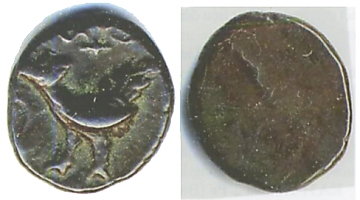
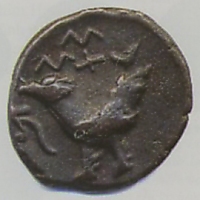
K1 Pe (1847-59): Weight 2.66 g, corresponding to the 1/100 salung standard; size 13 x 14.5 mm; uniface.
K1 Pe (1847-59): Weight 2.58 g, corresponding to the 1/100 salung standard; diameter 14 mm; uniface.
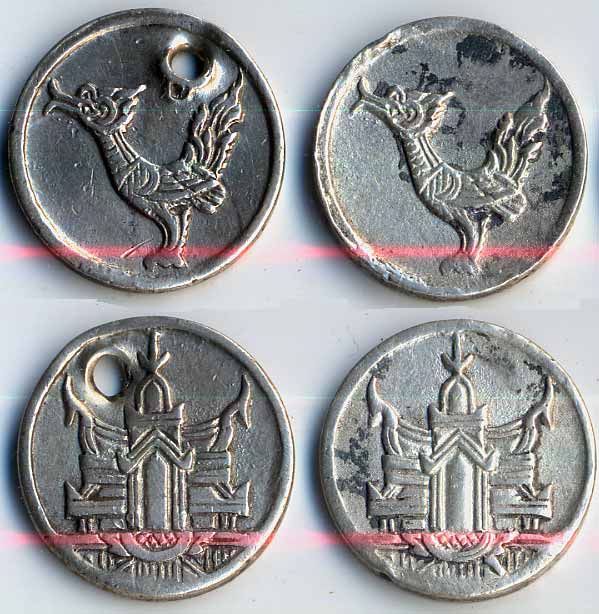
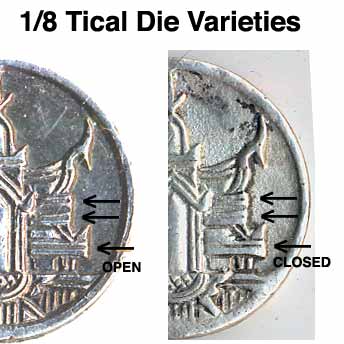
K33a 1/8 Tical (1856, Heaton dies): Obverse with the temple design and a closed horizontal groove. Weight 1.68 g.
K33b 1/8 Tical (1856, Heaton dies): Obverse with the temple design and an open horizontal groove. Weight 1.73 g.
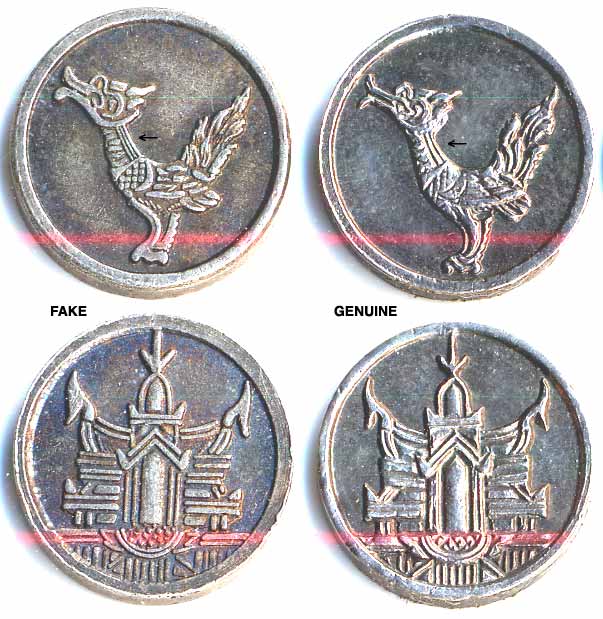
K33X 1/8 Tical Lapa counterfeit (1970s): Heavier (about 2.0-2.5 g), thinner, with cruder dies. There are many differences in the bird design, the most obvious being the neck: five horizontal lines and three diagonal lines, compared with six horizontal lines and two diagonal lines on the genuine coin. The temple design is reproduced quite accurately from K33b, but in a cruder style.
K34 1/4 Tical (c. 1856, Heaton dies): Diameter 20 mm, weight 3.63 g. The design was substantially revised, with inscriptions appearing for the first time.
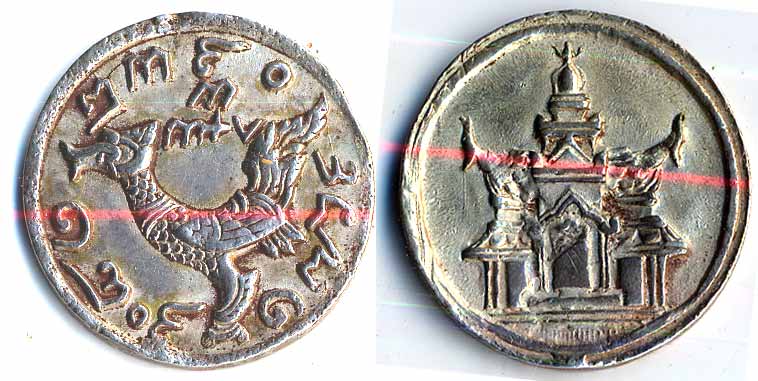
K35 1/4 Tical (1853, Ingram dies): Diameter 22.5 mm, weight 3.65 g.
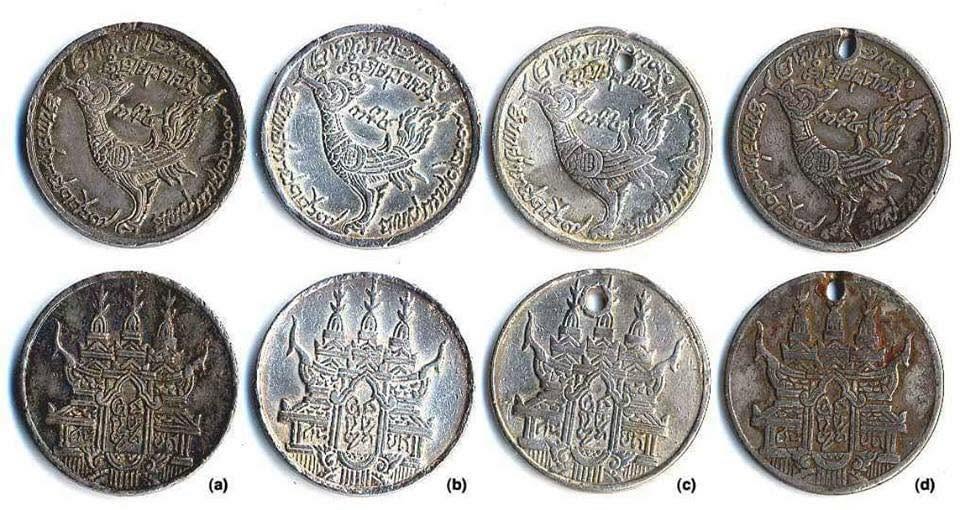
K36 Tical (c. 1856, Heaton dies): Diameter 30 mm, weight 14.0-15.5 g, with substantial revisions to the design.
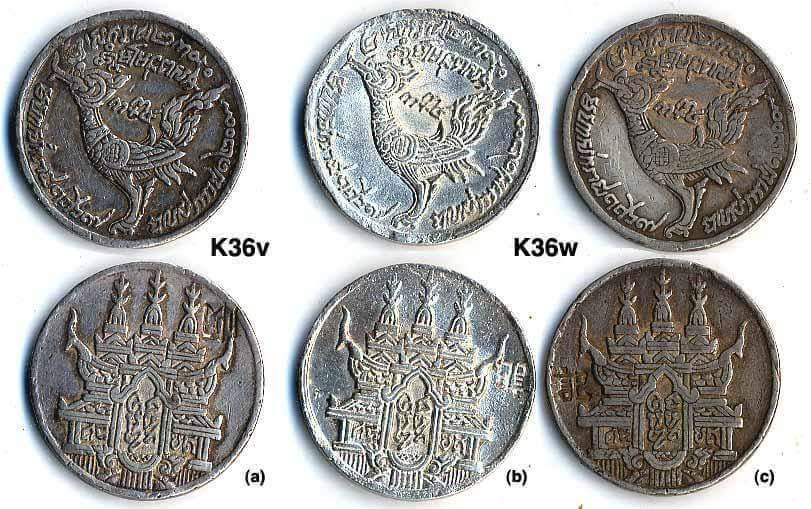
K36 Tical, counterstamped (c. 1856, Heaton dies): Diameter 30 mm.x
- v) Chopmark on the temple side.
- w) Chinese character on the temple side.
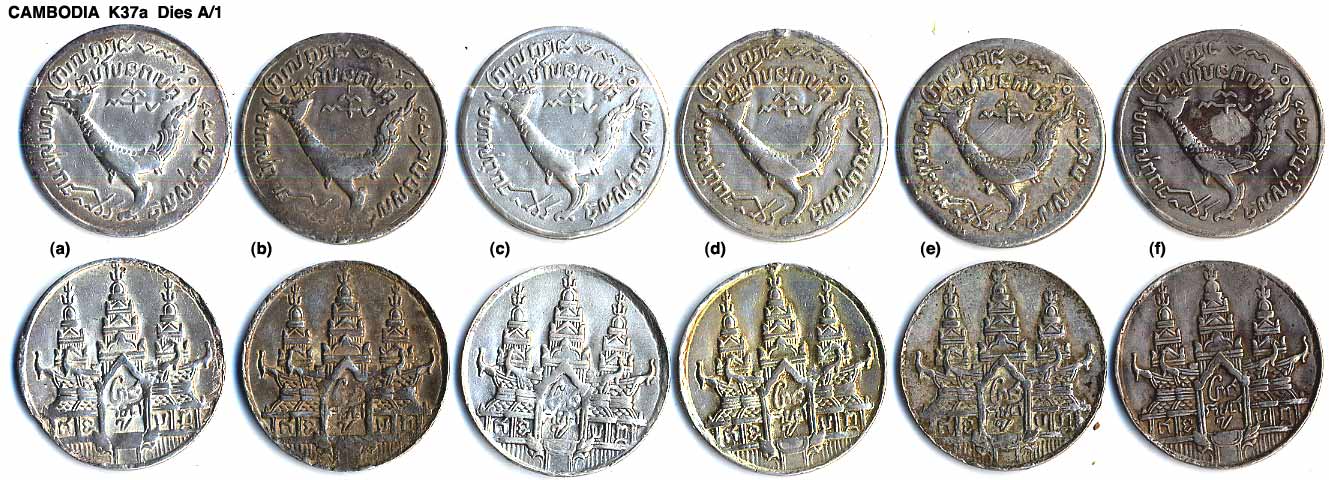
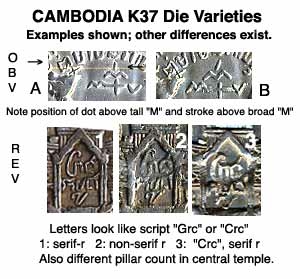
K37a Tical (1853, Ingram dies): Diameter 35-35.5 mm, weight 14.3-15.4 g. Die A1 variety.
K37b Tical (1853, Ingram dies): Diameter 35-35.5 mm, weight 14.3-15.4 g. Die B2 variety.
K37c Tical (1853, Ingram dies): Diameter 35-35.5 mm, weight 14.3-15.4 g. Die B3 variety.
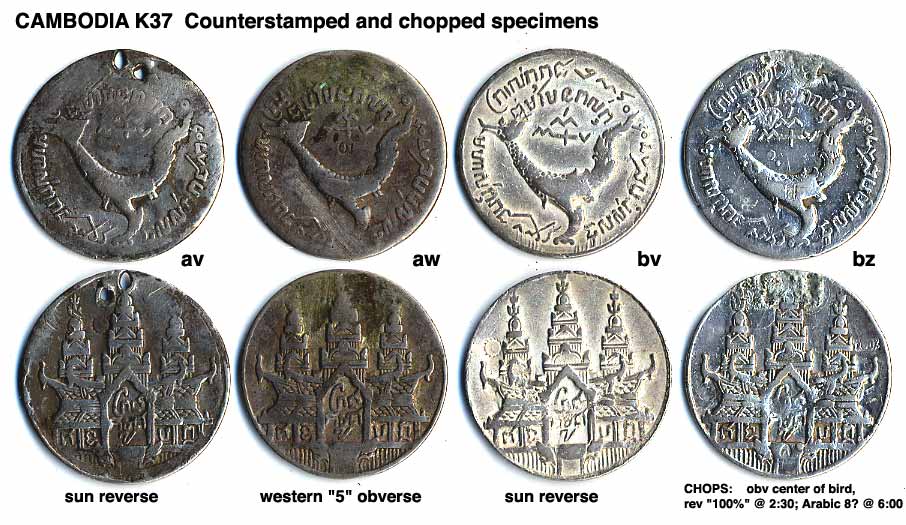
K37 Tical, counterstamped (1853, Ingram dies): Diameter 35 mm.
- av) K37a, sun symbol on the temple side.
- aw) K37a, Latin numeral 5 on the bird side.
- bv) K37b, sun symbol on the temple side.
- bz) K37b, chopmark at the center of the bird's body, possibly a Chinese or Arabic character.
K39 1/4 tical pattern (1855 or later): Tin, weight 2.55g, size 20mm.
Small-denomination coinage: Hamsa Pe coins (K11), commonly struck between 1870 and 1900, suggest a strong demand for low-denomination currency compared with 5 and 10 centimes coins. Standard Garuda Pe coin (K26), issued between 1880 and 1902, was struck using machinery from a mint established in 1880. Several dies were used, but there is little variation between them. Within the same Garuda series, the 4 Pe denomination is significantly rarer.
Centime coins (KM-TN1), pattern and trial strikes, were produced in Europe in 1897 (Lecompte, Yeoman) or 1875-1904 (KM), corresponding to the issues widely used in French Indochina and Cochinchina, 1875-1902.
K11 Hamsa (Praq) Pe: A rather crude Hamsa facing left, with a crest, vine branch, and tail feathers rendered as separate elements around the figure. A framed Chinese character Ji [吉] (good fortune) is placed above. Along with variations in design style and silver content, some variants show one or two dots above the tail feathers and five horizontal bars on the tail. Later variants do not have the upper dots and show four dots at the rear.
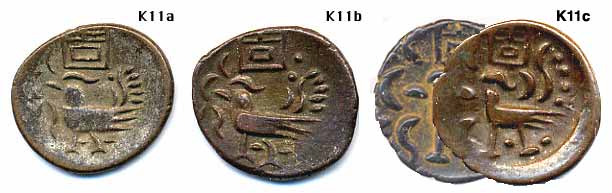
K11a: one dot above the tail feathers, five horizontal bars behind.
K11b: two dots above the tail feathers, five horizontal bars behind.
K11c: no dots above the tail feathers, five dots behind.
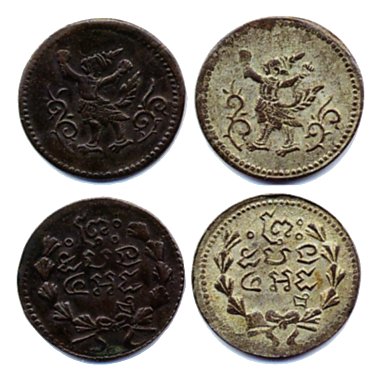
K26 Garuda Pe: Machine-struck coin produced between c. 1880 and 1902. Garuda standing facing left; the reverse bears the old Khmer inscription "Preah/Dambaan" (Battambang). Both sides have a beaded border near the rim.
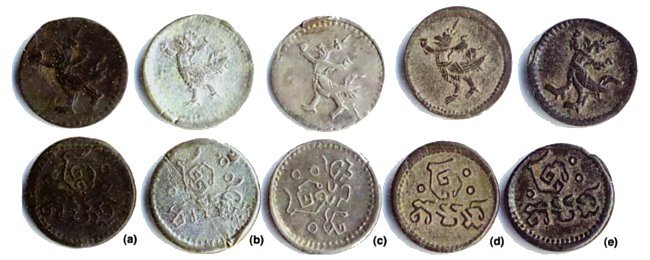
K30 Garuda 4 Pe: Similar in design to the Pe, but distinguished by an upturned tail and a different artistic style. The obverse has three lines of inscription within the wreath. Diameter 22 mm, weight 3.89-4.54 g (versus an average of 1.2 g for the Pe).
II. Related context
1. Hamsa is a Sanskrit term referring to a waterfowl, commonly interpreted as a goose or swan; however, it is traditionally regarded as a sacred bird and an important symbolic motif in Indian culture and throughout Southeast Asia.
According to Hindu belief, the Hamsa is a goose that migrates during the summer to the sacred Lake Manasarovar in the Himalayas. Manasarovar means "Lake of the Mind", as it is believed to be the first lake conceived in the mind of Brahma, the Creator god. The lake is associated with purity: anyone who drinks its water is believed, upon death, to attain rebirth in the realm of the god Shiva, and the lake's waters are said to have the power to cleanse the sins of a hundred lifetimes. Because it lives in such a pure and sacred lake, the Hamsa is an important symbol within the iconographic system of wisdom and beauty. The Hamsa is known by different names across various cultures and languages: hans in Hindi; hintha or hinthar in Burmese; and hong in Mon, Shan, Khmer, and Thai. In Tibet, the swan is known as ngang pa (Sanskrit: hamsa), while the goose is called so bya (Sanskrit: karanda). In Hindu and Buddhist artistic traditions, these two birds are frequently conflated and are often collectively designated by the term Hamsa.
The Hamsa also serves as the mount (vahana) of Brahma, the Creator god. In the Upanishads, the Hamsa embodies the divine wisdom of Brahman. It is also the mount of Sarasvati, the consort of Brahma and the goddess of wisdom and knowledge. The Hamsa is believed to eat pearls and to be able to separate milk from a mixture of milk and water, symbolizing clarity of perception and profound wisdom. The Hamsa's flight across the vast sky also symbolizes liberation from the cycle of rebirth.
The Hamsa appears in the cultures of Southeast Asia, initially through Brahmanical influence and later through its integration into Buddhist art. In Brahmanical religious monuments, the Hamsa is regarded as a sacred bird symbolizing wisdom. From this symbol of wisdom, the Hamsa was adopted by Buddhism as a symbol of the spreading of the Dharma. Erecting banner poles topped with Hamsa statues - called Hong - is common in Khmer and Thai temples. Furthermore, Hong/Hamsa is also found in decorative motifs in temples and stupas...
In Thailand, the Hamsa is called hong. It is considered the most beautiful mythical creature. This mythical bird resembles a swan, with a long body, a slender neck, fluffy feathers, and a fanned tail, and it appears gracefully in many temples in northern Thailand. In addition, there are variants with enlarged, puffed cheeks, a distinctive feature of the Burmese/Lanna form of the Hong bird. In temples in northern Thailand, the Hong bird is sometimes depicted as an ornate carved figure mounted on the prow of a dragon boat-shaped roof. It is possible that the abstract forms of the Hong bird represent guardian or protective bird figures, appearing in other roof-end carvings found in some Lanna and Lao temples. The difference lies in the elongated, curved stylization of the head and the hooked beak, which can be long or short depending on each artisan. The Hong bird is viewed as an intermediary between humans and the gods/Buddhas. The Hong bird often holds a cord or vine in its beak, from which a bodhi leaf is suspended, symbolizing movement in the light wind carrying prayers from the earthly realm to the heavenly realm of the Buddha and gods.
In summary, the Hamsa, originally a sacred mythical bird in Hinduism, was subsequently transformed into the Hongsa, Hintha, and Hong in Theravāda Buddhism, while in the context of Chinese culture it became the wild goose in Mahāyāna Buddhist tradition.
2. Garuda, also known as the Golden-Winged Bird and Ca-lâu-la, is a mythical bird in Hinduism that was later adopted into Theravāda Buddhism. In Hinduism, Garuda is the mount of Vishnu, depicted as a bird of prey with a human head, three eyes, and an eagle's beak.
Garuda is both a cousin and an enemy of the descendants of the serpent deity Naga. Garuda is often depicted tearing apart serpents with its beak and crushing them under its sharp-clawed feet. The serpents he kills are often depicted with human heads and upper bodies in place of the heads of reptiles. According to legend, the serpent deity Naga killed the mother of Garuda, which is why they are sworn enemies. Whenever encountering a serpent, Garuda tears it apart. Later, he was subdued by the god Vishnu and became his mount. The size of Garuda is not described in detail, but his wings are said to be extremely large, extending for several miles. This may be a mythological exaggeration, but it is said that when Garuda flaps his wings, he creates storm-like winds that can darken the sky. Today we can see Garuda in Theravāda Buddhist temple architecture in Vietnam, Thailand, and Cambodia, where Garuda figures are used to support temple roofs... The image of Garuda is also the central motif on the national emblems of Thailand and Indonesia. In Thailand, Garuda is depicted in a traditional style as a mythological human-like figure, while in Indonesia it is represented in a heraldic style with features resembling the Javan hawk-eagle.
With the meanings and characteristics of the "chicken coin" and the related topics discussed above, we would like to share this with readers in order to explore, exchange, and share basic knowledge about this field of metal coinage. We welcome readers to share further insights or alternative hypotheses regarding the "chicken coin" series to advance our collective study. Our sincere thanks!
III. Hamsa coins from the collection of Lê Thị Hoài Thu, Hanoi: