Trường Sơn money
Nguyễn Văn Mai, Vietnam Numismatics #3 (04-2018), p.3-8
After the Geneva Agreement of 1954, the Americans manipulated the government of Prime Minister Ngô Đình Diệm, abandoning the consultations for a general election to reunify North and South Vietnam.
After the government of the Republic of Vietnam was established, the revolutionary movement in South Vietnam was suppressed and suffered heavy losses. At this time, the Government of the Democratic Republic of Vietnam (DRVN) resolved to supply aid to the southern revolution to restore and strengthen its forces. The overriding principle was to operate with utmost tact and absolute secrecy, preventing the United States from using the pretext of a DRVN "invasion" of the South to launch a military intervention in Vietnam. In early May 1959, Colonel Võ Bẩm was assigned the task of establishing a secret "Special Military Task Force" to open the Trường Sơn route to provide support to the Southern battlefield. The unit was established in May 1959, so it was designated Group 559. Khe Hỏ, located in a narrow valley southwest of Vĩnh Linh, was the starting point of the route crossing the Trường Sơn Range, in an extremely remote and rugged area.
The initial strength of Group 559 was 500 soldiers and officers, with Colonel Võ Bẩm serving as its commander. The group was organized into a foot transport battalion (Battalion 301, commonly referred to as Group 301) and support units responsible for warehouse construction, cargo packing, weapon repair, equipment maintenance, and other services. The ground transport force was mainly recruited from Division 305 of Interzone 5 troops, who had regrouped and were stationed in Phú Thọ. Most of the soldiers and officers were from Quảng Nam and Quảng Ngãi and were between 28 and 35 years old.
The "3 no" policy - "Move without traces, cook without smoke, speak without sound" - became an absolute rule of Group 559. On June 14, 1959, Group 301 was ordered to begin operations along the route. After two days of traveling by train to Hàm Rồng Station in Thanh Hóa, and continuing by transport truck, Group 559 arrived at the barracks of Division 325, southwest of Đồng Hới town. Here, the unit was "civilianized" and "localized" in all lifestyle aspects, by switching to local civilian clothing, wearing tire sandals, replacing backpacks with rattan baskets, and so on. To ensure maximum secrecy, all of the unit's weapons and essential gear were old models left over from the French colonial era. After reviewing all preparation steps and reinforcing determination, the commander of Group 301 ordered the advance into the Trường Sơn Range, opening a campaign to establish a supply route supporting the Southern battlefield. On August 20, 1959, soldiers of Group 301 carried supplies on their backs through forests and over mountains, successfully delivering the first shipment, consisting of 20 Thompson submachine guns, 20 MAT rifles, and 10 crates of ammunition for submachine guns and rifles, safely to Tà Riệp (Thừa Thiên - Huế), greatly encouraging the soldiers and officers of Interzone 5.
With the consent of the Lao side, in mid-1961, Group 559 expanded its operations from the Eastern Trường Sơn route by opening an additional supply route along the Western Trường Sơn, running along the Vietnam-Laos border. After this highly important special border route, the unit opened Route 129, the third corridor, which used motor transport and crossed two major rivers, the Xe Pangkong and Xe Pangkhiang, in Laos.
In addition to the three main transport corridors, from 1961 to 1964, Group 559 opened additional east-west routes to strengthen support for the Southern battlefield and to assist the neighboring countries of Laos and Cambodia. At this point, the Trường Sơn route system had become a strategic supply network, growing significantly in both manpower and operational importance. The official strength of Group 559 at this time had increased to 24,000 men. In addition, there was support from reinforced engineer units participating in route construction, Vietnamese volunteer units coordinating with Pathet Lao forces to hold newly liberated key areas in Laos, youth volunteer forces, frontline laborers, and marching units passing through the route to reinforce the Southern battlefield. In total, the number of personnel operating along the entire route reached 60,000. At this time, logistics support work required improved and upgraded management measures to match the rapidly increasing number of personnel in operation.
In the early period, the troops had to take care of their own cooking and daily needs while on the move. Food supplies always had to be carried as personal reserves. Gradually, logistics support along the routes was organized into communication stations (later upgraded to military transport stations), with each station located about one day's march apart. Passing through each communication station, the troops could rest, turn in a meal coupon for a meal, and then receive packed rice to carry with them on the march to the next station.
Food supplies for the troops were very scarce, as they had to be transported by pack baskets and bicycles, and little remained by the time they reached the route. To comply with the "3 no" policy, the use of firearms to hunt wild animals for additional food was strictly limited. Conditions along the trail were incredibly harsh. The official meal allowance of 0.98 đồng per person per day in meal coupons was often little more than a formality. Sometimes, they had only a handful of rice for the whole day, and in some meals they ate only wild roots and forest bamboo shoots. In the later period, the supply of food rations and foodstuffs was relatively sufficient, but the route had been discovered by the enemy and was heavily attacked and destroyed. Some stations were bombed by the enemy before meals could be cooked, and because of mission requirements, the soldiers could not stop to wait for a meal at the station. When logistics stations were hit by bombs, soldiers were left with only roasted rice and dry rations carried with them.
Besides food, essential supplies for the troops were also not provided regularly or in sufficient quantities, and were often distributed uniformly regardless of actual needs. Stations issued whatever supplies they had available, while marching units, fearing they might not receive them again for a long time, would accept whatever was offered. Distribution was both insufficient and overlapping, leading to situations where one unit had enough sweets to last a month, while another had nothing but pipe tobacco throughout the year. No wonder that nearly every soldier became an expert at smoking the heavy rustic tobacco. The smoke drifted from their mouths like a flock of dragons winding through the air, and the crisp crack of the water pipe echoed like mothers tickling their children's bellies, a sound that delighted the ear and swept away the weariness of the long, difficult march... Logistics support lacked proper methods for managing and distributing supplies, and there was no system for tracking and making up shortages to ensure troops received their full food and living allowances. Bookkeeping by the units, based on meal coupons, no longer accurately reflected the financial situation of the troops along the route.
Furthermore, the troops along the route were from diverse backgrounds. Apart from some young soldiers receiving allowances, most officers and soldiers were married and already on salary; after joining the route, they also received additional field duty allowances. At this time, the special financial task was to find measures to ensure stability for both the front line and the rear for the officers and soldiers of Group 559; to ensure that troops along the route had enough food and clothing, while still allowing part of their salary to be sent back home to support their families.
In April 1965, Comrade Nguyễn Văn Chu, who was serving in a unit under the Finance Department of the Ministry of National Defence, was sent to the route and appointed Head of the Finance Section of the 559 Command. His first priority with the Finance Section was to establish regulations and guidelines for troops to deduct part of their salaries and send them to their families via postal service. To carry out this task, Group 559 set up a rear finance office at Station 63, Lý Nam Đế Street, Hanoi.
Next was how to ensure that troops along the route received and used the full standard recorded on their meal coupons and other daily necessities; if the full amount was not available at present, it had to be compensated later. Therefore, a form of document or voucher system was needed to serve as a basis for ensuring compensation and additional supply distribution to the troops.
In May 1966, Comrade Nguyễn Văn Chu was sent to Hanoi to report to the Finance Department and the General Department of Logistics on the irrational use of meal coupons along the Trường Sơn route and to propose a new type of voucher to replace them. With the approval of the General Department of Logistics and the Finance Department of the Ministry of National Defence, Comrade Chu was then assigned to work with the State Bank of Vietnam.
Using standard currency was naturally very convenient for daily spending, ensuring the entitlements and benefits of officers and soldiers, and facilitating smooth auditing and settlement with superiors. However, under the conditions of intense war, with operations spread across vast and rugged mountainous forest areas, transporting cash would face countless difficulties. Furthermore, the number of troops operating along the route was constantly changing, so to meet needs in all situations, a reserve amount of cash had to be kept in the Trường Sơn area. Keeping a large amount of money idle in the Trường Sơn area would directly affect the entire national economy... The Governor of the State Bank of Vietnam agreed to print and issue within Group 559 a type of "military canteen stamp" with a value equivalent to the Vietnamese đồng issued by the State Bank of Vietnam.
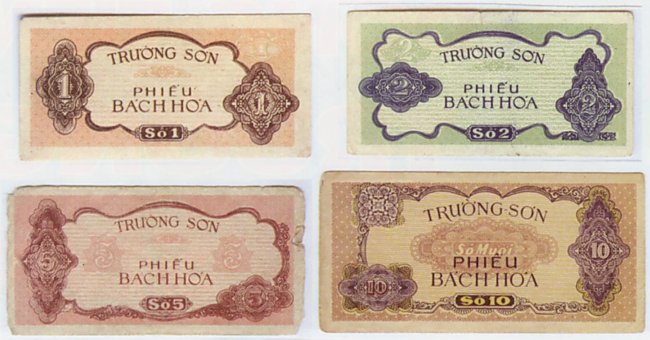
At the end of June 1966, the military canteen stamps were introduced in four types, differing in color and size. They were printed uniface with clear designs. At the top was the large words "TRƯỜNG SƠN", below it another large inscription "PHIẾU BÁCH HÓA" (general store coupon) in two rows, and at the bottom were four denominations: 1, 2, 5, and 10, corresponding to 1, 2, 5, and 10 đồng issued by the State Bank of Vietnam. Small repeated inscriptions reading "Thật thà khiêm tốn phục vụ tốt" (Honest, modest, and good service) were microprinted across the background, like slogans reminding Trường Sơn personnel to always carry out their duties with dedication. Military canteen stamps were known and referred to as Phiếu Bách hóa Trường Sơn (Trường Sơn general store coupons.
This type of coupon was reserved exclusively for Group 559 and for troops marching or serving along the Trường Sơn route, including the routes running through Laos and Cambodia. Serving as legal tender in theater, the coupons were distributed monthly directly to soldiers and officers based on their respective pay grades and allowances. The notes could be spent on canteen goods and daily necessities, bartered among personnel, or used to pay for meals at Group 559 logistics bases. When first introduced, all soldiers and officers were instructed to use the General Store Coupons in place of North Vietnamese currency according to the denomination printed on each coupon. Troops entering the route who still carried North Vietnamese currency would exchange it for Trường Sơn General Store Coupons for use along the route. The General Store Coupons were managed and used in circulation just like regular currency, so they were also called Trường Sơn Money.
In the book Military Logistics Memorabilia[1], there is a passage: "... Receiving a memorabilia item from Major General Tô Đa Mạn, former Deputy Director of the General Department of Logistics. ... He spent more than ten years serving on the Trường Sơn route in various positions: Deputy Commander and Commander of Regiment 98, Deputy Commander of Military Transport Station 37, and with Division 470 and Group 559. His duties included directly fighting the enemy, opening and securing the strategic transport route, transporting weapons, providing manpower and supplies to the B2 and B3 battlefields, and assisting the revolutionary movements in Laos and Cambodia... He was issued several Trường Sơn General Store Coupons by his unit as travel funds, including one with the denomination 5".
When personnel left the route and returned to the North, any remaining Trường Sơn Money could be exchanged for bank currency at two locations: Cự Nẫm, Bố Trạch District, Quảng Bình, and 3 Lý Nam Đế Street, Hanoi. After collecting the Trường Sơn Money, these two offices packaged it and sent it back to Trường Sơn for continued use.
In the book 65 Deep Memories of the Finance Sector[2], there is a passage recorded from the account of Colonel Vũ Mạnh Hùng, former officer of the Finance Department of the Ministry of National Defence: "... To save expenses and use supplies rationally, by 1972, on my way home on leave, passing through Làng Ho (Quảng Trị), I exchanged all my Trường Sơn Money and received 450 đồng in North Vietnamese currency. That sum was nearly enough to cover the entire cost of my wedding, which turned out to be one of the grandest celebrations the village had ever seen".
There is an anecdote about the early Trường Sơn currency on the route, told among the young finance officers of Group 559. One day, in the command bunker, a young orderly returned to the commander the allowances for the past few months that the commander had not yet used. Staring at the unfamiliar coupon with its rather sensitive name, the commander barked: "What the ... is this?" The young orderly, confused and frightened, replied: "These are your Trường Sơn General Store Coupons, Sir!" "Where did this come from?" "From the Finance Section, Sir." "Call Finance in here, now!"
A finance officer with a worried look on his face followed the orderly inside. The commander pointed and shouted: "What is this?"
The officer reported firmly: "Reporting, Sir! Trường Sơn General Store Coupons!"
Bang! The teacups rattled and clinked, then fell under the table and shattered into pieces. "Have you completely forgotten about military secrecy?!"
The young officer momentarily realized the issue. Stammering, he tried to appeal to a higher authority: "Sir, reporting, Comrade Tạ Cơ (Governor of the State Bank of Vietnam, Tạ Hoàng Cơ) has already approved it!"
Bang! "Who is Tạ Cơ?! Tạ Cơ, Tấn Cơ, whoever he is, should go to jail! All of you to jail! Jail! Jail!"
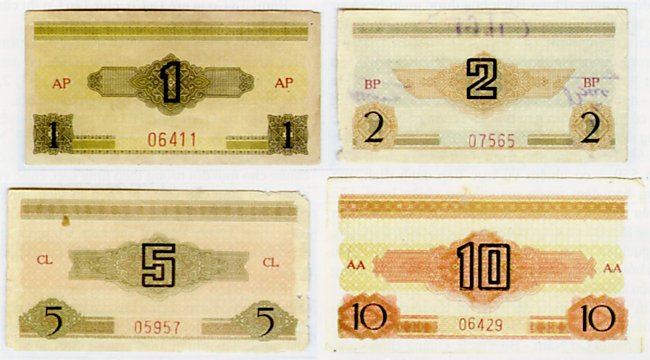
Rumors say that after this incident, it was proposed that the Trường Sơn General Store Coupons be redesigned as anonymous vouchers, bearing only decorative patterns and the numerical symbols 1, 2, 5, and 10, in accordance with the military's coded system.
Trường Sơn Money made a major shift in the logistics work of Group 559. It became a tool for distributing supplies fairly and fully in line with the standards assigned to each rank and position. It helped ensure that bookkeeping and settlement had valid supporting documents, and made the management and distribution of supplies more rational and more tightly controlled. Financial management work therefore also became more accurate and reliable.
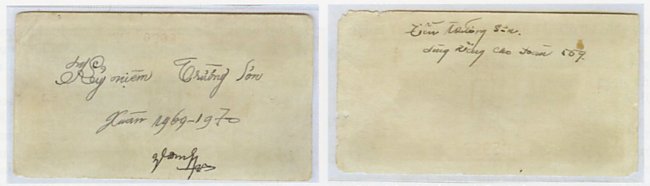
The Trường Sơn General Store Coupons circulated and were used like cash. The management and preservation of them were also treated with the same importance as that of State Bank currency. However, the use and preservation regulations of Trường Sơn Money were violated, with various inscriptions such as "Missing Mother", "Far from my love", "Meal payment value", "Savannakhet", and so on... After the currency was collected and cycled back out for reuse, some soldiers refused to accept it for reasons such as fearing that notes stamped with "Meal payment value" had already been used and were no longer valid, and worrying they would be reprimanded for violating the regulations on use and preservation of money, even though it was not their fault. A young soldier, still without a girlfriend, feared being teased by his comrades for being lovesick after unwittingly finding a note inscribed "Miss you, Lan" in his wallet... According to that Trường Sơn Money anecdote, these kinds of inscriptions exposing secrets and defacing the currency would land them in jail! All of you to jail! Jail! Jail!
Based on the origin and characteristics, Trường Sơn Money can be divided into three categories:
1. Trường Sơn General Store Coupons:
It originated from the idea of issuing a military canteen stamp with functions similar to bank money, to be used exclusively on the Trường Sơn route. The idea came from personnel working in the finance and logistics sector, whose professional duties always required transparency and openness. That professional operational character was reflected in clear terms such as "Trường Sơn", "Coupon", and "General Store", so that everyone would understand it and correctly refer to it as "Trường Sơn General Store Coupon". The slogans encouraging professional work, such as "Honest, modest, and good service", were also similar to signs like "Model Service Counter" and "Queue in Order", found in state-owned shops during the period of socialist construction in North Vietnam.
The General Store Coupons were used to pay salaries and allowances, allowing troops to pay for meals and buy essential supplies, and were used by stations to settle accounts among themselves and with higher levels. After being withdrawn from circulation on the route, the coupons were recirculated and used again to serve the route. The General Store Coupons had, in essence, become a special form of currency - a primitive military currency on the Trường Sơn route.
2. Unlabeled Currency:
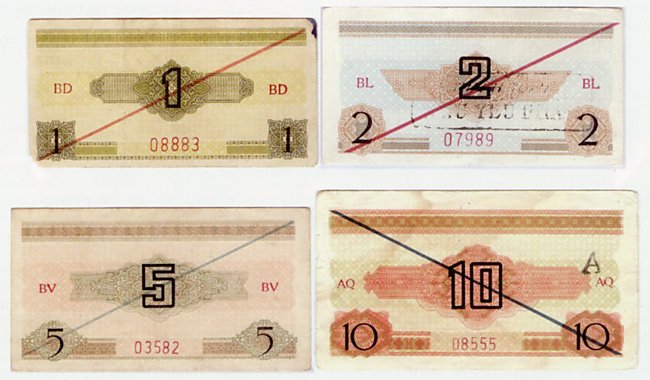
Due to national defense secrecy requirements, the General Store Coupons were replaced with a new type of anonymous coupon. The coupons bore no printed text for identification or explanation; they contained only the numbers 1, 2, 5, and 10, which represented the conventional monetary face values. The coupons were printed with an additional block prefix consisting of two letters and a serial number. At this time, the early military currency, originally known as the "Trường Sơn General Store Coupon", had been made unlabeled according to defense conventions and upgraded in terms of use and circulation management, being handled like a special anonymous currency.
This currency was divided into two basic types: those with a diagonal stripe (red or blue) and those without a stripe. To this day, there are still no documents mentioning these two types of currency, such as which type appeared first. How many types of stripes exist (running from left to right or from right to left)? How many stripe colors are there? What is the meaning of each type?
Trường Sơn money had only four denominations: 1 đồng, 2 đồng, 5 đồng, and 10 đồng, whereas the goods supplied to troops were diverse in type and pricing: powdered candy at 1 xu per piece, Tam Đảo cigarettes at 4 hào per pack, etc. Due to the lack of small denominations, the use of Trường Sơn Money had certain limitations. That was also one of the reasons for soldiers to hoard Trường Sơn Money. That is how, in 1972, there came to be one of the biggest weddings in the village, using 450 đồng in Trường Sơn money brought back from the route.
3. Trường Sơn Cheques:
They were used to address certain limitations in the use of Trường Sơn Money. Besides, Trường Sơn Money exhibited signs of shortage due to some of it being hoarded and failing to recirculate.
A number of documents have recorded the emergence of a new type of voucher called cheques. This type of cheque had the advantage of not being limited by denomination, with the amount written directly on the cheque at the time of use. Each cheque contained the soldier's personal details - name, place of origin, year of birth, and identifying characteristics - and bore two seals: one from the unit's finance office and one from the Command of the Trường Sơn Forces. Upon issuance, the cheques were entered into a register so that in case a cheque was lost or its holder died, payment could be made to their family based on the stored records.
To prevent counterfeiting, the Finance Department introduced a distinguishing letter "n". Instead of writing it normally, they flipped the letter n upside down as if it were a printing defect to distinguish whether a cheque was real or fake. This character was printed very small at the bottom of the cheque, within the line reading "Giữ gìn cẩn thận, đừng làm rách" (Handle with care, do not tear).
Like Trường Sơn Money, the cheques could also be exchanged for cash at Cự Nẫm in Quảng Bình and at 3 Lý Nam Đế Street in Hà Nội. Unlike Trường Sơn Money, once collected, cheques were accounted for and immediately destroyed.
To this day, collectors know of Trường Sơn cheques only through the recollections of those who were involved, as no examples of these cheques have yet been seen.
On 3 April 1965, the Standing Committee of the Central Military Commission passed a resolution upgrading Group 559 into High Command 559, equivalent in rank to a military region. During this period, the activities and achievements of Group 559 were not publicly disclosed in any form. In mid-July 1967, High Command 559 held its third commendation ceremony and received the First-Class Military Exploit Order. At this time, the mass media were permitted for the first time to report on the organization and activities of Group 559 under the name "Quang Trung Military Transport Unit". The name, which implied a deeper meaning of a military campaign, could also expose secrets, but few people noticed this - specifically the words "Quang Trung". Quang Trung was the only hero in Vietnam's feudal history to have established a military route across the Trường Sơn mountains and, in 1789, to have led a rapid advance to the capital Thăng Long, where he defeated the famous 290,000 Qing army in 1789.
On 29 July 1970, High Command 559 was renamed the Trường Sơn High Command under the direct authority of the General Command and the Central Military Commission. Group 559 evolved from a "Special Military Task Force" to the "Quang Trung Military Transport Corps" and was now strong enough to officially bear its rightful historical name. At this point, the finance department was still somewhat dissatisfied: "See, how could we possibly move away from our legendary Trường Sơn name from five years ago!" One must be closely attached to Trường Sơn and have lived and worked in Trường Sơn to truly understand its mysterious and immensely vast nature. The blood of comrades had blended into the dense jungle, adding to the heroic legacy of the Trường Sơn route. A veteran, now over 70, recalled with emotion: "I once held several Trường Sơn notes from a comrade who was badly wounded and asked me to send them to his elderly parents in his hometown. More than ten years later, when I left the service, I had forgotten the address and did not even know whether they could still be exchanged for money. For many years, I have always been troubled by that unfulfilled promise. Many people asked me for them as souvenirs, but I did not dare give them to anyone. In 2015, when I returned to the old battlefield, my strength had already faded and I did not know whether I would ever be able to return again. In front of the souls of my comrades, I decided to burn those notes as offerings, to return them to their owners..."
The Trường Sơn General Store Coupon is a unique phenomenon in the history of Vietnamese currency. It was governed by strict military regulations. And it was closely linked to the legendary Trường Sơn route of the Vietnamese people.
[1] Những kỷ vật hậu cần quân đội. NXB Quân đội Nhân dân, 2014, pp. 153-154.
[2] 65 kỷ niệm sâu sắc về ngành Tài chính. NXB Tài chính, 2010, p. 127.