Commemorative 4-Dollar coins for the Inauguration of the Caribbean Development Bank
from 8 member countries and territories financed by the Caribbean Development Bank
Vũ Huy Quang, Vietnam Numismatics #2 (01-2018), p.52-53
The Caribbean is a region bordered by South America to the south, Central America to the west, and North America to the northwest. The geography of the Caribbean includes the Caribbean Sea, the islands of the Lucayan Archipelago, the Greater Antilles, and the Lesser Antilles, as well as mainland coastal areas. It consists of more than 7,000 large and small islands, including the West Indies, stretching over 4,000 kilometers. The Bahamas group lies further to the north, while the Greater Antilles and Lesser Antilles form an arc-shaped chain linking North and South America, encircling the Caribbean Sea. The islands here are formed either by volcanic activity or by coral reefs building up from the sea floor.
The Caribbean Development Bank (CDB) currently has 27 members, including 22 Caribbean regional members, which are divided into three groups:
- Regional Members: 19 countries and territories that are eligible to borrow funds (BMCs) from the Bank and have voting rights, allowing them to participate in the Bank’s decision-making process.
- Other Regional Members: Colombia, Mexico, and Venezuela are 3 countries in the region that are also located in the Caribbean area but are non-borrowing members of the CDB.
- Non-Regional Members: five countries outside the region that are not eligible to borrow funds from the CDB, namely Canada, China, Germany, Italy, and the United Kingdom. These countries only provide funding to the Bank.
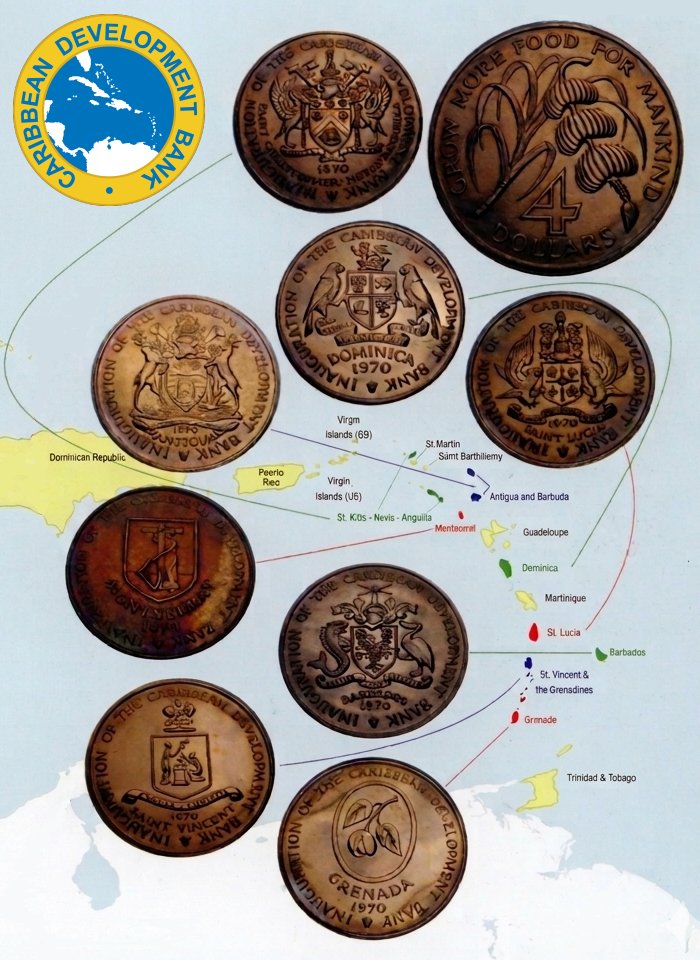
These are eight 4-dollar commemorative coins sponsored by the Food and Agriculture Organization of the United Nations (FAO) for eight countries and territories in the Caribbean region. They were minted in 1970 to mark the inauguration of the Caribbean Development Bank (CDB). The participating members include Antigua & Barbuda, Barbados, Dominica, Grenada, Montserrat, Saint Kitts (Christopher) Nevis-Anguilla, Saint Lucia, and Saint Vincent & the Grenadines. These eight countries and territories are borrowing members of the Caribbean Development Bank.
The agreement establishing the Caribbean Development Bank was signed in Kingston, Jamaica, on October 18, 1969, and entered into force on January 26, 1970, with an initial capitalization of US$50 million. The Bank operates with the aim of contributing to balanced economic development among its Caribbean member countries, promoting economic cooperation and integration, especially among the less developed countries in the region. The Bank received strong support from the International Bank for Reconstruction and Development (World Bank), the Inter-American Development Bank (IDB), and the United Nations Development Programme (UNDP). The permanent headquarters of the Bank is located in Wildey, St. Michael, Barbados, and it has no branches. The following countries and territories are founding members of the CDB - those that signed the agreement establishing the Bank in 1969: Antigua and Barbuda; the Bahamas; Barbados; Belize; British Virgin Islands; Cayman Islands; Dominica; Grenada; Guyana; Jamaica; Montserrat; St. Kitts/Nevis/Anguilla; St. Lucia; St. Vincent & the Grenadines; Trinidad and Tobago; Turks and Caicos Islands; Canada; and the United Kingdom.
The countries that joined after 1969 are: Venezuela (April 25, 1973); Colombia (November 22, 1974); Anguilla (May 4, 1982 - formerly part of the State of St Kitts/Nevis/Anguilla); Mexico (May 7, 1982); Italy (November 2, 1988); Germany (October 27, 1989); China (January 20, 1998); and Haiti (January 19, 2007). The most recent member is Suriname, which officially joined on September 17, 2013.
Regional members are required to hold at least 60% of the shares, while non-regional members are limited to a maximum of 40%.
These coins were struck in a copper-nickel alloy in crown size. The special features of these coins include:
- Denomination: 4 dollars. In the world, many cultures, especially in East Asia, tend to avoid the number 4. As a result, very few countries use this denomination for their coins. As far as I know, only a few countries have used this denomination. These include Portugal, which minted a 4-cent coin for just three years (1917–1919); India, under British colonial rule, which issued a 4-anna coin during 1919–1921; and in recent years, Canada, which issued a commemorative 4-dollar silver coin in 2012.
- Design: Struck in 1970, all eight coins share a common obverse design featuring sugar cane and a bunch of bananas (the two important and characteristic crops of the region) and a motto "Grow more food for mankind", running around the edge, along with the denomination of 4 dollars. The reverse shows either cultural symbols or the coat of arms of one of the eight Caribbean countries and territories, together with the inscription "Inauguration of the Caribbean Development Bank".
Given their maritime geography, the design reflects a distinct island-nation style.
Completing a full set of eight coins from the Caribbean countries and territories today, or even finding a single coin from the set, is quite difficult.