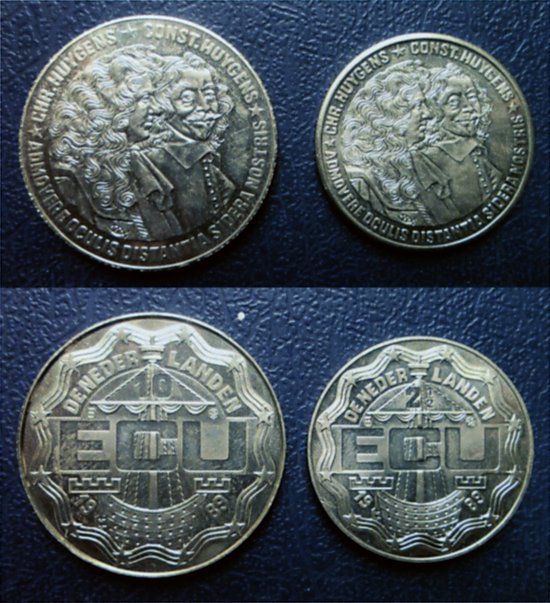
Christiaan Huygens (Nedherlands)
Lê Thị Hoài Thu, Vietnam Numismatics #2 (01-2018), p.20-22
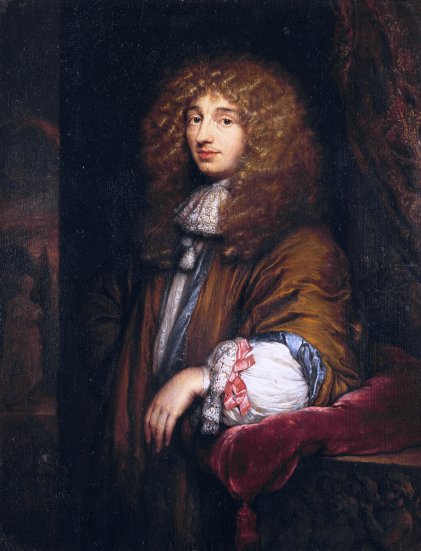
Christiaan Huygens (14 April 1629 - 8 July 1695) was a Dutch mathematician, astronomer, and physicist. He is considered one of the pioneering scientists of the Scientific Revolution, with groundbreaking research in mathematics, physics, and astronomy. Huygens was also a great inventor, especially known for his inventions related to clocks.
Recognition
- Space probes and landers used in the exploration of outer space, such as those to Saturn, are named after Huygens.
- The asteroid 2801 is named after Huygens.
- A crater on Mars and a mountain on the Moon bear the name of Huygens.
- The Huygens-Fresnel principle, a fundamental model of wave propagation and diffraction.
- Huygens Supercomputer: the national supercomputing facility of the Netherlands, located at SARA in Amsterdam.
- Many buildings and research centers in the Netherlands, as well as scientific image-processing software, are named after him.
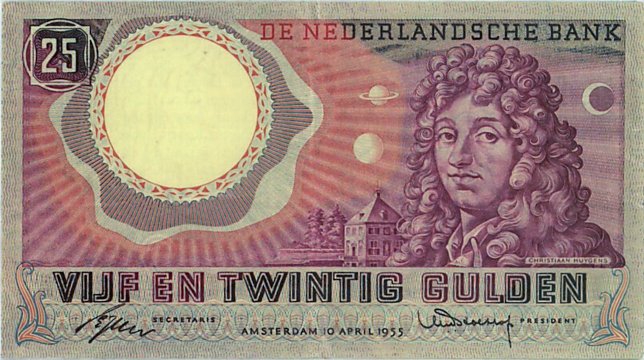
- He has been featured on numerous Dutch banknotes and coins.
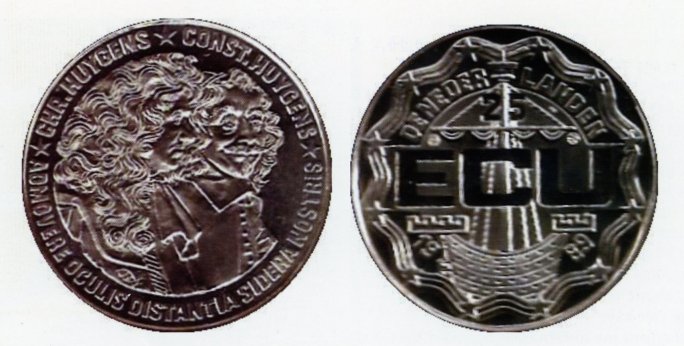
The coin depicts Christiaan Huygens on the left and his father, Constantijn Huygens, on the right.
Inscription: "CHR. HUYGENS * CONST. HUYGENS - ADMOVERE OCULIS DISTANTIA SIDERA NOSTRIS" ("Distant stars brought closer to our eyes")
Life and Career
Christiaan Huygens was born in 1629 in The Hague, Netherlands, into a noble family with a scientific tradition. His father, Constantijn Huygens, was a secretary to the Prince and a friend of René Descartes. And it was Descartes himself who predicted that he would have a brilliant scientific career after reading some of his early mathematical works. He studied law and mathematics at Leiden University and the University of Orange in Breda.
Huygens is considered one of the pioneering mathematicians in the development of modern calculus, having proved the tautochrone property of the cycloid curve. Encouraged by Blaise Pascal, Huygens wrote the first book in the field of probability theory, published in 1657.
As a physicist, his greatest discovery was the wave theory of light, first proposed in his work Traité de la Lumière in 1678 and published in 1690 in Paris. According to Huygens, light cannot originate from the motion of particles from a luminous object to the eye. He argued that if light were a stream of particles (as Newton suggested), then a ray of light would have to collide with another when they met, but in reality, that did not happen. He also rejected Descartes’ view that light propagates as an instantaneous impulse. According to him, light propagates through space like waves created when a stone is thrown into a pond, spreading across the water's surface. Wave propagation does not carry any matter along with it. His theory was forgotten for more than 100 years until Thomas Young demonstrated the wave-particle duality of light in 1801.
In astronomy, in 1655, using a telescope of his own design, Christiaan Huygens discovered Saturn's moon Titan and confirmed that Saturn's rings contain rocks. In the same year, he observed and sketched the shape of the Orion Nebula. These discoveries were later published in his work Systema Saturnium (1659). Huygens also succeeded in separating the nebula into individual stars; the brighter inner part of the Orion Nebula was named the Huygens region. He also discovered several nebulae located between stars, as well as binary stars. Huygens formulated what is now recognized as Newton's second law of motion, expressing it as a quadratic equation. Newton later published the formula and generalized it into his law.
On May 3, 1661, along with two astronomers Thomas Streete and Richard Reeves, he observed and confirmed that Mercury revolves around the Sun, using Richard Reeves' telescope in London. The Royal Society of London elected Huygens as a member in 1663. In 1666, he moved to Paris, where he held a position at the French Academy of Sciences under the patronage of King Louis XIV. Contributing to the construction and use of the Paris Observatory (completed in 1672), he broadened the scope of astronomy. In 1684, he published the book Astroscopia Compendiaria, in which he introduced his new type of telescope.
Huygens made major contributions to the design of precise clocks, which were essential for navigation at sea. In 1658, he published a treatise on the subject entitled Horologium. In 1657, he patented the pendulum clock, an invention that marked a major advancement in timekeeping. A notable component invented by Huygens is the escapement, which regulates the speed of clocks and watches. He also applied his proof of the cycloid's tautochrone property to create cycloidal cheeks, allowing the pendulum suspension system to operate more smoothly and ensuring uniform motion of the pendulum. The mathematical theory and practical applications of this discovery were published in Horologium Oscillatorium in 1673.
Huygens also observed that two pendulums hung on the same beam moved in opposite directions in perfect synchrony. He called this phenomenon "odd sympathy", which is now known as resonance. The oldest known pendulum clock was made by the clockmaker Salomon Coster in The Hague following Huygens' design in 1657, and is displayed at the Boerhaave Museum in Leiden. Another development in Huygens' clockmaking was the spring-driven clock, which he invented around the same time as Robert Hooke, leading to a dispute over the invention that lasted for centuries. In February 2006, a lost photocopy of Hooke's handwritten manuscript was discovered in Hampshire, finally resolving the long-standing dispute over the spring-driven clock.
Huygens also conducted detailed inquiries into the possibility of extraterrestrial life. In his book Cosmotheoros, titled "The celestial worlds discovered: or, conjectures concerning the inhabitants, plants and productions of the worlds in the planets", he imagined a universe full of life, most of which was relatively similar to life on Earth of the 17th century. The liberal atmosphere of the Netherlands at this time not only allowed but also encouraged this research.
In 1673, Huygens conducted experiments on combustion. Although he designed a simple form of an internal combustion engine, powered by gunpowder, he never succeeded in making it work.
Huygens returned to The Hague in 1681 after suffering a serious illness. He attempted to return to France in 1685, but the revocation of the Edict of Nantes concerning Protestants prevented this plan. Huygens passed away in The Hague on July 8, 1695.
Christiaan Huygens deserves recognition as a genius not only in mathematics but also in physics and astronomy, with his famous inventions leaving a lasting legacy for humanity. He truly is a great pride of the Netherlands.