Credit notes of Trung Bộ (1947-1954)
Part 1: 1/5/10 Đồng
Mai Ngọc Phát, Vietnam Numismatics #2 (01-2018), p.11-19
The introduction of Credit Notes (Tín Phiếu) equivalent in value to Vietnamese currency in the southern part of Trung Bộ (Central Vietnam) between 1947 and 1954 was not only an important landmark in our country’s monetary history, but also held significant political, cultural, and economic strategic importance within the special circumstances of the Vietnamese revolution.
From the end of 1946, the history of Vietnam entered a new phase. The French colonialists violated the Preliminary Agreement between France and Vietnam, signed on March 6, 1946, and seized Hải Phòng and Lạng Sơn. The expeditionary force of over 100,000 men occupied the country's key strategic positions. From December 15 to 19, 1946, they carried out provocations in Hanoi. On the night of December 18, 1946, the French military command in Indochina issued an ultimatum demanding the surrender of the Provisional Revolutionary Government of the Democratic Republic of Vietnam.
In response to the French plans and actions, on December 13, 1946, the commanders of the 12 war zones met in Hà Đông to receive the new directives from the Government and to supplement operational plans in the local areas. At the same time, on December 18 and 19, 1946, the Party Standing Committee held a conference in Vạn Phúc village, Hà Đông, chaired by President Hồ Chí Minh, where it decided to launch a nationwide resistance to save the country and adopted the policy of a comprehensive, prolonged people's war. On December 20, 1946, President Ho Chi Minh issued the "Appeal for National Resistance". On December 22, the Party Standing Committee issued the "National Resistance" directive. Responding to the call of the Party and Uncle Ho, the entire Vietnamese nation stood up with the spirit: "We would rather sacrifice everything than lose our country or be enslaved." On the night of December 19, 1946, the army and people of Hanoi opened fire, marking the beginning of the nationwide resistance.
In the southern provinces of Trung Bộ, in December 1946, the French increased their forces and military resources in Đà Nẵng. On December 20, they expanded their attacks to the surrounding areas to gain access to Huế. In the occupied provinces from Khánh Hòa southward, they established fortified posts, guarding important transportation routes and major population centers. From August to the end of 1947, they consolidated the regions they were occupying, carried out deceptive actions in the free regions, and withdrew some troops to launch attacks in Việt Bắc. After failing in Việt Bắc during their campaign to destroy our Government, from early 1948 to the end of 1949, they continued to consolidate the areas they occupied and launched attacks into the free regions. By mid-1948, French forces in Zone 6 comprised a five-battalion regiment and one battalion under the Command of South Trung Bộ and the Central Highlands. In addition, there were security forces commanded by the provincial supervisors and Vietnamese collaborationist troops across Khánh Hòa, Ninh Thuận, and other provinces. At the beginning of 1947, the French command in Nha Trang, Phan Rang, and Ba Ngòi went to Saigon for a meeting and received the orders to intensify offensive operations to force negotiations.
In the southern region of Trung Bộ, the Central Committee of the Party and the Government appointed comrade Phạm Văn Đồng as their representative to direct operations against the enemy under the new circumstances. In November 1948, the Central Committee also established the Administrative Committee of Nam Trung Bộ, with comrade Nguyễn Duy Trinh as its Chairman. Earlier, in February 1947, Zone VI was re-established, comprising the provinces from Khánh Hòa and Buôn Ma Thuột to Bình Thuận and Đồng Nai Thượng, with comrade Trần Công Khanh as Zone Commander and comrade Nguyễn Côn as Secretary of the Zone Party Committee.
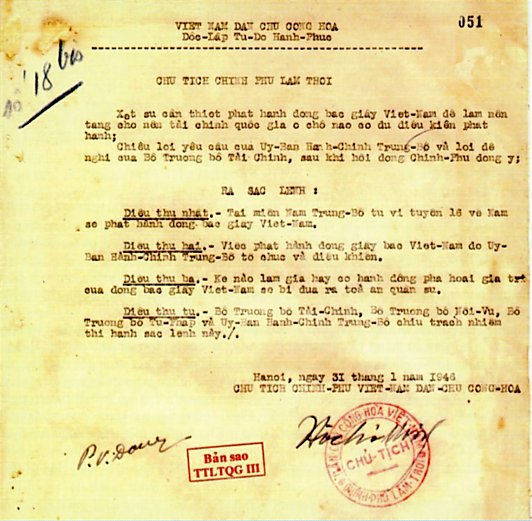
In the context of the Vietnamese revolution at that time, on January 31, 1946, President Hồ Chí Minh - Chairman of the Provisional Revolutionary Government of the Democratic Republic of Vietnam - signed Decree No. 18B/SL, which stipulated: "In the southern part of Trung Bộ, from the 16th parallel southward, Vietnamese paper currency will be issued", to be organized and administered by the Trung Bộ Administrative Committee.
In practice at that time, the amount of currency brought into the far southern areas of Trung Bộ was not large. In the interlocking pattern of warfare, the Zone V Party Committee and the Resistance and Administrative Committee of southern Trung Bộ were mainly based in the provinces of Bình Định and Quảng Ngãi, far from the Central authorities. Isolated from the Central Government, with severely limited communication and transport, it was impossible to rely on manpower to carry sufficient funds from the Central Government in time to meet the logistical and economic needs of the liberated areas of Inter-Zone V.
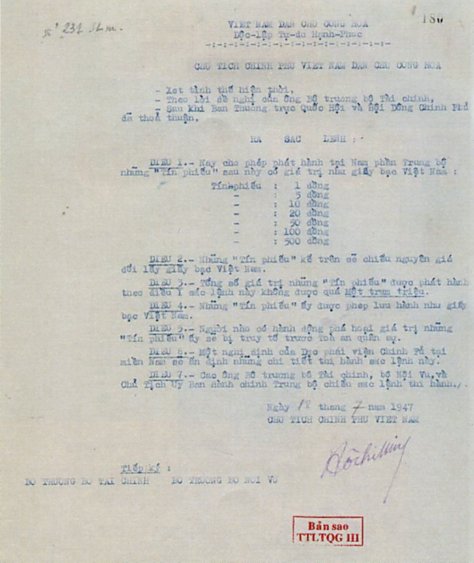
Faced with the difficult situation in Trung Bộ, on July 18, 1947, President Hồ Chí Minh signed Decree No. 231/SL, authorizing Southern Trung Bộ to issue Credit Notes with value equivalent to Vietnamese banknotes. The credit notes included the following denominations: 1 đồng, 5 đồng, 10 đồng, 20 đồng, 50 đồng, 100 đồng, and 500 đồng. The Inter-Zone V Party Committee assigned artist Hoàng Kiệt to design the credit notes. The printing plates were made of copper and were crafted by Văn Hồ, a well-known engraver from Đà Nẵng. First, the designs were made for the high-value denominations of 500 đồng and 1,000 đồng; only later were the lower-denomination notes designed and issued. The 500 đồng and 1,000 đồng denominations were designed and printed as proofs in 1947 but were never issued.
The credit notes were printed at a printing house in Xả Nai village, Sơn Nham commune, Sơn Hà district, Quảng Ngãi province, with part of the operation later set up in An Lão and Hoài Ân districts of Bình Định. The credit notes featured the signatures of Phạm Văn Đồng, the Central Government’s representative in Inter-Zone V, and Nguyễn Duy Trinh, Chairman of the Inter-Zone V Resistance and Administrative Committee. Inter-Zone V mainly consisted of four liberated provinces: Quảng Nam, Quảng Ngãi, Bình Định, and Phú Yên. Initially, the credit notes were printed on white paper made in the United States and imported through Cambodia. By 1950, the Inter-Zone Party Committee and Inter-Zone V had purchased the Nghĩa Hiệp paper mill and had also produced a type of straw paper with a five-pointed star watermark to print credit notes. People exchanged credit notes for Indochinese currency to purchase goods in areas temporarily occupied by the enemy. Both the government-issued banknotes and credit notes were trusted by the population and circulated side by side. Many torn banknotes were mended and kept in circulation, as long as the image of Uncle Hồ remained; from this, people often called them "Uncle Hồ's Money". In the Phan Thiết area occupied by French forces, people also exchanged Indochinese currency for Uncle Hồ's money to provide the resistance with the funds to purchase necessary goods.
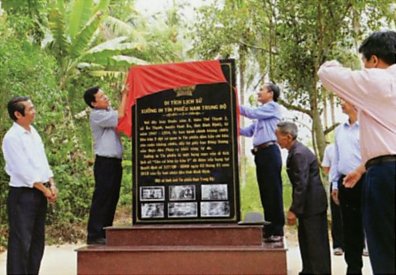
Hoài Ân district, Bình Định, in 2014
In practice, only the 1 đồng, 5 đồng, 20 đồng, 50 đồng, and 100 đồng denominations were issued in 1947. As for the 10 đồng note, it used the central government's banknote design, reprinted in Trung Bộ on white paper, with an overprint in red reading "Representative of the Minister of Finance in Trung Bộ".
From 1950, the 1 đồng, 5 đồng, and 20 đồng credit notes were reissued in new colors, and new credit notes of 50 đồng, 100 đồng, 500 đồng, and 1,000 đồng were added. In early 1951, the Inter-Zone V Party Congress decided to establish the Inter-Zone V Bank and appointed Phạm Cự Hải as its Director. The bank took over two units: the Credit Note printing house and the financial agency, which combined the treasury and the production credit office.
The French allowed merchants into the liberated areas to hoard goods, which reduced the value of the government’s currency. Initially, 1 Indochinese piastre was exchanged for 100 đồng of credit notes; gradually, exchange rate increased to 250 đồng per piastre. Through struggle and various measures taken by the bank, by July 1953 the exchange rate had returned to 100 đồng of credit notes per Indochinese piastre (from The Active Operations of Inter-Zone V Bank - memoirs of Phạm Cự Hải).
With the signing of the Geneva Accords on July 20, 1954, the production of credit notes ceased. The government recalled the credit notes and exchanged them for Indochinese currency for public use. Officials and soldiers returned the credit notes to their respective units and received receipts, which they later used to exchange for State Bank currency when relocating to the North. The recall period was from February 1, 1955, to March 31, 1955.
The Trung Bộ credit notes accompanied the people of Trung Bộ - Inter-Zone V in fighting the enemy and defending the country, shared in their daily hardships and joys, and inspired the production and combat spirit of workers, peasants, and soldiers through the images on the notes, contributing to the nation's great victories. The people of Trung Bộ will forever cherish the image of President Hồ on the credit notes.
In this first part, we present the 1 đồng and 5 đồng credit notes, as well as the 10 đồng banknote of Trung Bộ. The other denominations will be featured in upcoming issues, and readers are invited to stay tuned.
1 đồng credit note:
Issued in 1947, measuring approximately 90x45 mm. The face features a portrait of President Hồ Chí Minh, the back depicts a farmer plowing with a pair of buffaloes. Since the credit notes were printed multiple times in different locations, the design of the paired buffaloes also shows small variations, such as differences in the shapes of the front and rear horns.
Type 1: President Hồ Chí Minh in a single circle.
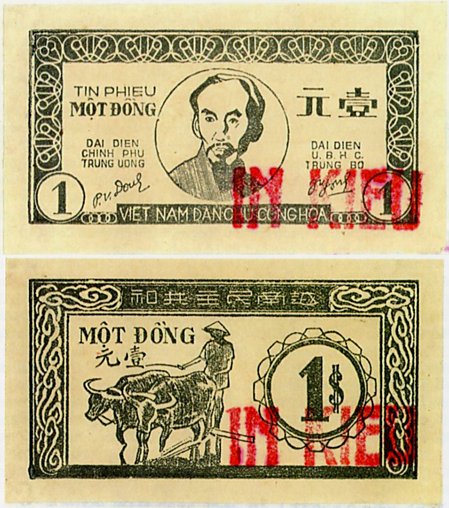
1 đồng credit note printed on white paper, face and back in green, serial number in black with 4 or 5 digits.
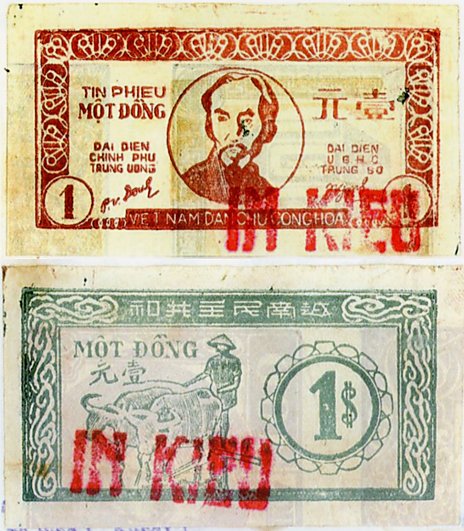
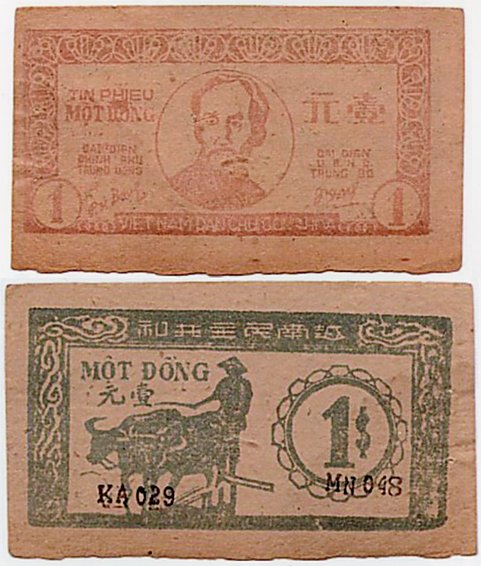
In June 1950, 1 đồng credit note was reissued in new colors, with face in red and back in green, printed on locally produced straw paper with a star in a circle watermark, serial number in black with 3 digits.
Type 2: President Hồ Chí Minh in a triple circle.
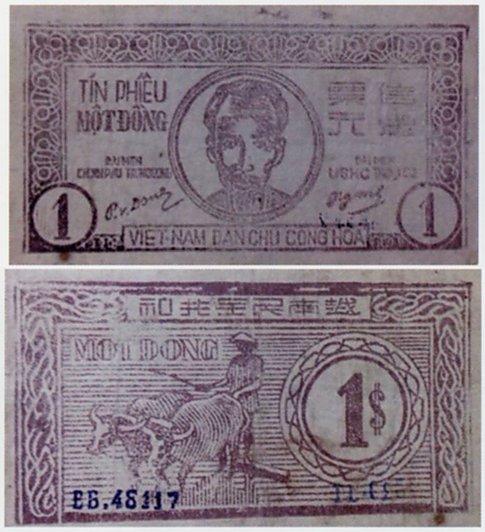
1 đồng credit note has both face and back in brown, with a dark blue serial number in the format LLxxxxx/LLxxx.
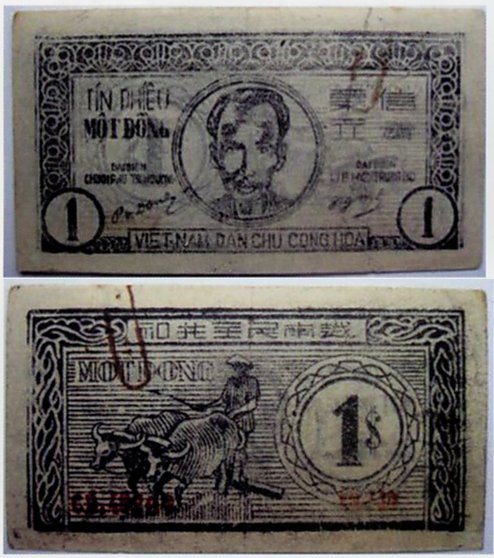
1 đồng credit note has both face and back in dark blue, with a red serial number in the format LLxxxxx/LLxxx.
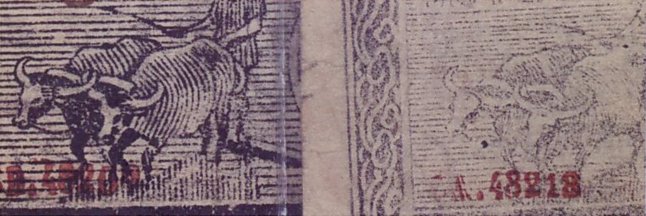
5 đồng credit note:
Issued in 1947, measuring approximately 100x55 mm, 102x53 mm, 103x54 mm, and 103x55 mm. The face features a portrait of President Hồ Chí Minh and the denomination 5$, the back has text "Tín phiếu năm đồng" and a number 5.
Type 1: The face has a portrait of President Hồ Chí Minh within a stylized wreath of rice, printed on white paper. The 5 đồng credit note has both the face and back in brown. Due to multiple print runs, there are noticeable variations in the border patterns and the forehead lines of President Ho Chi Minh, black serial numbers appear in two formats: AAxx/Lxxxx and Lxxx/xxxx.
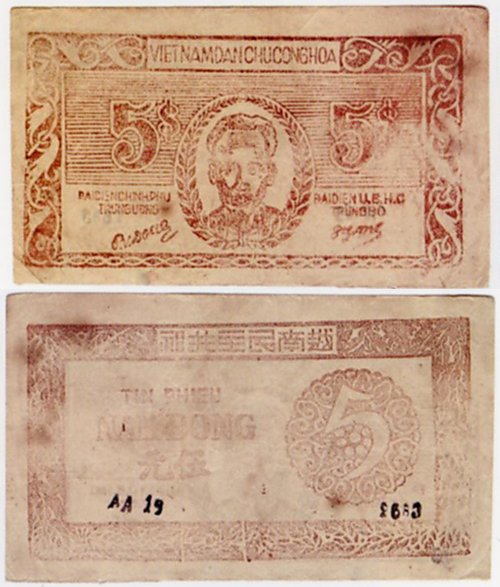
The AAxx/xxxx serial format was used in the first printing.
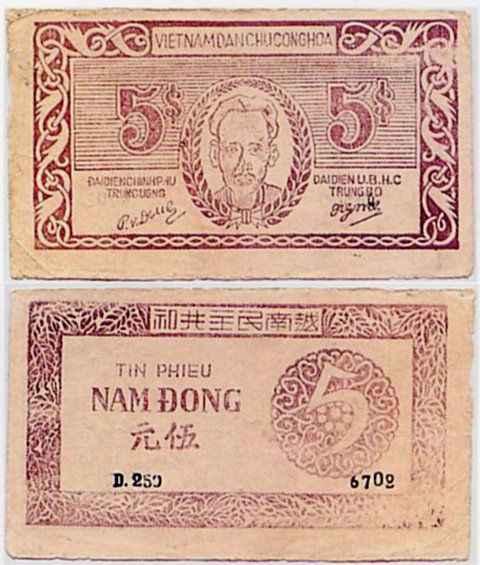
In later printings, the letters ranged from A to Z.
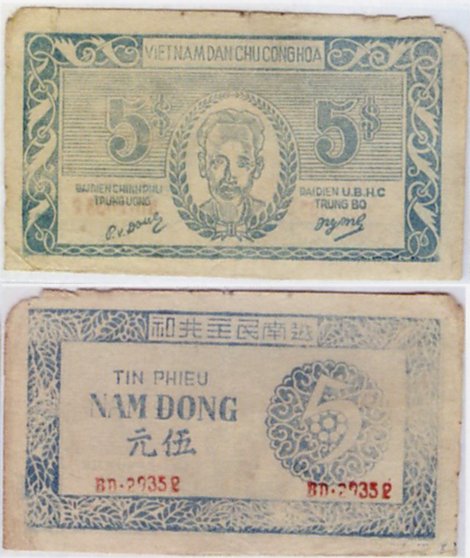
Face and back in light blue. Red serial numbers in format LLxxxxx/LLxxxxx.
Type 2: The portrait of President Hồ Chí Minh without a wreath.
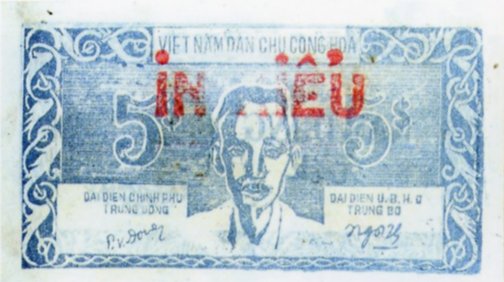
5 dong credit note specimen face printed on white paper.
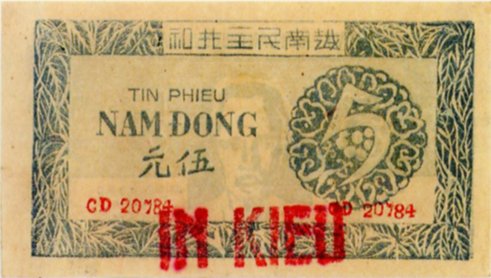
5 dong credit note specimen back printed on tan paper, red serial number has 4 or 5 digits.
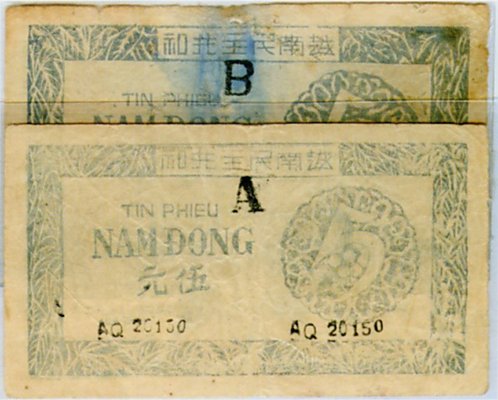
5 dong credit note with face and back in green printed on white paper, black 5-digit serial number and additional plate letters A/B.
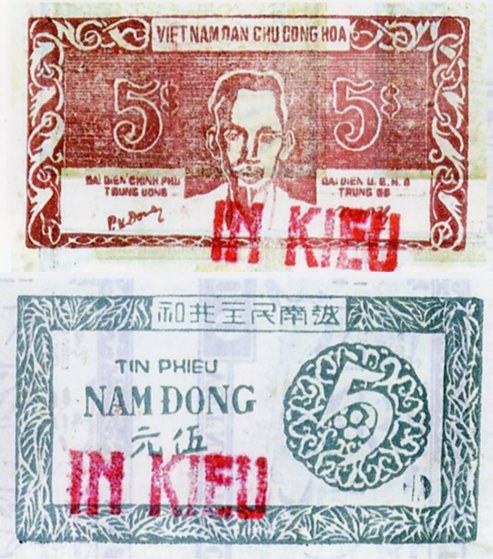
In June 1950, the 5 đồng credit note was reissued in new colors, with the face in red and the back in green. This type was printed on two kinds of paper: imported white paper and straw paper with a watermark produced in Trung Bộ.
10 đồng banknote:
Between 1947 and 1954, although the Decree allowed printing 10 đồng credit notes, the government's 10 đồng banknote design - originally printed on straw paper - was reprinted on white paper with an added overprint reading: "Representative of the Minister of Finance in Trung Bộ". Due to repeated print runs, the dimensions of these notes vary in length.
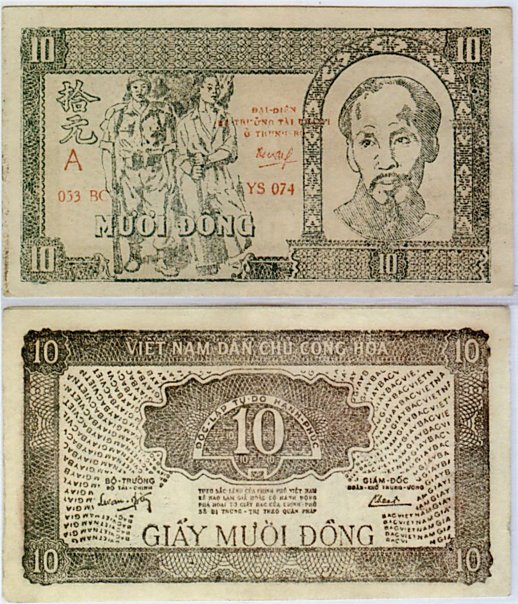
10 đồng was printed on white paper, measuring 128x70 mm and 126x70 mm.
Resources
[1] Various Authors, 1982. Memoirs: Những năm tháng thử thách trong thời kỳ kháng chiến chống Pháp 1945-1954. Internal document. Institute for Monetary, Credit, and Banking Research, under the State Bank of Vietnam, Hanoi.
[2] Various Authors, 2000. Đồng bạc tài chính đồng bạc cụ Hồ 1945-1954. NXB Tài Chính, Hanoi.
[3] Various Authors, 1992. Lịch sử ngành in Việt Nam, Vol. 2. NXB Bộ Văn hóa Thông tin, Hanoi.
[4] Specimen credit notes printed at Interzone V - Volume No. 33 (Containing 50 specimens).
[5] Various Authors, 2011. 60 năm Ngân hàng Việt Nam - Tư liệu & hình ảnh. State Bank of Vietnam, Hanoi.
[6] Various Authors, 2011. Tiền Việt Nam. State Bank of Vietnam, Hanoi.
[7]
Various Authors, 2014. Khánh thành Bia di tích Xưởng in tín phiếu Nam Trung Bộ. Thời báo Ngân hàng, June 2014.
https://thoibaonganhang.vn/khanh-thanh-bia-di-tich-xuong-in-tin-phieu-nam-trung-bo-21213.html
[8] Trần Kỳ, 2001. Từ cơ quan in tiền Tín phiếu đến sự ra đời của Ngân hàng Khu V. Bình Định Provincial Library Website.