Scientists on money: René Descartes
Lê Thị Hoài Thu, Vietnam Numismatics #1 (10-2017), p.48-50
Scientists in general, and mathematicians in particular, are people who have made remarkable contributions to the overall development of humanity. Their profound discoveries and achievements have paved the way for extraordinary progress, have sparked shifts in collective thought and perception, and have provided the direction and momentum for the advancement of human civilization. Human history always remembers the contributions of scientists and uses every possible way to honor these people and their scientific works. People establish museums, build monuments from various materials, and write history books about the lives and careers of scientists. The names of scientists are given to squares, streets, universities, scientific principles, formulas, theorems, mathematical operations, and even celestial bodies in the galaxy. One way of honoring them is to feature the portraits of scientists and their works on widely circulated public items, including badges, medals, stamps, banknotes, and coins.
In modern life, money is a means of payment in the economy and trade. With this role, money is certainly the most widely circulated item in modern society. Therefore, honoring scientists on money is a way to most widely spread their images, roles, and historical influence. To this end, many nations place images of outstanding scientists (usually their own citizens) on circulating coins or commemorative money, so that through these great figures, they remind people of tradition, strengthen national pride, and encourage people to study and follow their example.
For every mathematician featured on money, we provide a concise biography covering their life, career, and famous works accompanied by images of coins and banknotes. Many scientists in other fields such as physics, chemistry, astronomy, biology, philosophy, etc., are also honored on national currencies. However, due to the limited availability of numismatic material and time constraints for research and writing, this study will focus exclusively on the field of mathematics.
I will now introduce the mathematicians who have made great contributions to humanity and have been honored on the currencies of various countries.
René Descartes (France, 1596-1650)
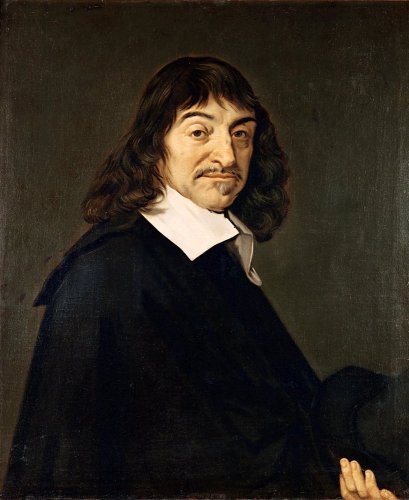
René Descartes (March 31, 1596 - February 11, 1650) was a French philosopher, scientist, and mathematician. He is considered the father of modern philosophy. Descartes' influence in mathematics was profound. He is recognized as the father of analytic geometry, providing the bridge between algebra and geometry. He played an important role in the development of differential calculus and analysis. Descartes was also one of the key figures in the Scientific Revolution and is honored as one of the scientific geniuses.
Recognition
- Descartes' name was given to the name of a crater on the visible side of the Moon
- A statue of him, along with inscriptions honoring his achievements, is placed on his tomb. Seventeen years later, his remains were transferred to France and reburied in a church that later became the Panthéon, the resting place of France’s national heroes.
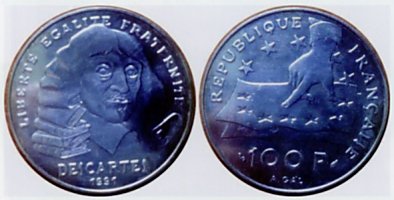
- Coins: In 1991, on the occasion of the 395th anniversary of his birth, France issued a commemorative 100 franc coin. KM#996, 0.9 silver, weight: 15g, mintage: 3,985,000.
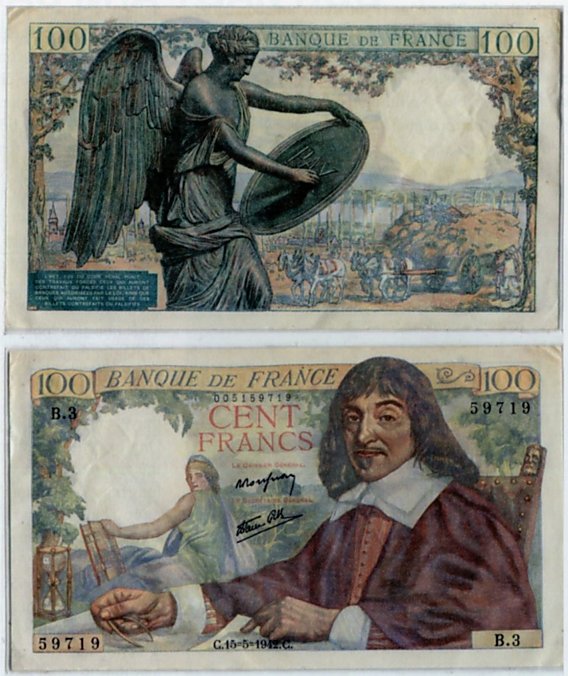
- Banknotes: In 1942, France issued a 100 franc banknote. The face depicts René Descartes sitting on a chair and holding a pair of dividers in his hand. In the background, a muse is holding a large book, lying beside an hourglass. The back features a bronze winged statue of Victory inscribing the word "Pax" (Peace) onto a shield. In the background is a rural landscape with crops and a horse-drawn cart loaded with hay.
Life and Career
Born in La Haye, Touraine, Descartes was the son of a minor noble family with a scholarly tradition and was a Roman Catholic. At the age of eight, he was sent to study at a Jesuit school in La Flèche, Anjou, where he studied for eight years. Alongside classical subjects, Descartes also studied mathematics with teachers of the Scholastic school, a tradition that used human reason to understand Christian doctrine. After finishing school, he studied law at the University of Poitiers and graduated in 1616. However, he never practiced law; instead, in 1618, he joined the army of Prince Maurice of Nassau in the Netherlands, intending to pursue a military career. In the following years, Descartes served in the armies, but he began to focus on mathematics and philosophy. He traveled to Italy from 1623 to 1624. Then from 1624 to 1628, he stayed in France. During his time in France, Descartes focused on studying philosophy and conducting experiments in optics. In 1628, after selling all his property in France, he moved to the Netherlands and lived most of the remaining life in the land of tulips. Descartes lived in several cities in the Netherlands, such as Amsterdam, Deventer, Utrecht, and Leiden.
In his first year in the Netherlands, Descartes wrote his first major work, Essais philosophiques (Philosophical Essays), published in 1637. This work comprised four parts: essays on geometry, optics, and meteors, and the famous Discours de la méthode (Discourse on Method), in which he presents his philosophical studies. After that, other works followed one after another, including Meditationes de Prima Philosophia (Meditations on First Philosophy, 1641, revised in 1642) and Principia Philosophiae (Principles of Philosophy, 1644). In total, he spent two decades living in the Netherlands. When Dutch universities began to spread his teachings, he was strongly opposed by the Church. He was accused of heresy. He was regarded as an enemy of the Church authorities, and punishment was demanded. Therefore, he was forced to leave the Netherlands. In 1649, Queen Christina of Sweden invited Descartes to teach her philosophy at the royal court in Stockholm. The harsh cold of Northern Europe caused him to contract pneumonia, and he died in 1650. After his death, in 1663, the Roman Catholic Church placed his works on the list of prohibited books.
Philosophy: Descartes applied the logical inductive method of science, especially mathematics, to philosophy. Before that, philosophy was dominated by the Scholastic method, which relied entirely on comparison and on matching views with those of authority figures. Rejecting this approach, Descartes ststed: "In searching for the straight path to truth, we do not need to consider anything that we cannot understand with certainty, as we do in algebra and geometry". Through that he pointed out that "nothing is accepted as true until the foundation for believing it is true is established". His fundamental point of certainty was summarized in the famous maxim "Cogito, ergo sum" (Latin for "I think, therefore I am"). According to Descartes' philosophy, God created two kinds of substances to make up all things in the universe. The first is thinking substance, that is, mind; the second is extended substance, that is, matter (Descartes' dualism).
Mathematics: Descartes' most important contribution to mathematics was the systematization of analytic geometry. The foundation of this subject is the coordinate system which he invented. It allows geometry to be studied using the language and methods of algebra. It can be said that Descartes was the one who unified algebra and Euclidean geometry. His work had an influence on the development of analytic geometry, calculus, and cartography. Later, the idea of the coordinate system was extended to three-dimensional space using three Cartesian coordinates. In general, an n-dimensional coordinate system can be constructed using n Cartesian coordinates. He was the first mathematician to classify curves based on the properties of the equations that define them. He also made contributions to the theory of equations.
Descartes was also the first to use the last letters of the alphabet to represent unknowns, and the first letters of the alphabet to represent known values. He also created a system of notation to represent powers of numbers (in expressions like x²). Additionally, he established "Descartes' Rule of Signs" for determining the number of positive and negative roots in any algebraic equation. His mathematical methods had a profound influence on the development of mathematics and mechanics in the following centuries.
Science: Descartes' philosophy led him to have some erroneous explanations of physical phenomena. However, these explanations still had value, because he used mechanical explanations instead of the vague spiritual views of earlier writers. Initially, Descartes recognized the Copernican theory of the universe in which the planets revolve around the Sun, but he later abandoned it because the Roman Catholic Church declared it heretical. Instead, he proposed the vortex theory, suggesting that the universe is filled with matter in different states, swirling around the sun.
In physiology, Descartes held the view that blood is a subtle fluid, which he called the animal spirits. He believed that these animal spirits interacted with the thinking substance in the brain, and flowed along the nerves to control the muscles and other parts of the body.
In optics, Descartes discovered the basic law of reflection: the angle of incidence equals the angle of reflection. His essay was the first text to present this law. Descartes' view of light as a kind of pressure on a solid medium paved the way for the wave theory of light.
Descartes deserves to be called a scientific genius. His research works will always remain building blocks of human knowledge for us to study and apply in life.