Collecting banknotes by serial number
Lê Khánh Ngọc Anh, Đào Thanh Bình, Vietnam Numismatics #1 (10-2017), p.38-43
Collecting banknotes by serial number is a long-standing practice in the numismatic community in Vietnam and around the world. This hobby is based on the sequence of serial numbers printed on issued banknotes, so some people poetically call it "the dance of numbers". There are many ways to collect serial numbers, such as Solid, Ladder, Radar, Fancy, Binary, etc.; each has its own unique beauty and many variations depending on the number of digits in the serial numbers.
Depending on personality, interests, collection sources, financial capacity, or personal meaning, each collector can choose their own collecting style. In this article, we would like to introduce some common ways to collect serial numbers for your reference. This section focuses specifically on banknotes with 7-digit serial numbers, which are issued in a total of 10 million notes per lot. The categories presented here are organized in order of decreasing rarity. We welcome your additional comments and contributions to make this article more engaging.
1. Ladder serial numbers
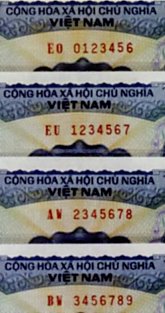
- Ladder notes are banknotes whose serial numbers form a sequence in which each digit is one higher or one lower than the previous digit. For example, 0123456 or 8765432.
- In a standard print run of 10 million 7-digit banknotes, only four pairs (eight notes) of the ladder type exist. This is the rarest type among 7-digit serial numbers. This type has very high collecting value, with market prices reaching several million Vietnamese Dong.
2. Solid serial numbers
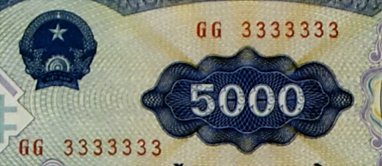
- Solids are serial numbers where all digits are the same. For example: 1111111 or 8888888.
- For 7-digit serial numbers, only nine solid notes exist per 10-million-note run (excluding the all-zero sequence, which denotes an error or specimen note rather than circulating currency). This is the second rarest type among 7-digit serial numbers. This serial type also has very high collecting value, with a market value reaching several million Vietnamese dong.
- Among solid notes, due to the Asian beliefs, solid 8 and solid 9 notes are the most valuable.
3. Ladder Radar serial numbers
- Radar serial numbers (also called mirrors) are sequences that are perfectly symmetrical around the center. Example: 2657562, where 7 is the center, and the two sides are perfectly symmetrical: 265-562.
- Ladder Radars are mirror-type numbers in which the digits on both sides of the center increase or decrease by one from the previous digit. For example: 1234321 or 4321234.
- For 7-digit serial numbers, the step can be 1, 2, or 3. Example: 2468642 or 1357531 or 0369630.
- A production run of 10 million 7-digit notes contains 12 pairs of Ladder Radar serials. This is the third rarest type among 7-digit serial numbers. This type of serial number has fairly high collecting value and commercial worth.
4. Super Radar serial numbers
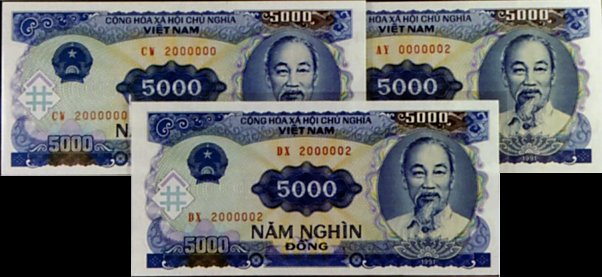
- Super Radar notes have mirror-type numbers in which the middle digits are identical, and the two digits at the ends are also identical. For example: 2000002 or 3777773.
- For banknotes with 7-digit serial numbers, there are 90 Super Radar notes per 10 million notes lot. This is the fourth rarest type among 7-digit serial numbers. This type of serial number has fairly high collecting and market value.
- Among Super Radar notes, those with zeros in the middle are usually more difficult to acquire. In addition, Asian collectors often prefer Super Radar sequences featuring the number pairs 6-8 and 7-9.
5. Super Repeater serial numbers
- Super Repeaters are serial numbers contain only two digits, repeated throughout the entire 7-digit sequence. Examples: 5656565 or 4848484.
- For 7-digit serial numbers, out of the 10 million notes issued per lot, there are 90 Super Repeaters. This also ranks as the fourth rarest 7-digit serial type. This type of serial number has fairly high collecting and market value.
- Super Repeaters that include a zero as one of the two digits are typically harder to find. Similarly to the previous type, collectors in Asia tend to prefer the number pairs 6-8 and 7-9.
6. Six-in-a-Row serial numbers
- Six-in-a-Row notes are banknotes whose 7-digit serial numbers contain six consecutive identical digits. Examples: 9777777 or 6666668.
- For banknotes with 7-digit serial numbers, out of the 10 million notes in a lot, there are 90 Six-in-a-Row notes, divided into two types: leading six (six identical digits in the beginning, e.g. 4444448) and trailing six (six identical digits in the end, e.g. 5999999). Normally, trailing sixes are harder to find than leading sixes.
- This is also considered the fourth rarest type among 7-digit serials. This type of serial number has fairly high collecting and market value.
7. Banknotes with Low or High serial numbers
- Low serial banknotes are notes with serial numbers below 0000100.
- High serial banknotes are those with numbers ranging from 9999900 to the final 9999999.
- This is the fifth rarest category among 7-digit serial numbers. These serial numbers hold significant numismatic interest and substantial market value. In particular, the lowest serial number 0000001 and solid 9999999 can sell for up to several million VND. Some Six-in-a-Row serials (0000001-9; 9999991-9) and Fancy numbers also fall into this group and have higher market value than the others.
8. Fancy serial numbers
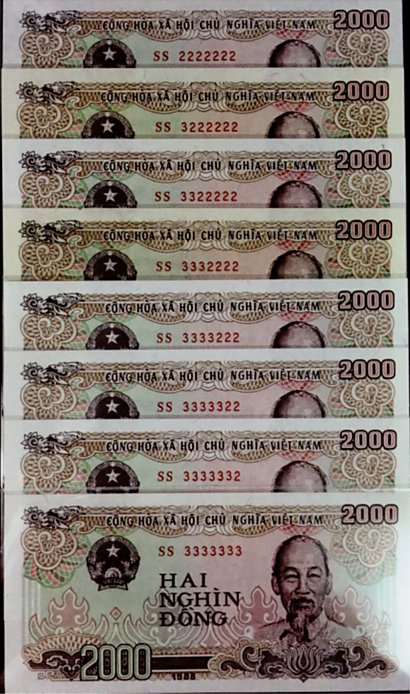
- Fancy serials consist of only two types of digits, arranged so that all instances of the first digit are grouped together followed by the second, regardless of the count of each digit. Examples include 2227777, 4444433, and 3311111. Six-in-a-Row serial numbers can be considered a special case of the Fancy category.
- In a standard 10-million-note print run of 7-digit serials, there are 45 possible digit pairs, with each pair producing 8 Fancy notes (excluding Six-in-a-Row notes). This results in a total of 360 Fancy notes per run.
- This is the sixth rarest type among 7-digit serial numbers. These serials are highly collectible and valuable, particularly when assembled into sequential running or Lego sets.
9. Binary serial numbers
- Binary serial numbers consist of only two different digits. Examples: 2223323, 8898989, 9393339.
- In a print run of 10 million 7-digit notes, 45 digit pairs exist, each yielding 126 Binary notes (including Six-in-a-Row, Super Radar, Super Repeater, and Fancy types). Thus, there will be 5,670 Binary notes. Binary serial number notes usually have moderate market value, while Binary Radar notes tend to be more valuable.
- Collectors typically focus on one or two specific digit pairs, often chosen for personal reasons such as birth dates or other numbers of special significance. For instance, a collector born in 1993 might choose the pair 9-3. The most commonly chosen pairs are those containing a zero, such as 0-1, 0-5, 0-9, or pairs associated with prosperity, such as 7-9 and 6-8.
- The hierarchy of Binary serials is ranked as follows:
- Six-in-a-Row, Super Radar, Super Repeater
- Binary with one different digit, for example 3433333
- Binary Radar
- Binary in the base-2 system (using only 0 and 1)
- Binary Fancy
- Other Binaries
10. Symmetric serial numbers
- Mirror serial numbers or Radars read the same when reflected across the center. Example: 2657562, where the center is 7, and both sides are perfectly symmetrical: 265-562. Collecting mirror notes is not as exclusive as Five-, Six-, or Seven-in-a-Row notes, but the cost is lower and it also has its own subtleties. Mirror serial number notes usually have moderate market value, while Binary mirror notes are more valuable.
- 7-digit mirror serial numbers can be divided into three types: Binary mirror, 3-digit mirror, and 4-digit mirror. They rank as follows:
- Symmetric Binary: The top tier categories are Super Repeat (abababa) and Super Radar (abbbbba). The second tier includes triple cluster patterns (aabbbaa, aaabaaa). The third tier includes all other variations like aababaa, abaaaba.
- Symmetric 3-digits: The top tier includes two patterns: triplet center (abcccba) and double-wing (aabcbaa). The second tier features the clipped wings pattern (abbcbba). The third tier includes the remaining patterns: abcabca, abacaba, abcbcba.
- Symmetric 4-digits: The top-tier type is the Ladder Radar. Others are regular 4-digit mirror notes.
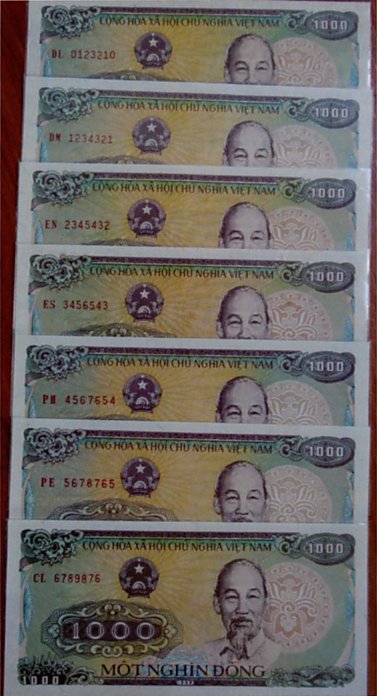
11. Date-like serial numbers.
- Date-like serial-numbers match the representation of a specific date. Dates are typically formatted as dd/mm/yyyy (European style) or mm/dd/yyyy (American style). However, since serial numbers only have seven digits, collectors omit the leading zero, resulting in formats like m/dd/yyyy or d/mm/yyyy. For example, serial 2351995 matches May 23, 1995; 5111997 matches November 5, 1997; and September 6, 1985, could appear as either 0691985 or 6091985. While most date serials have moderate value, those marking national holidays or historic events are more valuable, sometimes reaching several hundred thousand dong.
- Date-like serial numbers have appeared in the Vietnamese collecting community quite recently, and make a fun way to collect. Collectors can seek out dates of personal significance, such as birthdays or weddings, or historical milestones like a city's founding or national holidays like Independence Day.
- Some dedicated collectors attempt the unique challenge of assembling a set of notes covering every single day of a calendar year.
- A more accessible approach involves collecting notes where the last four digits represent a year, preceded by identical digits. For example: 0001987, 1111985, 2221993, etc.
- A limitation of 7-digit serials is their inability to represent 8-digit dates, such as those from the 10th of October, November, or December. For these dates, collectors must use polymer banknotes with 8-digit serial numbers.
12. Upside-down serial numbers
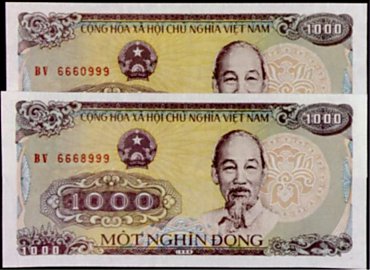
- Upside-down serial numbers remain unchanged when the note is rotated by 180 degrees. Examples: 9000006, 0690690, 0608090... This is a relatively new and fascinating trend in the Vietnamese numismatic community.
- These serials are restricted to the digits 0, 6, 8, and 9, with the central digit being only a 0 or 8. Such notes possess high numismatic interest and moderate market value.
13. Other types of serial numbers
- Mini Ladder serials
- Mini Ladder serial-number notes are banknotes whose first four digits are identical, while the last four digits form a ladder pattern. Examples include 1111234 and 6666789. This is a well-established and engaging area of collecting.
- In addition, five identical leading digits followed by a three-digit ladder can be also classified as a Mini Ladder. For example: 1111123, 4444456, 9999987...
- Mini Ladder serial-number notes have moderate market value and fairly high collecting value.
- Taxi serial numbers
- Taxi serials feature repeating two- or three-digit patterns, similar to easy-to-remember taxi phone numbers. For example: 0234234, 5789789, 8626262, 9252525, 8358354...
- Taxi-style serials generally have moderate prices.
- Dice serial numbers
- Dice serial numbers contain seven different digits, with no specific arrangement required, but all digits must be consecutive without gaps. For example, 1234567 and 3425671 are dice serials, but 1234568 is not, as it is not a consecutive set.
- Dice serial number notes have moderate market value.
- Other varieties include Four-in-a-Row and Five-in-a-Row.
- Four-in-a-Row serials include a sequence of four identical consecutive digits. They can be classified into the following types: leading quadruple: 3333008, 4444512, trailing quadruple: 7316666, 5268888, middle quadruple: 2399991, 8055552... Among these, leading quadruples typically have higher collecting value.
- Five-in-a-row serial numbers contain five identical consecutive digits. They can be classified into the following types: leading quintuple: 3333308, 4444412, trailing quintuple: 7366666, 5288888, middle quintuple: 2999991, 8555552... Among these, leading quintuples typically have higher collecting value.
14. Combining multiple serial numbers
- Matching serial numbers
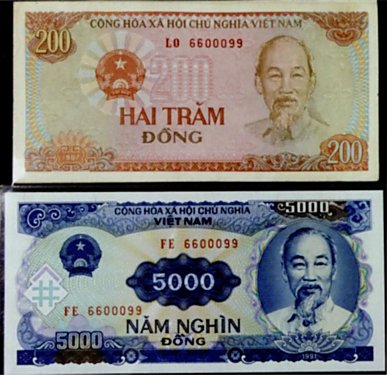
Matching serial numbers is the most common and oldest collecting practice in Vietnam. Banknotes with matching serial numbers can be of any type of number, and can have different prefixes or different denominations. In this approach, collectors may assemble full sets of different denominations sharing the same serial number, or sets of a single denomination with matching serial numbers. The most difficult to collect are notes that match both the serial and the prefix (naturally, they must be different denominations).
- Reversed serial numbers
- Reversed serial number pairing is a recently emerged collecting style, where the serials of two notes must meet the following conditions: Both notes must feature binary serial numbers. If read from left to right on the first note, the order of digits is the same as reading from right to left on the other note. For example: 3311131-1311133, 8887778-8777888.
- A more challenging variation involves matching the reversed prefix characters as well. Example: LT 4422242 - TL 2422244.
- Binary pairing serial numbers
- Binary pairing of serial numbers is a recently emerged collecting style, the serials of two notes must meet the following conditions: The banknotes must be of the binary type (A, B). At each position in the serial sequence, if one note has digit A, the other note must have digit B. Examples: 3311131-1133313, 8887778-7778887, 9009000-0990999.
- Running serial numbers
-
Running serial number notes are a relatively new collecting style and one of the most difficult, as these notes must be sourced from different bricks, and even from different bank bags.
In a running set, it is required that the banknotes be in six-of-a-kind form (running one digit) or five-of-a-kind binary fancy form (running two digits).
Running sets can be organized into several distinct categories:
Head run: in this arrangement, only the first digit (or first two digits) runs from 0 to 9, while the remaining digits stay unchanged. Assembling a head-running set is generally more difficult than other types.
1000000 1100000 2000000 2200000 3000000 3300000 ... ... 8000000 8800000 9000000 9900000 Tail run: in this arrangement, only the last digit (or last two digits) runs from 0 to 9, while the remaining digits stay unchanged. Tail-running sets are generally easier to complete, as all notes can be found within the same brick.
8888880 8888800 8888881 8888811 8888882 8888822 ... ... 8888888 8888888 8888889 8888899 Middle run: in this arrangement, only one middle digit runs from 0 to 9, while the digits on both sides remains unchanged. Assembling a middle-run set is more challenging than a tail-run set.
3330333 3331333 3332333 ... 3337333 3338333 3339333 - Across all types of running sets, those featuring a sequence of six zeros are the most difficult to acquire.
- Lego run: in this set, the banknotes must have binary serial numbers where one of the two digits appears only once or twice in adjacent positions. In this arrangement, a single digit (or pair) runs from the beginning to the end of the serial across the set, while the remaining digits shift accordingly. The visual effect of the completed set resembles a sequence of shifting Lego blocks.
| 8888880 | 1111100 |
| 8888808 | 1111001 |
| 8888088 | 1110011 |
| 8880888 | 1100111 |
| 8808888 | 1001111 |
| 8088888 | 0011111 |
| 0888888 |
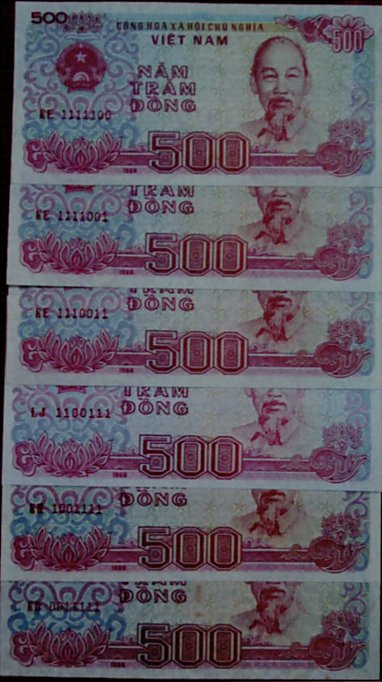
These represent the most popular current trends in collecting banknotes by serial number; similar strategies can be applied to serials of any length.