On the Edict of Lord Nguyễn Phúc Khoát authorizing circulation of Western silver coins
Nguyễn Anh Huy, Vietnam Numismatics #1 (10-2017), p.36-37
During the research of the currencies circulating in Vietnam, I have heard and read numerous sources stating that Lord Nguyễn Phúc Khoát (1738-1765), ruler of Đàng Trong (Vietnam), issued an edict authorizing the circulation of Western silver piastres. However, these documents only mention this indirectly without providing any specific citation. After more than 30 years of searching, it was only in July 2017 that I had the opportunity to access this document.
Pierre Poivre, a merchant of the French East India Company, in 1749 was assigned to contact Lord Nguyễn Phúc Khoát to request certain trading privileges for his Company in this region. On August 29, 1749, his merchant ship anchored at the port of Đà Nẵng; he had already prepared a letter from his Company, on behalf of the French king, requesting permission to trade. At 3 p.m. on September 22, his party arrived in Huế; at 11 a.m. on September 23, it was granted an audience at the main palace... and conducted negotiations with the authorities of Đàng Trong until its departure on February 11, 1750.
During those five and a half months in Đàng Trong, Poivre carefully recorded daily all his activities as well as everything he saw and heard. Henri Cordier reprinted this diary in Revue de l'Extrême-Orient in 1887, Volume 3, under the title Voyage de Pierre Poivre en Cochinchine, which consists of two parts. The first part is "Diary of the journey in Đàng Trong from August 29, 1749, the day we arrived, to February 11, 1750" on pages 81-121; the second part is "Description of Đàng Trong (1749-1750) - The trading voyage of the Company ship Machaul in Đàng Trong in 1749 and 1750" on pages 364-510.
The diary entry for November 20, 1749, published the French translation of the Lord's edict allowing the circulation of European silver coins. The original edict was, of course, written in Han script and no longer exists; only the French translation remains, as follows:[1]
Edict of the King of Đàng Trong
on the introduction of silver coins into circulation throughout the kingdom
I hereby order all officials, both inside and outside the palace, as well as all the people in my kingdom, to know that, as has been said from ancient times, it is wrong to block the streams[2] flowing from the mountains when they bring wealth. From the time of the Xia and Shang kings in China up to the reigns of the Tang and Song emperors, coins, silk, silver, and gold have always circulated widely and remained in common use in this kingdom. Nowadays, when foreign ships come to trade, the French bring silver coins, some round and some square, which are solid and durable. Therefore, I order the Master of the Goldsmiths to countermark these silver coins with the characters 通用 (legal tender), along with the names of the goldsmiths: Xuân [春] [3], Tiêm [𤣩], or Thiềm [沈]; if the name Xuân is missing, Tiêm shall replace it, and if Tiêm is missing, Thiềm shall replace it. Among these three names, just one name is enough to serve as the mark. Each round piastre, after deducting the expected wear (to make it 1/24), weighs only 6 tiền 5 phân; it is marked accordingly, and its fixed value is 1 quan 3 mạch, which equals 780 đồng. Each square silver coin, after deducting the expected loss (1/24), weighs only 6 tiền 4 phân; it is marked accordingly, and its fixed value is 1 quan 2 mạch and 48 đồng, which equals 768 đồng. The zinc coins and silk of the old days are also still used normally in the present.
From now on, in trade and in the affairs of the kingdom, whether for paying debts, making agreements, or paying taxes, these round and square silver coins, cast into ingots, may be used. Each ingot shall have a value of 20 quan, and this practice shall become customary; no one may raise or lower the value at their own discretion. If anyone opposes these orders and shows resistance, the Master of the Goldsmiths, according to the regulations, shall immediately arrest and punish that person. My edict must be obeyed and respected.
The 1st day of the 10th lunar month in the 2nd year of the Cảnh Hưng era.
The edict is dated the 1st day of the 10th lunar month, 1749, which corresponds to the 10th year of the Cảnh Hưng [景興] era. However, in the original French text, it is recorded as the 2nd year of Cảnh Hưng, likely because the translator misheard "dix" (10) as "deux" (2).
According to Poivre's journal, more than 30,000 silver coins were given to the court for countermarking, but the court silversmiths attempted various schemes to misappropriate this silver.
As collectors, we have witnessed this firsthand: in 1993, Mr. Trần Tiễn Tâm, living in Thanh Hà (Minh Hương, Thừa Thiên - Huế), while working in the fields, unearthed many types of Western silver coins along with several bars of silver from the Nguyễn lords' period, counterstamped with the character 春 (Xuân). Upon inspection, I found the majority those were Spanish dollars and Dutch East India Company (VOC) coins dating to approximately 1741. Our family bought one coin of each type for our collection. According to a coin dealer in Saigon, the rest of the batch - over 500 silver coins - was sold abroad.
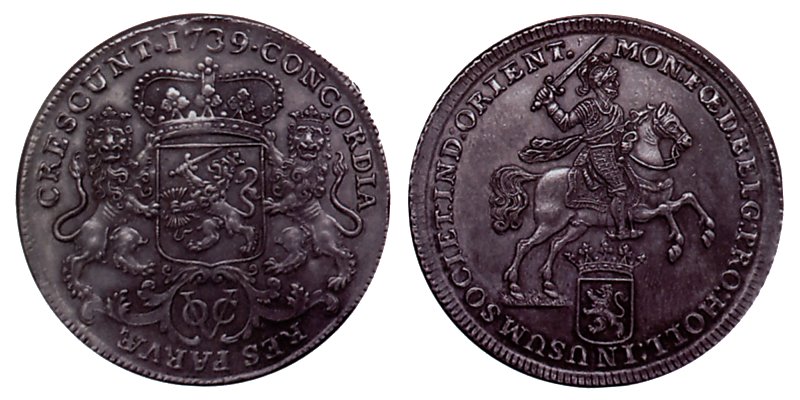
Because of those diary entries, some later researchers mistakenly believed that "Piastre de Commerce" coins were minted in the mid-18th century; this is completely incorrect. The term "piastre" in Poivre's journal is used as a generic term for "silver coin" referring specifically to Western issues like VOC coins or Spanish pieces of eight from Mexico. This is distinct from the "Piastre de Commerce" minted by the Bank of Indochina after 1879, where "Piastre" serves as a proper noun denoting a specific monetary unit.
Furthermore, while Pierre Poivre claims that the Edict required that Western coins were to be counterstamped with 通用 (legal tender), in reality it was not entirely accurate. In fact, when allowing these silver coins to circulate, the Lord only ordered the silversmith workshops to test the silver's purity and only stamp the names of the workshop owners on the coins as proof of inspection. We have personally seen coins bearing these countermarks.
[1] Translated by Hà Xuân Liêm, with subsequent revisions by the author for accuracy.
[2] The Han character 泉 (tuyền) means both a spring and a coin. This sentence by Lord Nguyễn Phúc Khoát implies: since there are coins (from Poivre), one should not refuse to use them!
[3] Poivre transcribed it as "Xun"