Does the Kiến Phúc Thông Bảo coin exist?
建福通寶
Mai Ngọc Phát, Bùi Tiến Đạt, Vietnam Numismatics #1 (10-2017), p.28-32
1. Introduction
There are many dynastic coin inscriptions in ancient Vietnamese numismatics. The official status of certain issues has long been a subject of intense debate among collectors and researchers, and the Kiến Phúc Thông Bảo [建福通寶] coin is one of them. In this article, we examine contemporary records from the Quốc sử quán triều Nguyễn (Nguyễn Dynasty Historiographical Office), some evidence that has been published in documents, and especially artifacts that have appeared, to raise several unresolved doubts about the legitimate existence of this coin type. We hope this article will stimulate further interest and encourage collaboration between ancient coin researchers and historians, in order to provide more concrete evidence and clarify the existence (or non-existence) of such coin types.
2. Historical overview
2.1. Historical context and background
In the sixth month of the year Quí Mùi [癸未] (July 19, 1883), King Tự Đức passed away. Because the king had no descendants, he previously adopted three nephews, Nguyễn Phúc Ưng Ái (changed his name to Ưng Chân in 1869), Nguyễn Phúc Ưng Kỷ, and Nguyễn Phúc Ưng Đăng. During this time, Vietnam fell into a period of extremely severe political crisis, with power falling into the hands of high court officials. The territory gradually diminished under the occupation of the French, as evidenced by the Harmand (1883) and Patenôtre (1884) treaties, which completely ended Vietnam's status as an independent nation under the Nguyễn dynasty. Before Kiến Phúc ascended the throne, there were two other kings who were brought to power and dethroned within a very short period: King Dục Đức [育德] (Nguyễn Phúc Ưng Chân) ruled for 3 days, and King Hiệp Hòa [協和] (Nguyễn Phúc Hồng Dật) held the throne for 4 months.
Regarding his biography, the Quốc sử quán triều Nguyễn wrote: "Giản Tông Thiệu Đức Chi Hiểu Uyên Duệ Nghị Hoàng Đế, taboo name Hạo, courtesy name Ứng Hỗ, and another courtesy name Ứng Đăng, third son of Emperor Dực Tông Anh Hoàng Đế, was born on the 2nd day of Giáp Tuất [甲戌], first month of Bính Dần [丙寅], year Kỷ Tỵ [己巳] (February 12, 1869), the 22nd year of Emperor Dực Tông Anh Hoàng Đế Tự Đức [嗣德], or the 8th year of the Tongzhi [同治] era of Qing. Formerly, under the system of regional peerage (vassal princes), he was named Ứng Đăng. The emperor was originally the third son, born to a concubine, Bùi Thị Thanh, of Hồng Hợi, Duke of Kiên. Hồng Hợi was later posthumously elevated to the rank of Imperial Uncle, with the full title Phụ Thuần Nghị Kiên Thái Vương. Bùi Thị Thanh herself was later honored as Imperial Uncle's Consort (Kiên Thái Vương Phi). In the first month of spring, year Canh Ngọ [庚午], the 23rd year of Emperor Tự Đức's reign (1871), he was only two years old when, by imperial order, he was selected to enter the palace and appointed as Imperial Prince, with Học Phi, Nguyễn Văn Thị Chuyên, assigned to care for him."[1]
Kiến Phúc was enthroned at the age of 15 by Nguyễn Văn Tường and Tôn Thất Thuyết: "In the 11th month of the 36th year of Emperor Tự Đức's reign, year Quý Mùi [癸未] (1883), ... on the day Canh Thìn [庚辰] (3rd day of the 11th lunar month), he ascended the throne as emperor at the Thái Hòa Hall, declaring the following year, Giáp Thân [甲申], as the first year of the Kiến Phúc [建福] era."[2]
During his short reign, Emperor Kiến Phúc accomplished almost nothing on the throne, and power fell entirely into the hands of the two regents, Tôn Thất Thuyết and Nguyễn Văn Tường. This period also marked the escalation of French colonial expansion in Tonkin, as shown by the Tianjin Accord (April 18, 1884, lunar calendar), which France signed with the Qing court (also known as the Fournier Convention), stipulating that the Qing would withdraw its troops from Tonkin and leave all matters concerning Vietnam to be fully handled by France. The submission of the Nguyễn court was also clearly shown in the Patenôtre Treaty (May 13, 1884 Lunar calendar), which recognized the French protectorate and divided Vietnam into Annam and Tonkin, signaling the end of Vietnamese independence.
Emperor Kiến Phúc died on the 10th day of the 6th lunar month in the year Giáp Thân [甲申] (July 31, 1884), at the age of 15. His temple name was Giản Tông, and he was buried at Bồi Lăng, located within the Khiêm Lăng complex of Emperor Tự Đức.

2.2. Monetary Policies
During Kiến Phúc's eight-month reign, Vietnam was experiencing a severe political and economic crisis, and the Quốc sử quán triều Nguyễn barely mentioned any monetary policies implemented during his reign or those of his two immediate predecessors.
In the Đại Nam thực lục (the official historical chronicle), there are occasional references to monetary matters of the time, but they mostly concern rewards or gifts of zinc, gold, or silver coins. Issues related to coin minting are hardly mentioned, with only a few notes concerning the casting of Kim Sách, such as:
"In the 11th month of the 36th year of Emperor Tự Đức's reign, year Quý Mùi [癸未] (1883), on the day Kỷ Sửu [己丑], a Kim Sách was cast. (He had not had time to cast it upon ascending the throne; only now was a lucky day chosen for casting, so that it could be respectfully presented on the 15th day of the following month.)"[3] and "In the first year of Kiến Phúc, Giáp Thân [甲申] (1884) (Qing, 10th year of Guangxu [光緒]), in the second month, a golden Kim Sách was cast at the capital (2 sets of 5 sheets, weighing 58 lạng 5 tiền 9 phân, using gold of 80% or 50% purity), with a gold seal (weighing 86 lạng 4 tiền 8 phân), to be respectfully presented to the Dowager Empress Từ Dụ. Following the ceremony, the imperial family and court officials petitioned for the formal commencement of the title-conferring rites. The Emperor submitted the request, and the court decreed that the rites be delayed until the end of the mourning period (they were eventually held in the third month of the first year of Emperor Hàm Nghi)."[4]
For example, regarding the awarding of coins: "In the 11th month of the 36th year of the Tự Đức era, year Quý Mùi [癸未] (1883), the regent prince of Gia Hưng, Hồng Hưu, was granted a large gold coin inscribed Vạn Thế Vĩnh Lại [萬世永來] ('Remembered for Ten Thousand Generations'), and a gold ring with a cat's-eye diamond; two great Regent officials, Crown Prince Tutor and acting Grand Secretary of the Văn Minh Pavilion, Minister of the Board of Revenue, Lord of Kỳ Vĩ Nguyễn Văn Tường, and General of the Palace Guard and Associate Grand Secretary, Minister of the Board of War, Lord of Vệ Chính Tôn Thất Thuyết, each received a gold coin of the same type."[5] And "In the first year of Kiến Phúc, Giáp Thân [甲申] (1884), at the beginning of spring, 10,000 strings of zinc coins were offered to the Gia Thọ Palace, 8,000 strings to the Empress Dowager, and 7,000 strings to the Imperial Dowager Consort."[6] or like "In the first year of Kiến Phúc, Giáp Thân [甲申] (1884), in the 5th month, the Great Emperor of Đại Nam issued an imperial decree granting additional valuable items, including a large gold khánh pendant with a cord of pearls, as a mark of special favor ... He also rewarded the attending soldiers (those stationed at the Historiographical Office and at the Thuận An sea gate garrison), numbering more than 400 men, with over 2,000 strings of zinc coins, and 500 silver 5 đồng ingots."[7]
It can be seen that, for most emperors of the Nguyễn dynasty recorded in the Đại Nam thực lục, in both the main and supplementary sections (with the exception of Bảo Đại), major events were generally recorded in considerable detail, especially regarding the production of various types of coins and the establishment of minting offices. However, for the three successive emperors from Dục Đức to Kiến Phúc, such matters were hardly mentioned, which also partly suggests that it was very unlikely for official dynastic coins to have been minted during this period.
3. Artifacts and Doubts
To date, several specimen of Kiến Phúc Thông Bảo coins, made from various materials such as zinc, copper, and silver, have been documented. Some authors and collectors still recognize them as a form of official dynastic coinage produced at that time. However, in our view, there remain several doubts that cannot convincingly establish these as coins minted by the imperial court.
3.1. Zinc specimens
On several foreign auction websites, we have recently observed at least five specimens of Kiến Phúc Thông Bảo made of zinc, displaying clear characteristics of Nguyễn dynasty coin calligraphy. According to the assessment of a few collectors and researchers, these specimens all originate from the collection of Jules Silvestre (1841-1918) from Rochefort, France. Silvestre, a soldier in the French expeditionary forces stationed in Vietnam during that era, was a prominent collector of Southeast Asian coins and banknotes. After his death, some items from his collection were auctioned in Nantes, including coins of Kiến Phúc and Hàm Nghi. In 2014, François Thierry mentioned Jules Silvestre and these pieces in his book Le Trésor de Huê (The Treasure of Huê), Paris, 2014.
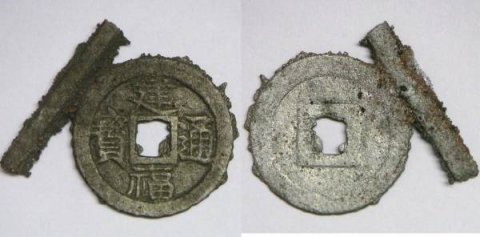
In addition to the type shown in Figure 1, there is another type of Kiến Phúc zinc coin of Kiến Phúc, shown in Figure 2; this specimen has a noticeably smaller diameter compared to the ones as in Figure 1.
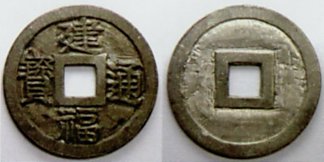
From the images, we can observe that one characteristic of these zinc specimens is that the three characters Kiến [建], Thông [通], and Bảo [寶] are written in the regular script, showing the distinctive features of Nguyễn dynasty coinage, and in particular, closely resembling the large-type Minh Mạng Thông Bảo [明命通寶] coins. The character Phuc [福] is written in the seal script.
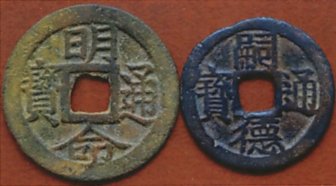
In our view, these zinc coins are highly questionable as official coins minted by the imperial court for two main reasons:
- Continuity in ancient coinage: It is evident that throughout the long history of ancient coins, continuity can be clearly observed in the coin molds, as well as in the calligraphy used on coins within the same dynasty. That is, the coins of a succeeding emperor generally inherit the design style of his predecessor, especially from father to son. But in the case of this series of specimens, the situation is completely different: they bear no stylistic resemblance to the earlier Tự Đức Thông Bảo coins, and this very divergence stands in opposition to the expected markers of legitimacy for such a series.
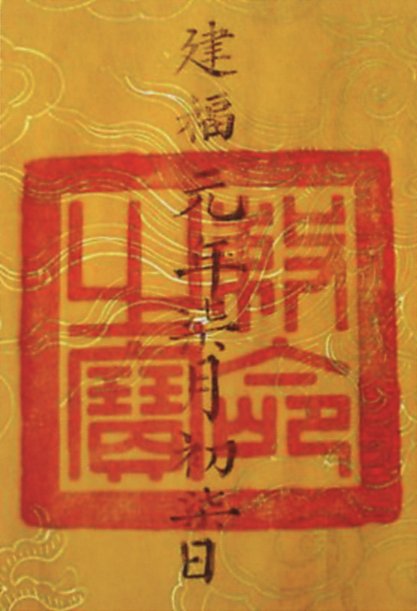
- The character Phúc [福] written in seal script: in the Nguyễn dynasty's Thông Bảo coinage system, almost all the main calligraphy follows the regular script style, except for the two inscriptions Lục Phân [六分] and Thái Bình [太平] (based only on references in published works) found on the reverse of the Gia Long Thông Bảo coins. Besides, we also note that in official documents from the same period, the Kiến Phúc era name was consistently written in regular script (Figure 4). The clear difference in calligraphy between the coins and official documents also raises serious doubts about the official status of the artifact.
3.2. Copper specimens
A rare copper coin specimen, which has appeared and has been cited in various publications as an official state issue, currently resides in the collection of Nguyễn Đình Sử. It was published by him in Kho báu tiền cổ Đại Việt (Treasure of Ancient Vietnamese Coins), issued in 2006.
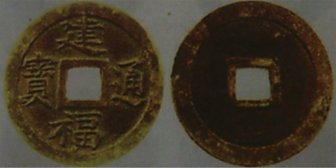
In several previously published books, this specimen is recognized as a legitimate contemporary issue of the Nguyễn dynasty court. However, in the records of the Quốc Sử Quán triều Nguyễn, there is almost no mention of this issue. It is also possible that some authors have misunderstood or misinterpreted the information recorded by the Quốc Sử Quán, specifically: The Đại Nam thực lục states: "In the year Giáp Thân [甲申], the first year of Kien Phuc (1884), the 11th month, a mint was established at the Office of Public Works, Vũ Khố Treasury. (A mold maker was recruited from Hanoi, and a master caster brought all necessary equipment to the capital to instruct and train coin casting.)"[11] In fact, this official historical record is referring to trial coin casting under the reign of Hàm Nghi, because, as mentioned above, on the 10th day of the 6th lunar month of the same year, Kiến Phúc had already died, and Hàm Nghi ascended the throne only two days later. Therefore, it is very unlikely that at the end of the year the court would have issued an order to mint coins in the name of a deceased ruler. In addition, another important point is the different calligraphy on the specimen itself, especially the 3-legged character Bảo [寶], which also leads collectors and researchers to doubt its official status due to the artifact's lack of continuity.
3.3. Silver specimens
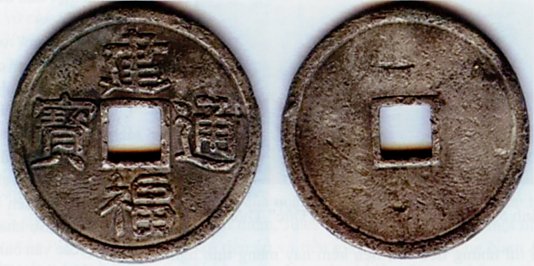
Similar to the copper specimen, the silver Kiến Phúc Thông Bảo currently held in our collection is also a rare piece that has appeared and originates from the former imperial capital of Huế. Overall, this silver piece shares the same calligraphic and design anomalies as the copper one, diverging significantly from established Nguyễn dynasty minting standards. Therefore, the authenticity of this artifact remains doubtful and requires thorough further verification.
4. Conclusion
Based on the materials collected from the Quốc Sử Quán triều Nguyễn, contemporary official documents, and the analysis of artifacts appearing in various materials such as zinc, copper, and silver, it can be seen that confirming the official dynastic status of Kiến Phúc Thông Bảo specimens is a conclusion that is difficult to accept. Therefore, in order to attribute these artifacts to official production, further detailed research and concrete evidence are required. We hope this article encourages researchers, collectors, and historians to collaborate in investigating the existence of Kiến Phúc Thông Bảo coins and other similarly disputed issues. If it is truly possible to further clarify the questioned dynastic coin series, this would be one of the greatest hopes of both the collector community and the still-developing field of numismatics in Vietnam, and would help resolve many of the uncertainties that researchers and collectors like ourselves continue to encounter in the course of collecting and studying these materials.
Resources:
1. Quốc sử quán Triều Nguyễn, Đại Nam thực lục, 2007. NXB Giáo dục, Quảng Nam. Vol. 9.
2. Quốc sử quán Triều Nguyễn, Đại Nam thực lục, 2007. NXB Giáo dục, Quảng Nam. Vol. 10.
3. Allan Barker, The Historical Cash Coins of Việt Nam. Singapore, 2004.
https://www.abebooks.com/9789810523008/Historical-Cash-Coins-Viet-Nam-9810523009/plp
4. Quỳnh Cư - Đỗ Đức Hùng, Các triều đại Việt Nam, NXB Thanh Niên, Hà Nội, 2003.
5. Ding Fubao [丁福保], and Ma Dingxiang [馬定祥]. Illustrated Catalog of Ancient Coins through the Ages [歷代古錢圖譜]. Shanghai Classic Publishing House, Shanghai, 1992.
6. Hội đồng trị sự Nguyễn Phúc tộc, Nguyễn Phúc tộc thế phả, NXB Thuận Hóa, Huế, 1995.
7. Phạm Quốc Quân, Kho báu tiền cổ Đại Việt, Công ty in Tạp chí Cộng sản, Hà Nội, 2006.
[1] Quốc sử quán Triều Nguyễn, Đại Nam thực lục, 2007. NXB Giáo dục, Quảng Nam. Vol. 9, p. 16.
[2] Quốc sử quán Triều Nguyễn, Đại Nam thực lục, 2007. NXB Giáo dục, Quảng Nam. Vol. 9, p. 18.
[3] Quốc sử quán Triều Nguyễn, Đại Nam thực lục, 2007. NXB Giáo dục, Quảng Nam. Vol. 9, p. 24.
[4] Quốc sử quán Triều Nguyễn, Đại Nam thực lục, 2007. NXB Giáo dục, Quảng Nam. Vol. 9, p. 59.
[5] Quốc sử quán Triều Nguyễn, Đại Nam thực lục, 2007. NXB Giáo dục, Quảng Nam. Vol. 9, p. 27.
[6] Quốc sử quán Triều Nguyễn, Đại Nam thực lục, 2007. NXB Giáo dục, Quảng Nam. Vol. 9, p. 52.
[7] Quốc sử quán Triều Nguyễn, Đại Nam thực lục, 2007. NXB Giáo dục, Quảng Nam. Vol. 9, pp. 79-80.
[8] https://www.zeno.ru/showphoto.php?photo=70634
[9] https://www.zeno.ru/showphoto.php?photo=70623
[10]
Allan Barker, The Historical Cash Coins of Việt Nam. Singapore, 2004, p. 238.
https://www.abebooks.com/9789810523008/Historical-Cash-Coins-Viet-Nam-9810523009/plp
[11] Quốc sử quán Triều Nguyễn, Đại Nam thực lục, 2007. NXB Giáo dục, Quảng Nam. Vol. 9, p. 118.