The first state bond of the Democratic Republic of Vietnam
Nguyễn Văn Mai, Vietnam Numismatics #1 (10-2017), p.18-22
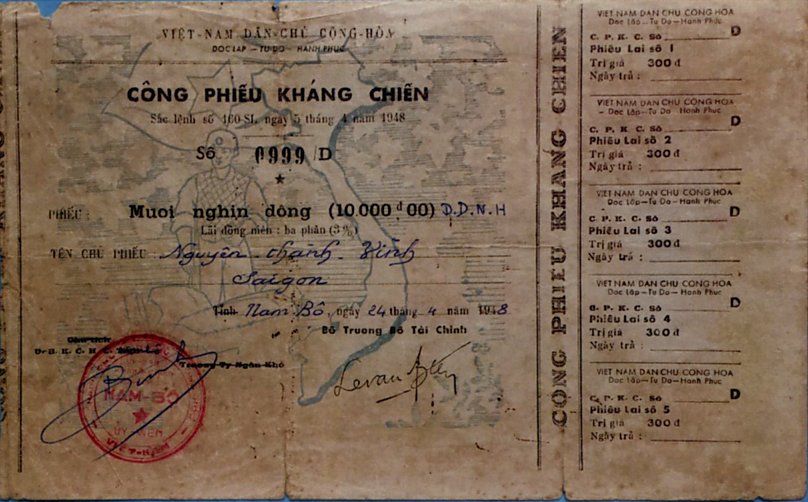
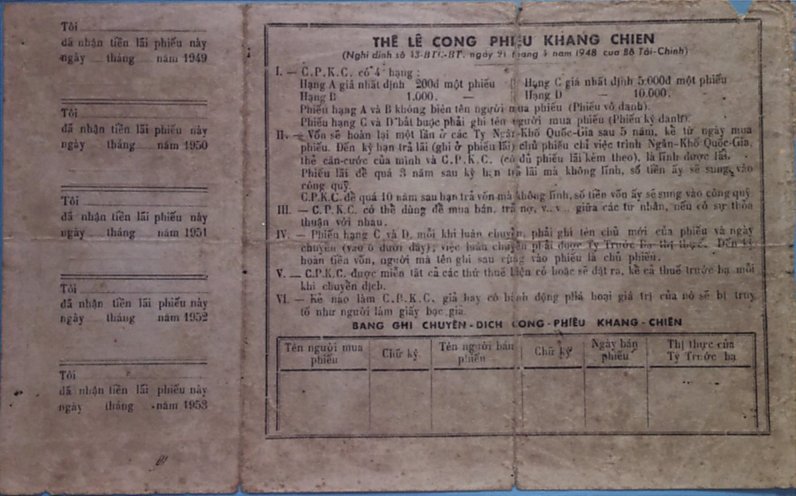
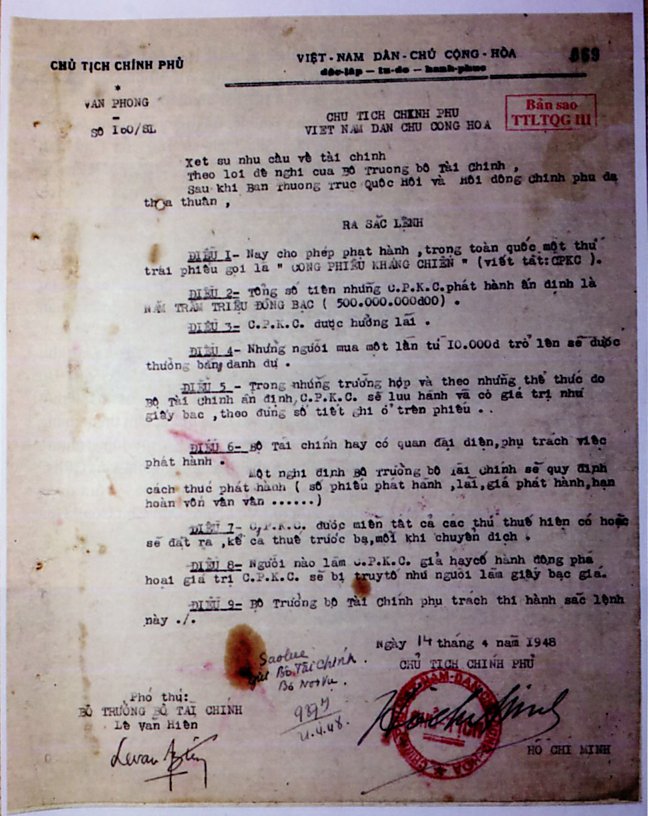
The Resistance Bond (Công phiếu kháng chiến, CPKC) was the first government bond issued nationwide under Decree No. 160 of the President of the Democratic Republic of Vietnam. To implement the Decree, on April 24, 1948, the Ministry of Finance issued Regulation No. 43 prescribing the rules for issuing the CPKC. Under Regulation No. 43, the bonds were issued in three regions, each responsible for its own printing:
1. In the Northern and Northern Central Regions CPKC were printed by the Ministry of Finance and issued in April 1948.
2. In the Southern Central region, CPKC were printed by the Administrative Resistance Committee (UBKCHC) of the the Southern Central Region and issued in April 1949.
3. In the Southern region, CPKC were printed by UBKCHC of the Southern Region and issued in February 1949.
CPKC had four denominations, divided into two classes:
- Anonymous bonds: Category A: 200đ; Category B: 1,000đ.
- Named bonds: Category C: 5,000₫, Category D: 10,000₫.
According to the regulations of the Ministry of Finance, upon completion of printing, the Resistance Administrative Committees of South Central Vietnam and Southern Vietnam had to send the Ministry of Finance 40 specimens of each denomination, and 20 specimens of each denomination to each other for identification and archiving.
The CPKC printed in the three regions were not completely identical in design, color, and other features. However, all of them had to bear three signatures, including:
- The first signature was pre-printed on the Bond. The Northern issues bore the signature of the Minister of Finance Lê Văn Hiến; the South Central issues, Chairman Lê Đình Thám; and the Southern issues, Chairman Phạm Văn Bạch.
- The other two were handwritten signatures of the provincial chairman and the head of the provincial treasury where the bonds were issued.
In my collection, there is a CPKC issued to Mr. Nguyễn Thành Vĩnh that has several unusual features:
1. The note has multiple erasures, overwriting, and alterations to the originally printed text:
- The title "Chủ tịch U.B.K.C.H.C Tỉnh" (Chairman of the Provincial Committee) is amended to "U.B.K.C.H.C Nam Bộ" (Southern Committee). This change is understandable as Nam Bộ (Southern Region) is at a higher administrative level than a province. Mr. Nguyễn Bình signed the note as a committee member in charge of military affairs, not as a provincial chairman.
- The word "Tỉnh" (Province) is crossed out, and the words "Nam Bộ … 24 … 4 … 1948" are added, indicating that the bond was issued in the Southern Region.
- The line "Trưởng Ty Ngân Khố" (Head of the Treasury Department) is crossed out. When issued at the provincial level, the second signature would be the Chief of the Treasury. The line "Head of the Treasury Office" was crossed out by Mr. Nguyễn Thành Vĩnh himself, to avoid signing the bond for himself.
- The letters "D.D.N.H", which stand for Đông Dương Ngân Hàng (Bank of Indochina), are added after the denomination of 10,000 đồng. This indicates that the bond was purchased with Indochinese piastres rather than Vietnamese đồng as it was initially stated.
2. The CPKC was issued in the South on April 24, 1948, and the seal stamped over General Nguyễn Bình's signature states "Ủy ban kháng chiến hành chính Nam Bộ - Ủy viên" (Southern Administrative Resistance Committee - Member). Here I observe four issues that need to be discussed:
- First, although it was issued in Southern Vietnam, it is not the Southern Region CPKC signed by Chairman Phạm Văn Bạch. This is a CPKC intended for issuance in the North, printed by the Ministry of Finance, and signed by Finance Minister Lê Văn Hiến.
- Second, the North issued CPKC in 1948, before the Southern Central and Southern regions. It wasn't until February 1949 that the South issued documents to conduct propaganda for the issuance of CPKC. The existence of this bond in Southern Vietnam in April 1948 raises a major question that needs to be explained.
- Third, CPKC issued in any province required the stamp and the signatures of the Chairman and the Head of the Treasury of the province. However, Mr. Nguyễn Bình used a committee-level signature and seal in the section reserved for provincial authorities. Therefore, it was necessary to cross out, overwrite, and amend the original text.
- Fourth, Decree No. 149 from March 29, 1948, mandated the removal of the word "kiêm" (and) from the phrase "Ủy ban kháng chiến kiêm hành chính Nam Bộ" (Resistance and Administrative Committee of the South). However, in reality, the South continued using the old seal with the word "kiêm", and the stamps were not updated. Documents in Southern Vietnam still used seals containing the word "kiêm" up until December 1949. This CPKC is dated April 24, 1948, yet it bears a new seal in which the word "kiêm" has already been removed.
The content of the CPKC issued to Nguyễn Thành Vĩnh appears extremely messy and inconsistent. To explain these issues, it is necessary to consider historical factors, the identity and background of the bondholder, and the people involved.
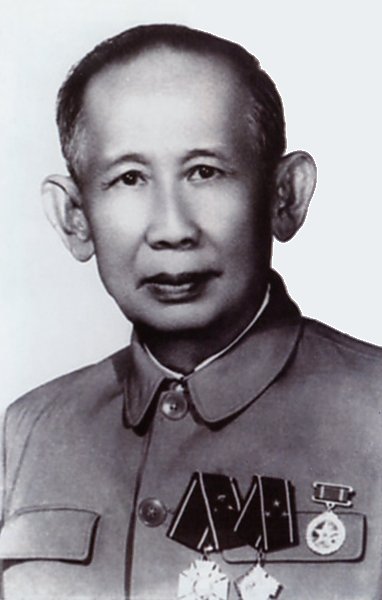
Mr. Nguyễn Thành Vĩnh was originally a lawyer and a successful businessman in Saigon who gave up his career and wealth to join the resistance in the swamps and forests. He served as a financial commissioner of the Southern Administrative Committee and Director of the Southern Department of Finance. He was the father of the "Vietnamization of Indochina banknotes" initiative, an unprecedented innovation in the history of Vietnamese currency circulation. He initiated and established the special printing unit in the Đồng Tháp Mười war zone to print "Uncle Hồ money" in order to affirm Southern sovereignty and meet the financial needs of the resistance.
Lieutenant General Nguyễn Bình was an exceptional figure of military talent in the early days of the resistance against the French. He was a brilliant commander, a supreme leader, who unified the armed forces in the South that was in a state of permanent conflict, the architect and organizer of the resistance campaign in the South. He was the military commissioner of the Southern Resistance and Administrative Committee, Vice Chairman of the Southern Resistance and Administrative Committee, and commander-in-chief of the Southern resistance forces. He gave his life on the way to the North to undertake a new mission in October 1951. Nguyễn Bình fell down for the South to rise!
Bound by mutual respect for their shared ideals, duty, and talent, the two men became sworn brothers, calling each other in the Southern style "Brother Two" and "Brother Three" (Brother Two Vĩnh and Brother Three Bình).
The CPKC issued to Nguyễn Thành Vĩnh cannot be explained by normal financial standards or conventional logic. It must be understood through a sharp, brutal perspective, like a violent storm that struck on the 16th day of the 3rd lunar month, year Giáp Thìn (1904), over the land of Đạo Ngạn, Châu Thành - Mỹ Tho... Heaven and earth were dark without a spark of light. Trees were broken and uprooted, lying on their sides. Houses collapsed, and floodwaters swept away both people and livestock. The desperate sound of wooden clappers used for calling for help rose everywhere... A young mother, writhing in labor pain, lay curled up on the brick floor of a house whose roof had been blown away. The villagers hurriedly gathered to set up a makeshift shelter for childbirth, and the Southern Finance Commissioner was born with a piercing cry, as if...[1]
How did the South obtain Northern CPKC for issuance? A possible explanation is that the Ministry of Finance also sent each Committee a number of CPKC specimen notes of each denomination for identification and archival purposes. This Northern CPKC may be one of the sample notes sent by the central authorities to the South, and it must have been signed by General Nguyễn Bình before October 1951 - the time when he had not yet departed for the North (thereby ruling out the possibility that Mr. Vĩnh obtained the Northern CPKC only after 1955, when he regrouped to the North). This timeline also matches financial developments in Southern Vietnam: before 1950, the Vietnamese currency was at par with the Indochina piastre, but from 1950 to 1952 the Vietnamese currency depreciated against the Indochina piastre by about 30-75%. This is why it became necessary to distinguish which type of currency was used to purchase the CPKC. The handwritten addition of "D.D.N.H" after the 10,000d.00 figure is an abbreviation for "Indochina Bank", and it was likely written during the 1950-1952 period; if the bond had been purchased in 1948, there would have been no need for such a note. Furthermore, the seal with the word "kiêm" removed could not have been in use before December 11, 1949.
Mr. Vĩnh managed all ranks of of Southern CPKC denominations, so why did he not use them? Instead, he used a Central government bond, subjecting it to a series of messy strikes, overwrites, and corrections. His reasons surely went beyond a simple desire to redeem the bond for cash upon its maturity. Many times he had given his own money to Brother Three to buy weapons and support the troops, and he once donated 200 taels of gold to supply the Cầu Kè campaign... A wealthy intellectual from Saigon who was willing to give up luxurious villas, cars, and horse carriages for the hardships of the resistance, would likely value something more symbolic: the Northern CPKC carrying the spirit of the central government - the cause to which he had devoted his life. On that note was the signature of a comrade, a close sworn brother with whom he had formed a deep bond of friendship. Under these circumstances, the date written on the bond must be viewed from a different perspective; its inconsistency with reality is already evident. However, analyzing this inconsistency is precisely a way of searching for the underlying logic within this seemingly chaotic and contradictory situation. It is possible that this was the date when the Ministry of Finance issued Regulation No. 43, setting out the rules and procedures for issuing the CPKC, thereby formally putting Decree No. 160 of the President of the Government of the Democratic Republic of Vietnam into practical implementation. That date - April 24, 1948 - was even printed as a reference on the reverse side of the CPKC. He wanted to be among the earliest contributors to the nationwide CPKC issuance campaign, supporting the resistance effort, which was severely short of financial resources, and he had no intention of claiming repayment when the bond matured.
A historic national bond that left from the Việt Bắc resistance zone to find its purpose in the heroic "Iron Citadel" of the South. A government bond filled with the sentiments of a Saigon intellectual and businessman determined to join the resistance. While some aspects remain speculative, the artifact itself suggests that this may be the earliest CPKC issued in the entire country - the first government bond of the Democratic Republic of Vietnam bearing the name Nguyễn Thành Vĩnh.
[1] art-hanoi.com: sic! 😧